

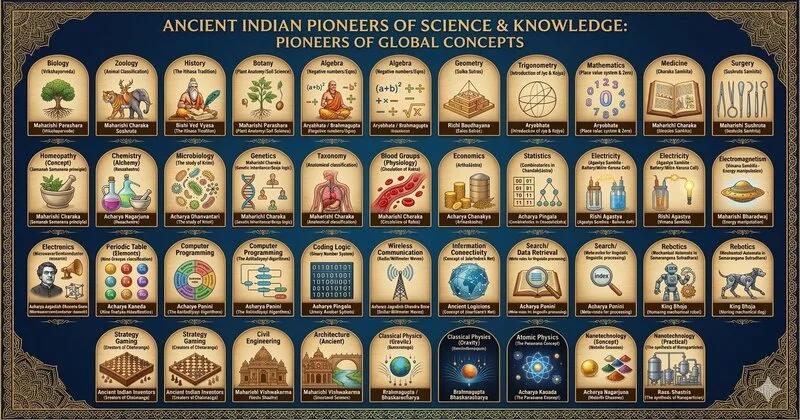
Long before modern laboratories and formal scientific institutions emerged, ancient India nurtured a deep tradition of inquiry into nature, mathematics, medicine, and philosophy. Texts, sutras, and treatises composed by sants and scholars laid the intellectual groundwork for many disciplines we recognise today.
Let me fix this list:
1. Father of Biology – Maharishi Parashara (Vrikshayurveda)
2. Father of Zoology – Maharishi Charaka / Sushruta (Animal Classification)
3. Father of History – Rishi Ved Vyasa (The Itihasa Tradition)
4. Father of Botany – Maharishi Parashara (Plant… https://t.co/z29JRLmsDU— Parimal (@Fintech03) March 12, 2026
While modern science attributes “Father of…” titles to later figures based on formalisation and global impact, the contributions of Indian thinkers remain foundational, often centuries ahead of their time.
Medicine and Life Sciences
The medical sciences in ancient India were highly advanced and systematised.
* Charaka, through the Charaka Samhita, established principles of diagnosis, pharmacology, and holistic health, making him a pioneer in internal medicine.
* Sushruta, author of the Sushruta Samhita, is widely regarded as one of the earliest surgeons, detailing procedures like rhinoplasty and surgical instruments.
* The concept of microorganisms, referred to as “Krimi”, appears in Ayurvedic texts, showing early awareness of unseen life forms.
* Ideas resembling heredity and genetics (through Beeja theory) were also discussed in Ayurvedic literature.
These contributions demonstrate that ancient Indian scholars approached biology and medicine with remarkable observational depth.
Mathematics and Astronomy
India’s contribution to mathematics is globally recognised and transformative.
* Aryabhata introduced concepts like place value systems and worked extensively on trigonometry (jya and kojya).
* Brahmagupta formalized rules for zero and negative numbers and explored gravity-like concepts (gurutvākarṣaṇam).
* Baudhayana, through the Sulba Sutras, described geometric principles similar to what is later known as the Pythagorean theorem.
* Pingala developed combinatorics and binary-like structures in prosody, forming a basis for modern computational logic.
These mathematical insights influenced not only Indian thought but also later developments across the world.
Chemistry, Physics, and Material Sciences
Ancient Indian scholars also explored the nature of matter and transformation.
* Nagarjuna is associated with Rasashastra, dealing with metallurgy, alchemy, and medicinal compounds.
* Kanada proposed the concept of paramanu (atom), an early atomic theory.
* Early texts also discuss metals, alloys, and processes resembling nanotechnology through bhasma preparations.
While these ideas were philosophical or experimental rather than modern scientific, they show a strong curiosity about the material world.
Language, Logic, and Early Computing Ideas
India’s linguistic and logical traditions were extraordinarily sophisticated.
* Panini created the Ashtadhyayi, a highly structured system of grammar often compared to modern computational algorithms.
* Pingala also contributed to binary-like representations, which are conceptually similar to digital systems today.
These systems highlight how ancient scholars developed rule-based, algorithmic thinking long before computers existed.
Engineering, Architecture, and Technology
Texts and traditions also point to developments in applied sciences:
* Chanakya, through the Arthashastra, discussed economics, governance, and statecraft.
* Jagadish Chandra Bose, in modern times, made pioneering contributions to wireless communication and semiconductor research, bridging ancient curiosity with modern experimentation.
* Treatises like Vastu Shastra and Samarangana Sutradhara describe architecture, city planning, and even mechanical devices.
Separating Legacy from Labels
It’s important to clarify that many “Father of…” titles, like Father of Biology (Aristotle) or Father of Modern Chemistry (Antoine Lavoisier), are assigned based on modern scientific frameworks. Ancient Indian scholars did not work within these frameworks, but their contributions were precursors, parallels, and inspirations, not direct equivalents.
Ancient India’s intellectual heritage is vast and deeply influential. From medicine and mathematics to linguistics and philosophy, its scholars explored the world with rigor, creativity, and insight.