
Lotus Blooms in Bengal: Amit Shah’s blueprint & rise of Suvendu
June 23, 2026
  • Read Ecopy
  • Circulation
  • Advertise
  • Careers
  • About Us
  • Contact Us
Android AppiPhone AppArattai
Organiser
  • ‌
  • Bharat
    • Assam
    • Bihar
    • Chhattisgarh
    • Jharkhand
    • Maharashtra
    • View All States
  • World
    • Asia
    • Europe
    • North America
    • South America
    • Africa
    • Australia
  • Editorial
  • International
  • Opinion
  • RSS @ 100
  • More
    • Op Sindoor
    • Analysis
    • Sports
    • Defence
    • Politics
    • Business
    • Economy
    • Culture
    • Special Report
    • Sci & Tech
    • Entertainment
    • G20
    • Azadi Ka Amrit Mahotsav
    • Vocal4Local
    • Web Stories
    • Education
    • Employment
    • Books
    • Interviews
    • Travel
    • Law
    • Health
    • Obituary
  • Subscribe
    • Subscribe Print Edition
    • Subscribe Ecopy
    • Read Ecopy
  • ‌
  • Bharat
    • Assam
    • Bihar
    • Chhattisgarh
    • Jharkhand
    • Maharashtra
    • View All States
  • World
    • Asia
    • Europe
    • North America
    • South America
    • Africa
    • Australia
  • Editorial
  • International
  • Opinion
  • RSS @ 100
  • More
    • Op Sindoor
    • Analysis
    • Sports
    • Defence
    • Politics
    • Business
    • Economy
    • Culture
    • Special Report
    • Sci & Tech
    • Entertainment
    • G20
    • Azadi Ka Amrit Mahotsav
    • Vocal4Local
    • Web Stories
    • Education
    • Employment
    • Books
    • Interviews
    • Travel
    • Law
    • Health
    • Obituary
  • Subscribe
    • Subscribe Print Edition
    • Subscribe Ecopy
    • Read Ecopy
Organiser
  • Home
  • Bharat
  • World
  • Operation Sindoor
  • Editorial
  • Analysis
  • Opinion
  • Culture
  • Defence
  • International Edition
  • RSS @ 100
  • Magazine
  • Read Ecopy
Home Politics

Lotus Blooms in West Bengal: Amit Shah’s blueprint and rise of Suvendu Adhikari

From organisational precision to cultural recalibration, BJP’s Bengal breakthrough marks the biggest political shift in the state in decades

Dr Prosenjit NathDr Prosenjit Nath
May 9, 2026, 09:00 pm IST
in Politics, Bharat, Opinion, West Bengal
Follow on Google News
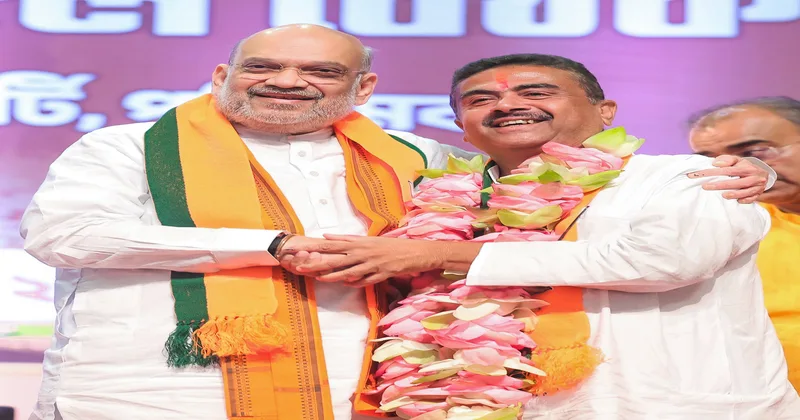
Kolkata, May 08 (ANI): Union Home Minister Amit Shah and the newly elected leader of the West Bengal BJP Legislative Party, Suvendu Adhikari, during a BJP MLA meeting, in Kolkata on Friday. (@AmitShah X/ANI Photo)

Kolkata, May 08 (ANI): Union Home Minister Amit Shah and the newly elected leader of the West Bengal BJP Legislative Party, Suvendu Adhikari, during a BJP MLA meeting, in Kolkata on Friday. (@AmitShah X/ANI Photo)

FacebookTwitterWhatsAppTelegramEmail

On May 4, the political map of West Bengal changed irreversibly. The Bharatiya Janata Party’s emphatic victory in the 2026 Assembly elections was not merely another electoral success; it was the collapse of one of India’s most enduring political fortresses. For decades, Bengal had resisted national political currents with remarkable consistency. Whether under the Congress, the Left Front or the Trinamool Congress led by Mamata Banerjee, the state cultivated an image of political exceptionalism.

That aura has now been shattered.

As Bengal prepares for another historic moment on May 9, when Suvendu Adhikari takes oath as the state’s first BJP Chief Minister along with his newly formed Cabinet at Kolkata’s Brigade Parade Ground, it is clear that this transformation did not happen overnight.

The BJP’s stunning victory, which delivered 206 seats in the 293-member Assembly, was the result of a campaign executed with rare discipline and clarity. At the centre of that operation stood Amit Shah, whose political style once again demonstrated why he remains the BJP’s most formidable strategist after Prime Minister Narendra Modi.

Read More: India & Vietnam ink 13 pacts, eye $25B trade goal under new “Enhanced Comprehensive Strategic Partnership”

Indian elections are usually driven by emotion, spontaneity and last-minute shifts. Bengal politics, in particular, has always thrived on ideological passion, intellectual symbolism and regional identity. Yet Shah approached Bengal differently. His strategy resembled a carefully managed corporate operation more than a traditional Indian political campaign.

After the BJP’s setbacks in the 2021 Assembly elections, the party leadership realised that its earlier Bengal model had hit a ceiling. Excessive dependence on defectors from the Trinamool Congress and aggressive national rhetoric had generated momentum but failed to create durable political trust. Shah understood that Bengal could not simply be conquered electorally; it had to be understood culturally.

That recognition changed everything.

The BJP consciously recalibrated its Bengal outreach. Leaders visited Bengali households, shared “mach-bhaat” meals and worked to break the long-standing perception that the BJP represented an alien North Indian political culture hostile to Bengali social traditions. Cultural integration became as important as ideological mobilisation.

Shah’s visits to Gangasagar and the Kapil Muni Ashram were not symbolic accidents. They were carefully planned efforts to embed the BJP within Bengal’s spiritual and cultural landscape. Unlike earlier campaigns which leaned overwhelmingly on broad Hindu consolidation narratives, the 2026 campaign attempted to blend Bengali identity with the BJP’s nationalist vision.

The message was subtle but powerful: Bengal’s culture and the BJP’s politics were not incompatible.

Simultaneously, the organisational structure beneath the campaign became extraordinarily sophisticated. Constituencies were divided into micro-level clusters. Voting behaviour was analysed with forensic detail. Local grievances were catalogued systematically. In industrial belts, economic stagnation and unemployment became central themes. In urban areas, corruption, administrative fatigue and law-and-order concerns dominated BJP messaging.

Importantly, the BJP shifted focus from celebrity campaigning to booth-level consolidation. Bengali-speaking workers from neighbouring Assam and Tripura were strategically deployed to strengthen communication and organisational coordination. Call centres staffed by Bengali-speaking volunteers operated from Delhi, driving targeted social media campaigns and voter outreach programmes.

The result was perhaps the most technologically managed election campaign Bengal had ever witnessed.

Yet Shah’s political strength lies not merely in centralisation but in adaptation. The BJP campaign constantly recalibrated itself through continuous feedback loops. District-level reports influenced messaging almost in real time. Rallies and roadshows were not only demonstrations of strength; they were also instruments for political assessment.

The BJP also learned an important lesson from other state elections: ideology alone cannot defeat entrenched regional governments. Governance promises had to become tangible. Commitments such as implementing the Seventh Pay Commission for state employees, restoring industrial confidence and strengthening policing structures gave the BJP campaign administrative credibility beyond ideological rhetoric.

The outreach towards the politically influential Matua community proved particularly significant. Concerns arising from the Special Intensive Revision of electoral rolls created anxiety among sections of the community. The BJP responded by organising enrolment assistance camps and citizenship support initiatives, reinforcing its image as a responsive political force rather than merely an oppositional movement.

Meanwhile, the Trinamool Congress increasingly appeared weighed down by incumbency fatigue. Mamata Banerjee remained Bengal’s most charismatic mass leader, but the perception of administrative stagnation and corruption weakened the emotional connect her government once enjoyed. Bengal’s electorate, historically known for dramatic political realignments once public opinion shifts decisively, appeared ready for change.

That shift ultimately elevated Suvendu Adhikari into the central figure of Bengal’s new political era.

Ironically, Adhikari himself represents Bengal’s political transformation more vividly than anyone else. Once among Mamata Banerjee’s closest lieutenants and one of the architects of the Trinamool Congress’s grassroots rise, he eventually became the face of the BJP’s Bengal expansion. His journey from Trinamool strategist to the state’s first BJP Chief Minister symbolises the scale of Bengal’s political realignment.

On May 9, Adhikari will formally take oath at a grand ceremony expected to be attended by Prime Minister Narendra Modi, Amit Shah and several NDA chief ministers. The symbolism is impossible to miss. The BJP is not treating this merely as a government formation ceremony; it is projecting it as the culmination of a decades-long ideological ambition dating back to Syama Prasad Mookerjee.

The real challenge, however, begins after the celebrations end.

Bengal has historically reshaped those who govern it. The Congress adapted to Bengal’s intellectual culture. The Left Front became inseparable from Bengali political identity. Even Mamata Banerjee’s populism emerged from Bengal’s unique social temperament. The BJP, too, will now have to evolve from being an insurgent political force into a governing establishment.

That transition will not be easy.

The party must now balance ideological assertiveness with administrative pragmatism. It must govern Bengal without appearing culturally intrusive. It must prove that its Bengal project is not merely an electoral conquest but a durable political alternative capable of delivering governance, stability and economic revival.

For now, however, the moment belongs to Amit Shah and Suvendu Adhikari.

Bengal did not turn saffron through accident or sudden emotional upheaval. It changed through relentless organisational work, cultural adaptation and political patience. Amit Shah’s Bengal strategy succeeded because it recognised an important truth about the state: Bengal resists imposition, but it responds to persuasion.

And in 2026, persuasion finally prevailed.


Topics: Bharatiya Janata PartySuvendu AdhikariUnion Home Minister Amit ShahWest Bengal Election Results 2026
Dr Prosenjit Nath
Dr Prosenjit Nath
The writer is a technocrat, political analyst, and author. [Read more]
ShareTweetSendShareSend
✮ Subscribe Organiser YouTube Channel. ✮
✮ Join Organiser's WhatsApp channel for Nationalist views beyond the news. ✮
Previous News

BMS promotes harmony, not conflict between employers and workers: Bhaiyyaji Joshi

Next News

Not Just Zero: How Pingala’s Chandas Shastra reveals India’s deep roots in computing logic & algorithms

Related News

In a major relief for state govt employees and pensioners, the Suvendu govt has announced a 20 per cent hike in DA in its first budget

West Bengal Budget 2026: Suvendu Adhikari govt announces 20 per cent DA hike for state employees in BJP’s first budget

Rashtriya Swayamsevak Sangh (RSS) founder Dr Keshav Baliram Hedgewar

Amit Shah pays tribute to RSS founder Hedgewar ji on his death anniversary, hails his vision of “Nation First”

Representative Imaeg

The Fifty-Year Sabotage: How politicians are making delimitation meaningless

CM Suvendu Adhikari announces 125-ft Syama Prasad Mookerji statue in Kolkata on 125th birth anniversary

CM Suvendu Adhikari announces 125-foot Syama Prasad Mookerjee statue in Kolkata to mark his 125th birth anniversary

12 years of Modi Govt: Meaningful philosophy or manufactured phenomenon; Bharat’s tryst with democracy

BJP National President Shri Nitin Nabin poses for a group photograph with representatives from 12 countries under the "Know BJP" initiative at the BJP Headquarters in New Delhi on May 26, 2026.

Beyond Borders, Beyond Ballots: How ‘Know BJP Initiative’ is advancing India’s democratic diplomacy worldwide

Load More

Latest News

With new military deployments, export opportunities and potential Russian production, BrahMos is entering a new era of strategic relevance

BrahMos enters high-volume production as military demand and global export orders surge

Dr Mahrang Baloch

Pakistan: Mahrang Baloch gets life sentence, Balochistan erupts in protest; BYC calls for shutdown

Prime Minister Narendra Modi

‘Maoism is breathing its last’: PM Modi highlights crackdown on red terror in last 12 years and growth in tribal areas

(Left) Dr Shyama Prasad Mookerjee (Right) West Bengal CM Suvendu Adhikari

Syama Prasad Mookerjee was instrumental in creation of West Bengal’: CM Suvendu Adhikari

Female recruitment in Jihadist networks emerges as major security concern

Khadija Terror Case: Female recruitment, online radicalisation in Jihadi networks poses major security concern

Outcry grows after Dalits in Theeyathur village carry deceased woman across paddy fields due to lack of burial access

Tamil Nadu: Dalits forced to carry deceased woman through paddy fields as Pudukkottai village lacks road access

ASI transfers Rakhigarhi skeletal remains to Anthropological Survey of India for detailed examination

Rakhigarhi’s ancient secrets to be unveiled as human skeletal remains reach AnSI for advanced scientific analysis

Dr Syama Prasad Mookerjee: A Life That Still Guides Bharat’s National Resolve

(Left) Maoist Arms seized (Right) Security personnel with the seized arms of Maoists

Odisha: Major Maoist arms cache recovered in Koraput, sixth such seizure within two weeks

Delhi Chief Minister Rekha Gupta paid tribute to Bharatiya Jana Sangh founder Syama Prasad Mookerjee on his death anniversary

Article 370 abrogation was the greatest tribute to Syama Prasad Mookerjee: Delhi CM Rekha Gupta

Load More
  • Privacy
  • Terms
  • Cookie Policy
  • Refund and Cancellation
  • Delivery and Shipping

© Bharat Prakashan (Delhi) Limited.
Tech-enabled by Ananthapuri Technologies

  • Home
  • Search Organiser
  • Bharat
    • Assam
    • Bihar
    • Chhattisgarh
    • Jharkhand
    • Maharashtra
    • View All States
  • World
    • Asia
    • Africa
    • North America
    • South America
    • Europe
    • Australia
  • Editorial
  • Operation Sindoor
  • Opinion
  • Analysis
  • Defence
  • Culture
  • Sports
  • Business
  • RSS @ 100
  • Entertainment
  • More ..
    • Sci & Tech
    • Vocal4Local
    • Special Report
    • Education
    • Employment
    • Books
    • Interviews
    • Travel
    • Health
    • Politics
    • Law
    • Economy
    • Obituary
  • Subscribe Magazine
  • Read Ecopy
  • Advertise
  • Circulation
  • Careers
  • About Us
  • Contact Us
  • Policies & Terms
    • Privacy Policy
    • Cookie Policy
    • Refund and Cancellation
    • Terms of Use

© Bharat Prakashan (Delhi) Limited.
Tech-enabled by Ananthapuri Technologies