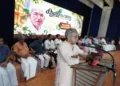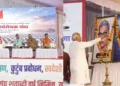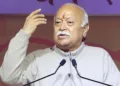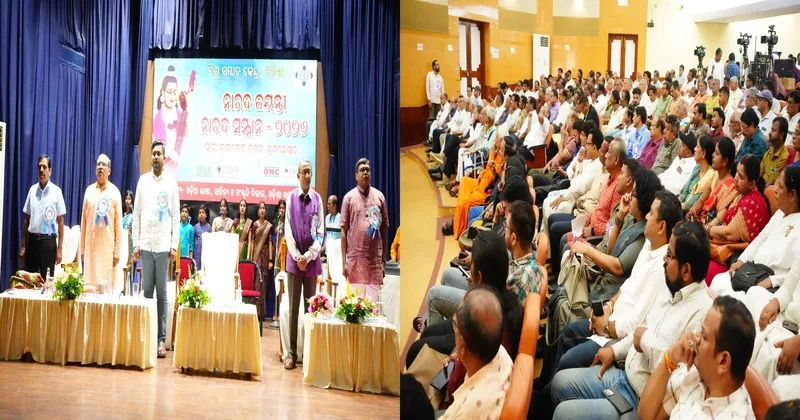
Bhubaneswar: In a call for the revival of “contemporary dharma” inspired by Narad Muni, Rashtriya Swayamsevak Sangh (RSS) Akhil Bharatiya Sah Prachar Pramukh Pradeep Joshi Ji emphasized on Monday that forces aiming to weaken Bharat are constantly devising new strategies. It is the collective responsibility of citizens to recognize and counter these challenges. Just as Narad Muni practiced the dharma of his time, we must learn from him and strive to re-establish contemporary dharma. The younger generation must be prepared to stand firmly in the nation’s interest. Joshi was addressing a gathering at the Narad Jayanti celebration and Narad Samman award ceremony organized by Vishva Samvad Kendra, Bhubaneswar.
The program, held at Jayadev Bhawan in the state capital, brought together intellectuals, journalists, and social leaders. On this occasion, senior journalist Prasanna Pati was conferred the Narad Samman in recognition of his lifelong dedication to journalism. The award was presented in the presence of Odisha’s Minister for Culture, Sports, and Youth Affairs, Suryabanshi Suraj.
In his keynote address, Joshi highlighted that Narad Muni embodies the ideal of communication in the Bharatiya tradition. He stated that Narad’s life and teachings remain profoundly relevant today, especially as there is a need to reawaken Bharat’s civilizational values, worldview, and cultural ethos. “Narad Muni always acted in accordance with the dharma of his time. We must draw inspiration from him and work towards re-establishing contemporary dharma in today’s context,” he said.
Joshi further stressed the importance of preparing the younger generation for this responsibility. According to him, youth must be guided and inspired to remain steadfast in their commitment to the nation and to uphold values that promote social cohesion and national unity. He noted that Narad’s character symbolized universality, inclusiveness, and a commitment to the welfare of all—qualities essential for building a strong and harmonious society.
Highlighting the philosophical foundations of Bharat, Joshi described spirituality as the core of Bharatiya civilization. He stated that this spiritual outlook distinguishes Bharat from other nations and allows it to envision the entire world as one family. “Bharatiya thought has always aimed for the welfare of the entire world. From Adi Shankaracharya to numerous saints and sages, this tradition has been upheld across centuries. It is now our responsibility to continue and strengthen this legacy,” he remarked.
At the same time, Joshi pointed out that over the past 150 years, certain ideological trends influenced by foreign perspectives have emerged in Bharat. Referring to historical developments, he mentioned events such as the partition of Bengal in 1905, the formation of the Muslim League in 1906, and subsequent movements that, according to him, impacted national unity and cultural identity. He also noted instances where traditional symbols and expressions, such as the singing of “Vande Mataram,” faced challenges, and referenced historical episodes of conflict and division.
Contrasting these developments, Joshi discussed another stream of thought that sought to strengthen national consciousness. He cited Swami Vivekananda as a key figure who traveled across Bharat as a wandering monk and later represented Bharatiya philosophy on the global stage. Vivekananda, he asserted, played a crucial role in shaping global understanding of Bharat’s spiritual and cultural heritage.
Joshi asserted that the ideas of Hindutva and Rashtratva foster a sense of belonging and unity within society. He called for greater efforts to disseminate these ideas and reinforce a shared sense of identity among citizens. He also referred to recent developments in the country, which he described as positive steps, including the abrogation of Article 370, the construction of a grand temple at the birthplace of Lord Ram in Ayodhya, and progress in addressing internal security challenges such as Naxalism. However, he cautioned that several issues still require sustained attention and effort.
Raising concerns about external influences, Joshi alleged that organized attempts from abroad are being made to weaken Bharat through various means. He cited a program titled “Dismantling Global Hindutva,” organized by a group of universities in the United States, as an example. According to him, such initiatives reflect attempts to shape narratives and influence perceptions about Bharat and its cultural identity.
Forces seeking to weaken India are now attempting to carry out their activities through various new methods. He stated that, as part of this, they are engaging in the “glorification of invaders,” which involves the deliberate praise of aggressors. This is being done systematically, with efforts to portray invaders like Aurangzeb and Akbar, who attacked India, as great figures.
Shri Joshi stated that, in addition to this, these forces are also engaged in the “de-iconisation of Indian icons.” He noted attempts to portray Bharat’s heroes as villains, emphasizing that such efforts have been ongoing for a long time. He cited the example of Netaji Subhas Chandra Bose, who was derogatorily referred to as “Tojo’s dog,” and added that baseless remarks have also been made about Swami Vivekananda.
Drawing international comparisons, Joshi mentioned countries like Japan, Germany, and Israel as examples of nations that have overcome adversity through determination and a strong sense of national priority. He observed that while differences exist within these societies, their citizens unite when it comes to national interests. “If these countries can achieve progress through unity and resolve, there is no reason why Bharat cannot do the same,” he added.
Addressing the gathering, Minister Suryabanshi Suraj highlighted the relevance of Narad Muni in the context of journalism and communication. He described Narad as a figure embodying a unique blend of expression and wisdom, symbolized by his mastery of speech and music. The minister emphasized that the principles of journalism should be guided by truth, responsibility, and a commitment to public welfare.
He urged journalists to verify facts and present the truth fearlessly, rather than being influenced by preconceived agendas. “Journalism must serve society by upholding truth and integrity. There is a growing concern about agenda-driven reporting, which needs to be addressed,” Suraj said.
The program was presided over by academician Niranjan Padhi. On behalf of the organizing body, secretary Saiprasad Das presented the annual report. The event was coordinated by Sindhu Sagar Mahanty, while Dushmanta Kumar Barik delivered the introductory address. Shiv Prasad Nayak read out the citation for the award, and Jagadananda Pattanayak proposed the vote of thanks.
Students from Unit-8 Saraswati Shishu Vidya Mandir added a cultural dimension to the event by presenting patriotic songs, which were well received by the audience.
Several prominent individuals contributed to the successful organization of the program, including Engineer Sudarshan Das, Gyanendra Kumar Nayak, Engineer Prabhakar Behera, Bipin Behera, Soumendra Jena, Tapesh Das, Bhadrasen Swain, Achyut Biswal, Narayandas Maotawale, Nihar Ranjan Pati, Suryakant Sahu, Anshuman Martha, Sumant Kumar Panda, Manindra Sundar Das, and Niranjan Nayak, among others.
The Narad Jayanti celebration in Bhubaneswar thus served as a platform for reflecting on Bharat’s cultural heritage, discussing contemporary challenges, and emphasizing the role of communication, values, and national consciousness in shaping the future.