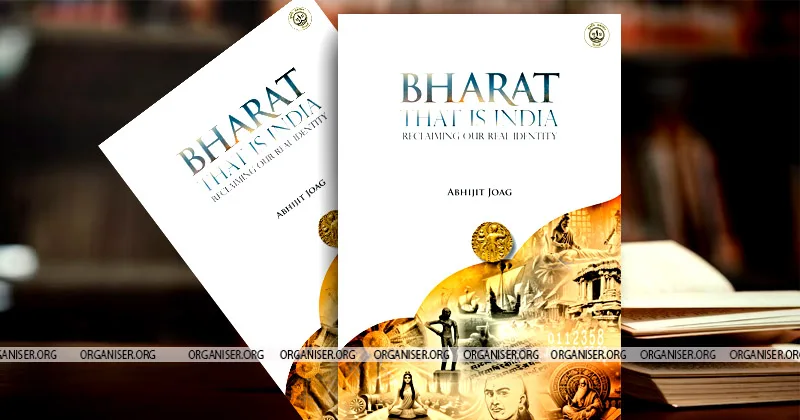
Joag’s central thrust in this book is a reclamation of Bharat’s indigenous cultural consciousness — a narrative that predates and transcends the modern nation-state. Unlike many histories that interpret Bharat, predominantly through colonial or postcolonial lenses, Joag argues that Bharat’s sense of nationhood arises not from 20th-century political constructs but from a continuity spanning more than 5,000 years, rooted in spiritual, cultural, and ethical traditions. This includes an emphasis on Dharma — a framework of duty, moral order, and social responsibility — and advanced philosophical expressions such as Advaita Vedanta, suggesting an intellectual cohesion that has underpinned Indian thought through centuries.
In sum, Bharat That Is India offers a thought-provoking, culturally rooted argument for reclaiming Bharat’s civilisational narrative. It is a fascinating read for those interested in civilisational history, cultural self-understanding, and the interplay between past and present identity formation
One of the book’s notable strengths is its broad cultural sweep. Joag does not limit his writing to political history alone; he connects philosophical concepts, Bharatiya knowledge systems, and civilisational self-understanding with the narrative of nation and identity. This helps the reader see Bharat not merely as a geopolitical entity, but as a living continuum of ideas, faiths, and practices that adapt yet endure.
An entire chapter has been devoted to ancient scientific practices in Bharat, ranging from Metallurgy, Medicine and Maths. No area of Science was left untouched by our ancestors. We were the first knowledge society in the world, and students from all over Asia used to come to study in our universities. It won’t be an exaggeration to say that we laid the foundation of Western civilisation.
Another chapter that caught my interest was how Bharat was the world’s economic powerhouse, contributing 25 per cent of the world’s GDP, until the arrival of the British. The author delineates in detail how farming, trade, and manufacturing laid the foundation of rich and thriving India. Indians used to raise three crops a year, some 2,000 years back while Europe is still not able to achieve that.
The prose style is clear, accessible, and “encyclopaedic in its scope” while being “free flowing” and engaging, making it accessible to a wider audience. Joag writes with a purposeful clarity that makes complex philosophical ideas readable to a general audience, while still offering sufficient depth for those seeking a serious engagement with India’s intellectual past. The book’s approachable narrative has a potential to make it a popular read among students, thinkers, and cultural enthusiasts alike.
Critically, the book also enters current debates on cultural authenticity and historical interpretation. By challenging narratives that privilege Western modernity as the default framework for understanding Indian identity, Joag invites readers to re-examine long-held assumptions about secularism, colonial impact, and the role of indigenous knowledge systems. The result is not a neutral history but a decolonial reinterpretation that asserts agency in India’s own civilisational voice.
The book has already received positive reviews from notable figures, including Dr. Vikram Sampath, who called it a “wonderful contribution to Indian historiography”. In sum, Bharat That Is India offers a thought-provoking, culturally rooted argument for reclaiming Bharat’s civilisational narrative. It is a fascinating read for those interested in civilisational history, cultural self-understanding, and the interplay between past and present identity formation. Whether one agrees with all its conclusions or not, the book succeeds in sparking a larger conversation about who Bharat is and how its people perceive themselves — a conversation that is likely to inform cultural discourse for years to come.