How Mamata Banerjee’s TMC lost power in West Bengal?
July 21, 2026
  • Read Ecopy
  • Circulation
  • Advertise
  • Careers
  • About Us
  • Contact Us
Android AppiPhone AppArattai
Organiser
  • ‌
  • Bharat
    • Assam
    • Bihar
    • Chhattisgarh
    • Jharkhand
    • Maharashtra
    • View All States
  • World
    • Asia
    • Europe
    • North America
    • South America
    • Africa
    • Australia
  • Editorial
  • International
  • Opinion
  • RSS @ 100
  • More
    • Op Sindoor
    • Analysis
    • Sports
    • Defence
    • Politics
    • Business
    • Economy
    • Culture
    • Special Report
    • Sci & Tech
    • Entertainment
    • G20
    • Azadi Ka Amrit Mahotsav
    • Vocal4Local
    • Web Stories
    • Education
    • Employment
    • Books
    • Interviews
    • Travel
    • Law
    • Health
    • Obituary
  • Subscribe
    • Subscribe Print Edition
    • Subscribe Ecopy
    • Read Ecopy
  • ‌
  • Bharat
    • Assam
    • Bihar
    • Chhattisgarh
    • Jharkhand
    • Maharashtra
    • View All States
  • World
    • Asia
    • Europe
    • North America
    • South America
    • Africa
    • Australia
  • Editorial
  • International
  • Opinion
  • RSS @ 100
  • More
    • Op Sindoor
    • Analysis
    • Sports
    • Defence
    • Politics
    • Business
    • Economy
    • Culture
    • Special Report
    • Sci & Tech
    • Entertainment
    • G20
    • Azadi Ka Amrit Mahotsav
    • Vocal4Local
    • Web Stories
    • Education
    • Employment
    • Books
    • Interviews
    • Travel
    • Law
    • Health
    • Obituary
  • Subscribe
    • Subscribe Print Edition
    • Subscribe Ecopy
    • Read Ecopy
Organiser
  • Home
  • Bharat
  • World
  • Operation Sindoor
  • Editorial
  • Analysis
  • Opinion
  • Culture
  • Defence
  • International Edition
  • RSS @ 100
  • Magazine
  • Read Ecopy
Home Politics

From 2011 wave to complete wipeout in 2026: How Mamata’s rule in Bengal ended in anger, allegations and collapse

West Bengal Election 2026 results end Mamata Banerjee’s 15-year rule. From anti-incumbency to corruption and economic concerns, here’s a detailed analysis of TMC’s defeat

WEBDESKWEBDESK
May 5, 2026, 07:00 pm IST
in Politics, Bharat, West Bengal
Follow on Google News
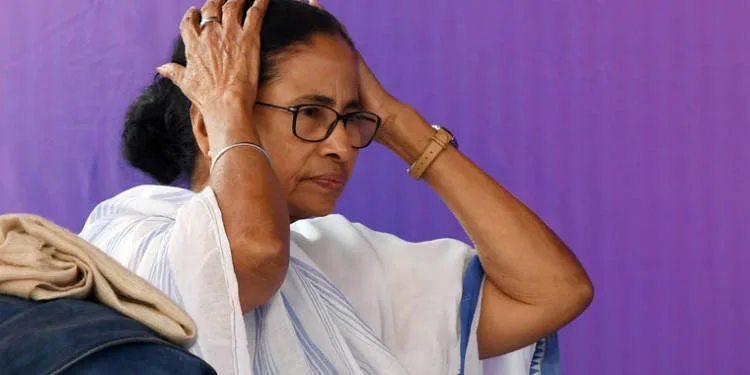
Mamata Banerjee, former Chief Minister of Bengal

Mamata Banerjee, former Chief Minister of Bengal

FacebookTwitterWhatsAppTelegramEmail

In 2011, Mamata Banerjee was not just a politician. She was a movement. A street fighter who rose against the might of the Left and promised dignity, jobs, safety and a future to the people of West Bengal.

In 2026, that same leader stands rejected by the very people who once chanted her name. The fall of the All India Trinamool Congress is not just an electoral defeat. It is a public indictment of a regime that many now describe as arrogant, corrupt, and disconnected from reality.

What began as “Poriborton” slowly turned into what critics call “Protidwandi Daman” a system where dissent was crushed, questions were unwelcome, and power became concentrated in a shrinking inner circle.

The early years of Mamata Banerjee’s government did show energy. Roads were built. Government offices were painted. Welfare schemes reached millions. For a while, it looked like Bengal had finally broken free from decades of stagnation.

But beneath the surface, a different system was taking shape.

The same leader who had once protested land acquisition in Singur drove away the Tata Group’s Nano project. Investors took note. Bengal, they felt, was politically unpredictable and economically unsafe.

Over time, industry did not come. Jobs did not come. What came instead, was a tightly controlled local network of political middlemen who decided who could build, who could trade, and who could survive.

‘Syndicate Raj’ and the cost of doing business

Ask small contractors or local businessmen in Bengal and one phrase comes up again and again: syndicate.

This alleged system of political patronage meant that nothing moved without approval from local power brokers linked to the ruling ecosystem. Construction materials, labour, permissions everything, came at a price.

Major investors stayed away. Smaller businesses either complied or collapsed. Many quietly shifted to other states.

The annual Biswa Bangla Global Business Summit became a showpiece event full of announcements and promises. But on the ground, job creation remained painfully slow. For thousands of young Bengalis, the only real option was to leave.

Walk through families in Kolkata or districts and a pattern emerges. The brightest children are not here anymore.

They are in Bengaluru, Pune, Hyderabad, Delhi. Some are abroad.

Parents who once believed Bengal would rise again began sending their children away not by choice but by compulsion. The collapse of credible job opportunities and declining confidence in higher education institutions created what many now openly call a brain drain.

This was not just economic failure. It was emotional. A generation that should have built Bengal chose to abandon it.

Appeasement politics and rising anger

Mamata Banerjee’s government strongly pushed minority welfare schemes. On paper, they were framed as inclusive. On the ground, a large section of voters began to see them differently.

In districts like Asansol, Maldah, Murshidabad and Basirhat, repeated communal tensions deepened mistrust.

The administration was selective silent. Allegations surfaced that police often acted cautiously or hesitantly in sensitive situations, fuelling a perception of bias.

The controversy intensified after remarks attributed to Banerjee during the campaign, which opponents said reinforced fears of vote-bank politics over equal governance.

Sandeshkhali and the breaking point

If one incident shook Bengal’s conscience, it was Sandeshkhali.

Allegations against local strongman Shahjahan Sheikh ranging from land grabbing to abuse created outrage across the state. Women came forward with disturbing testimonies.

What angered people even more was not just the allegations but the perceived delay in action. For many, Sandeshkhali became proof of what they had long suspected. That political protection mattered more than justice.

Mamata Banerjee built a strong support base among women through schemes like Lakshmir Bhandar.

But welfare could not silence fear.

The RG Kar Medical College rape and murder case triggered statewide protests. Students, doctors, ordinary citizens came out on the streets.

The anger was raw. The question was simple. If women are not safe, what is the value of financial assistance?

For many women voters, this election became a moment of reckoning.

Corruption as a way of life

Perhaps the most damaging blow to the TMC government was the relentless series of corruption scandals.

From the Saradha chit fund scam to the Narada sting operation, from teacher recruitment irregularities to ration distribution scams, the allegations kept piling up.

What made it worse was the involvement of senior leaders and ministers. Arrests, raids, and court cases became routine headlines.

In Bengal’s drawing rooms, a bitter joke began circulating. The only industry that truly flourished under TMC was corruption.

For the bhadralok, this was not just political disappointment. It was humiliation.

The ‘Didi’ who stopped listening

Mamata Banerjee’s biggest strength was once her accessibility. She was seen as someone who listened.

Over time, that image changed.

She grew increasingly insulated, surrounded by a loyal inner circle that filtered reality. Dissenting voices were dismissed as conspiracies. Journalists, opposition leaders, even civil society activists often found themselves targeted or sidelined.

There were also persistent allegations that the police machinery was used to control opposition and manage narratives. This perception damaged institutional credibility.

The leader who once challenged power was now accused of clinging to it at any cost.

2026: The verdict of anger

The 2026 result is not just about anti-incumbency. It is about accumulated anger.

Anger of unemployed youth.
Anger of women who felt unsafe.
Anger of families who sent their children away.
Anger of citizens who believed corruption had become normal.

West Bengal has a history of delivering decisive political messages. In 2011, it voted for hope. In 2026, it voted against what many saw as a betrayal of that hope.

For Mamata Banerjee, this defeat is deeply personal. She rose from the streets to become one of India’s most powerful women leaders. She defeated the Left when few thought it was possible.

But history is unforgiving.

Her legacy will now be debated not just for what she achieved, but for what she allowed to happen under her watch. A state that once trusted her with overwhelming power has now turned away with equal decisiveness.


Topics: Sandeshkhali caseBengal PoliticsRG Kar caseWest Bengal Election 2026TMC defeatanti-incumbencycorruption in TMCMamata Banerjee
ShareTweetSendShareSend
✮ Subscribe Organiser YouTube Channel. ✮
✮ Join Organiser's WhatsApp channel for Nationalist views beyond the news. ✮
Previous News

Tamil Nadu Elections 2026 Results: Of 234 Seats, 130 see 10,000+ margins, 61 below 5,000

Next News

ABVP condemns bid to hurt Hindu sentiments at Hyderabad Central University, attack on karyakartas by SFI extremists

Related News

West Bengal: TMC MLA Madan Mitra joins rebel camp

West Bengal: Fresh blow to Mamata Banerjee as senior TMC leader Madan Mitra joins Ritabrata Banerjee’s rebel camp

The TMC chief led a protest march from Ballygunge Phari to Hazra More over the rape and murder of an 11-year-old girl in Baruipur. (Photo: X)

Did Mamata Banerjee slap her own party worker during Kolkata protest? Viral video sparks political row

West Bengal CM Suvendu Adhikari (Left) and Former West Bengal Chief Minister Mamata Banerjee (Right)

West Bengal’s OBC Amendment Bill: How Suvendu government seeks to end Mamata’s Muslim reservation framework

Chief Minister of Bengal Suvendu Adhikari and Mamata Banerjee

West Bengal assembly braces for UCC battle; Split TMC faces first legislative test after electoral defeat

Kakoli Ghosh Dastidar and Sagarika Ghose

TMC internal rift: Kakoli Ghosh Dastidar hits back at Sagarika Ghose saying, ‘What about team of thieves you belong?’

TMC chief and former CM of Bengal Mamata Banerjee

Mamata’s Damage-control Exercise? TMC reshuffle comes as rebel leaders reject Banerjee family’s leadership

Load More

Latest News

ABVP demands immediate INSPIRE SHE scholarship release, flags delay affecting thousands of science students

A CJP protest in Delhi turned violent, injuring police personnel, damaging government property, and triggering an investigation

CJP Protest in Delhi Turns Violent: Police injured, government property damaged; Investigation underway

Britain's market opens wider as India's textile sector gains a long-awaited competitive edge

India-UK CETA: Duty-Free access set to double textile exports, adding $1.6 billion, challenging China and Bangladesh

Representative Image

Pune Horror: 4 Muslim men Farhan, Fazal, Rehan & Sahil arrested for year long rape and blackmail of college student

Congress supremo Rahul Gandhi

If Rahul Gandhi backed Sonam Wangchuk, why did he never visit the CJP protest at Jantar Mantar?

Senior IPS officer G S Rao

Tripura govt appoints G S Rao as in-charge DGP after Anurag Dhankar found dead at police headquarters

Dipke was at NCP-SP leader Anish Gawande's house when Delhi Police detained him

Who is Anish Gawande? NCP (SP) spokesperson at whose house CJP founder Abhijeet Dipke was staying during Delhi protest

When Indira Gandhi government killed hundreds of Sadhus and Gau rakshaks

Do you know, Indira Govt killed thousands of sadhus & Gaurakshaks? Revisiting Jantar Mantar to Parliament march of 1966

Over 50 police and paramilitary personnel sustain injuries in the violence.

CJP protest breaches barricades, sparks violent clashes in Delhi; Over 118 police personnel hurt

Cockroach Janata Party (CJP) founder Abhijeet Dipke speaks following a protest

Did CJP deliberately flout India’s security norms? Illegal protest and drone footage from red zone spark major question

Load More
  • Privacy
  • Terms
  • Cookie Policy
  • Refund and Cancellation
  • Delivery and Shipping

© Bharat Prakashan (Delhi) Limited.
Tech-enabled by Ananthapuri Technologies

  • Home
  • Search Organiser
  • Bharat
    • Assam
    • Bihar
    • Chhattisgarh
    • Jharkhand
    • Maharashtra
    • View All States
  • World
    • Asia
    • Africa
    • North America
    • South America
    • Europe
    • Australia
  • Editorial
  • Operation Sindoor
  • Opinion
  • Analysis
  • Defence
  • Culture
  • Sports
  • Business
  • RSS @ 100
  • Entertainment
  • More ..
    • Sci & Tech
    • Vocal4Local
    • Special Report
    • Education
    • Employment
    • Books
    • Interviews
    • Travel
    • Health
    • Politics
    • Law
    • Economy
    • Obituary
  • Subscribe Magazine
  • Read Ecopy
  • Advertise
  • Circulation
  • Careers
  • About Us
  • Contact Us
  • Policies & Terms
    • Privacy Policy
    • Cookie Policy
    • Refund and Cancellation
    • Terms of Use

© Bharat Prakashan (Delhi) Limited.
Tech-enabled by Ananthapuri Technologies