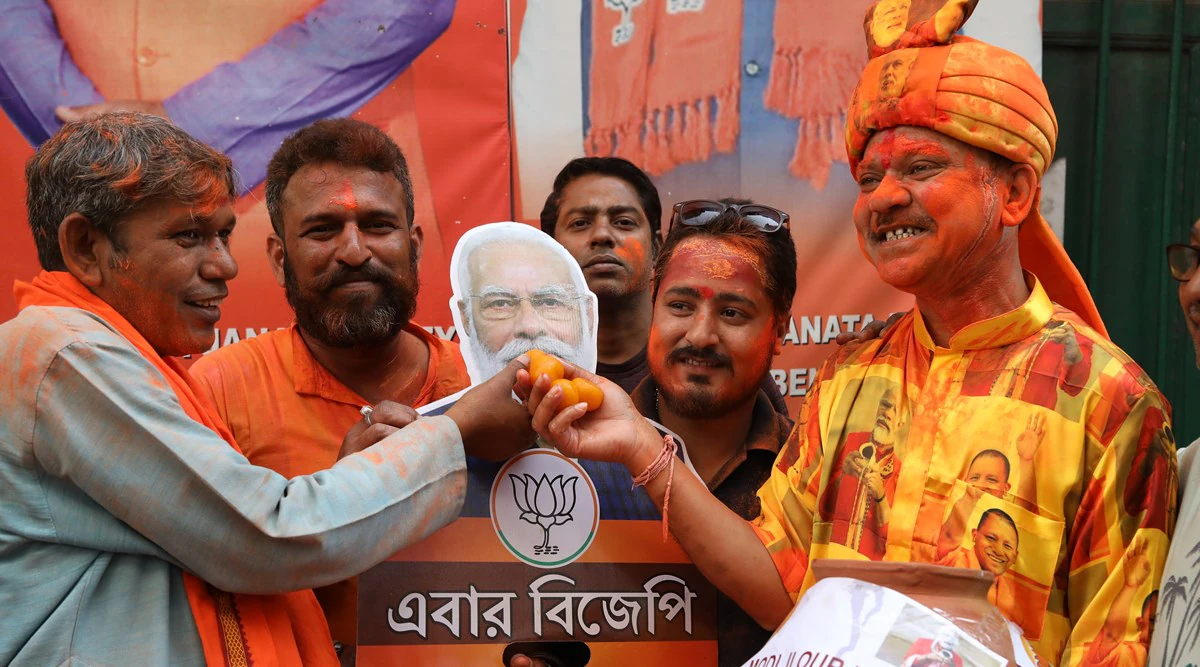
The 2026 West Bengal Assembly election has unfolded as a sharply polarised, bipolar contest dominated by the ruling All India Trinamool Congress and the challenger Bharatiya Janata Party. Unlike earlier elections where multiple political fronts influenced outcomes, this election has largely narrowed into a straight fight between two dominant forces.
At the centre of this contest stands Chief Minister Mamata Banerjee, seeking to extend her party’s uninterrupted rule since 2011, and BJP’s state leadership spearheaded by Suvendu Adhikari, who has positioned himself as the face of resistance against the incumbent regime. The election has therefore evolved into not just a political contest, but a leadership battle layered with ideological undertones.
The BJP has mounted an aggressive campaign aimed at expanding its footprint in eastern India, while the TMC has leaned heavily on its welfare schemes, grassroots cadre network, and appeal to regional identity. The result is a high-voltage electoral contest where even marginal shifts in voter preference could lead to dramatic outcomes.
Record-breaking turnout shows intensity of contest
One of the most striking features of the 2026 election has been the exceptionally high voter turnout, recorded at approximately ninety two to ninety three percent. This places West Bengal among the highest turnout states in Indian electoral history.
The state has a total of 294 assembly seats, with 148 required for a simple majority. However, counting on May 4 covers 293 seats, as the Falta constituency will go to repoll later.
The consistently high turnout across all phases indicates the depth of political mobilisation and public engagement. Such turnout can be interpreted in multiple ways. It could signal anti-incumbency sentiment, strong support for the ruling party, or simply heightened political polarisation. In Bengal’s case, all three factors appear to be at play simultaneously.
High turnout elections are historically difficult to predict, as they tend to disrupt established voting patterns. This has added an additional layer of uncertainty to an already unpredictable contest.
Falta repoll adds twist to the final outcome
A significant development that has shaped the election narrative is the complete repoll ordered in the Falta constituency. Authorities took the rare step of cancelling the entire polling process in the seat following serious allegations of voter intimidation, procedural lapses, and irregularities related to voting mechanisms.
The repoll, scheduled later in May, means that the final result for one seat will be delayed. In addition to Falta, limited booth-level repolls were also conducted in parts of South 24 Parganas, including areas such as Magrahat Paschim and Diamond Harbour.
The implications of this delay are substantial. In a tightly contested election, the outcome of a single seat could determine government formation. If the results on counting day produce a narrow margin between the two major parties, Falta could emerge as the deciding seat that ultimately decides who forms the government.
What is at stake for both parties
For the All India Trinamool Congress, this election is less a routine political contest and more a referendum on over a decade of governance under Mamata Banerjee. While a victory would extend her rule into a fourth consecutive term, it would also signal the continuation of a regime long accused of deep-rooted corruption, syndicate politics, and institutionalised patronage networks.
Allegations ranging from recruitment scams to financial irregularities in welfare distribution have repeatedly surfaced, raising questions about transparency and accountability. For many voters, the election represents an opportunity to either endorse or reject what opponents describe as systemic exploitation of state resources and erosion of administrative neutrality.
For the Bharatiya Janata Party, the stakes are equally high, if not higher. A win in West Bengal would mark the party’s first-ever government in the state, representing a major political breakthrough in eastern India. Such an outcome would not only end the long-standing dominance of the TMC but also significantly boost the BJP’s national momentum, strengthening its position ahead of future electoral battles and expanding its geographical footprint.
This election, therefore, is not merely about forming a state government. It is about redefining the political trajectory of West Bengal and influencing the larger national narrative, particularly in the ongoing contest between entrenched regional power structures and an expanding national political force.
Key constituencies that could decide the outcome
Several constituencies have emerged as critical battlegrounds that could influence the final result. Bhabanipur remains Mamata Banerjee’s stronghold and carries symbolic importance for the TMC. Nandigram continues to be a prestige battle, representing the intense rivalry between the BJP and TMC.
Diamond Harbour has drawn attention due to its political sensitivity, while Magrahat Paschim has gained prominence due to repoll-related developments. Falta, with its delayed result, could ultimately become the deciding factor in a close contest.
These constituencies represent a mix of urban, rural, border, and tribal dynamics, reflecting the diverse socio-political landscape of West Bengal.
Exit polls for the West Bengal election have presented a fragmented and inconclusive picture. While some surveys suggest that the BJP could secure a majority or emerge as the single largest party, others indicate a close contest or even a narrow victory for the TMC.
There are also projections pointing toward a hung assembly, where neither party crosses the majority mark of 148 seats. This divergence among exit polls has reduced confidence in any single prediction.
Historically, exit polls in West Bengal have struggled to accurately capture electoral outcomes, often misreading the final verdict. This track record, combined with the current variability in projections, reinforces the perception that the election result remains too close to call.
Four possible scenarios as results unfold
As counting progresses, four broad scenarios could emerge from the results.
The first scenario is a BJP majority. Several projections indicate the possibility of the Bharatiya Janata Party crossing the majority mark for the first time, driven by visible anti-incumbency, consolidation of votes, and growing fatigue with the current regime. Party leaders have expressed confidence in securing a decisive mandate, projecting it as a vote for structural change and governance reset in the state.
The second scenario is the All India Trinamool Congress retaining power. If the party crosses the 148-seat threshold, it would hand Mamata Banerjee a fourth consecutive term. However, such an outcome would also raise serious questions about the state’s political climate, with years of entrenched corruption, political violence, appeasement-driven policies, and systematic suppression of dissent. Opponents argue that another term could further institutionalise what they describe as administrative decay and partisan control over state machinery.
The third scenario is a hung assembly. In this situation, neither major party reaches the majority mark, leading to intense post-poll negotiations. While smaller parties and independents may not command large numbers, their support could become disproportionately influential in a fractured mandate, opening the door to unstable arrangements and backroom political bargaining.
The fourth scenario involves a delayed final outcome due to the Falta repoll. If margins are extremely narrow, recounts, legal challenges, and procedural disputes could prolong the government formation process, adding another layer of uncertainty to an already volatile electoral verdict.
Battle that reflects India’s political evolution
The 2026 West Bengal Assembly election encapsulates broader trends in Indian politics. It highlights the growing dominance of bipolar contests, the increasing importance of leadership-driven campaigns, and the role of high voter mobilisation in shaping outcomes.
The election also shows the interplay between regional identity and national political narratives. While the TMC has focused on Bengali asmita and welfare governance, the BJP has emphasised expansion and ideological positioning.
The intensity of the campaign, the scale of voter participation, and the unpredictability of the outcome all point to a maturing democratic process where voters are actively shaping the political landscape.
As West Bengal awaits the final results, the question remains whether the BJP can end the Trinamool Congress’s 15-year rule or whether Mamata Banerjee will secure yet another term.
With record turnout, a direct leadership clash, and razor-thin margins predicted, the election stands as one of the most consequential in the state’s history. The final verdict will not only determine the next government in Bengal but could also influence political strategies and alignments at the national level.