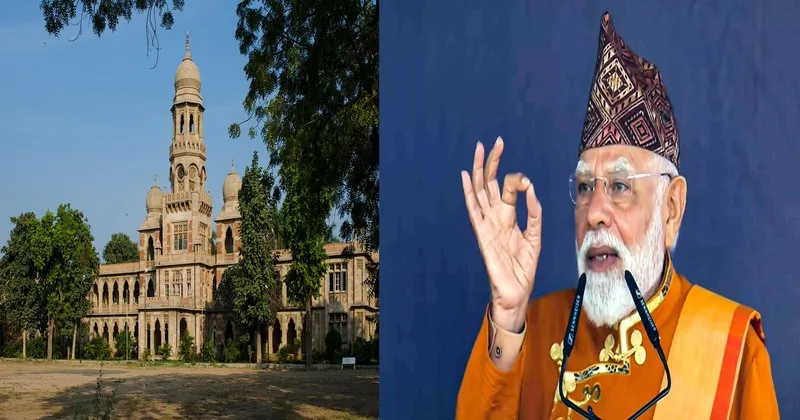
Maharaja Sayajirao University of Baroda has introduced a new course titled “Sociology of Patriotism” under its Department of Sociology. The course aims to explore the evolving dimensions of nationalism, governance and social integration in contemporary India, with specific reference to the leadership of Narendra Modi, the ideology of the Rashtriya Swayamsevak Sangh (RSS), and the reformist legacy of Maharaja Sayajirao Gaekwad III. It is considered as an academic expansion within the department, which has introduced three new courses to align sociology studies with current socio-political realities. However, “Sociology of Patriotism” has emerged as the most discussed among them due to its unique blend of theory and contemporary references.
Speaking on the rationale behind the course, Sociology Department Head, Dr. Virendra Singh explained that the idea originated from field experiences. “When we go into the field for research and social work, we observe multiple dimensions at play i.e., women empowerment, national welfare, and upliftment of forest-dwelling communities. These experiences triggered our desire to understand these aspects more deeply,” he said.
Dr. Singh pointed to a conceptual shift in terminology as well. Traditionally, we have used the term ‘tribal,’ but the word ‘vanvasi’ offers a different perspective. Interestingly, we found no exact English equivalent for it, which itself became a subject of discussion and exploration.
#WATCH | Vadodara, Gujarat: Maharaja Sayajirao University has launched a new course, 'Sociology of Patriotism,' in the Sociology Department. The curriculum will include studies on PM Modi's leadership, RSS ideology, and Maharaja Sayajirao Gaekwad's reforms.
Sociology Department… pic.twitter.com/rXzqtWjOQy
— ANI (@ANI) May 2, 2026
He said that during further research, they found that many such grassroot activities are already being run under the RSS. He added that they wanted to understand who is behind these efforts whether the government or social groups and how they help bring society together.
Course Content: From nation-state to cultural identity
The curriculum of “Sociology of Patriotism” begins with foundational concepts such as the idea of a nation-state, often discussed in political sociology. It then moves into themes like geo-nationalism, where national identity is shaped by geographical boundaries and cultural nationalism, which emphasizes shared traditions, histories, and values.
Dr. Singh explained this with a simple example: “He said, earlier we used to study stories like that of traders traveling from Afghanistan to India with dry fruits that reflect deep cultural linkages across South Asia. These narratives help us understand that beyond political borders, there exists a shared cultural identity.” Similarly, the course also emphasizes dialogue and unity. Differences of opinion are natural, but they should not lead to divisions of the mind. The objective is to work towards a shared identity while respecting diversity.
Another key component of the course is the study of what Dr. Singh referred to as “Modi Tatva”, or the socio-political impact of Prime Minister Narendra Modi’s leadership. The curriculum will help students in understanding how governance models, policy innovations, and public participation have influenced societal change in recent years. After 2014, several new dimensions have emerged in governance, be it technological advancements, cleanliness campaigns, or administrative innovations. He gave the example of the Ministry of Jal Shakti, saying it was created to bring new solutions to long-standing issues like water security. The course also examines democratic participation mechanisms introduced in recent years. Policies are now often opened for public feedback through online portals before implementation.
The introduction of the course has already shown a strong response among students. Admissions are conducted through the centralized Gujarat Common Admission Services (GKAS) system, and the number of applications has seen a sharp rise. “At the undergraduate level, we received over 850 applications last year. For postgraduate studies, the number increased from 30 to 40 applicants earlier to around 150 this year,” Dr. Singh said. In response to the growing demand, the university has significantly expanded its intake capacity. “We have increased the number of seats from 50 last year to 280 this year,” he confirmed.
With this initiative, Maharaja Sayajirao University aims to bridge the gap between theoretical sociology and ground realities. By incorporating themes such as nationalism, governance, and social organizations, the course of ‘Sociology of Patriotism’ seeks to prepare students for a deeper understanding of India’s evolving social fabric.