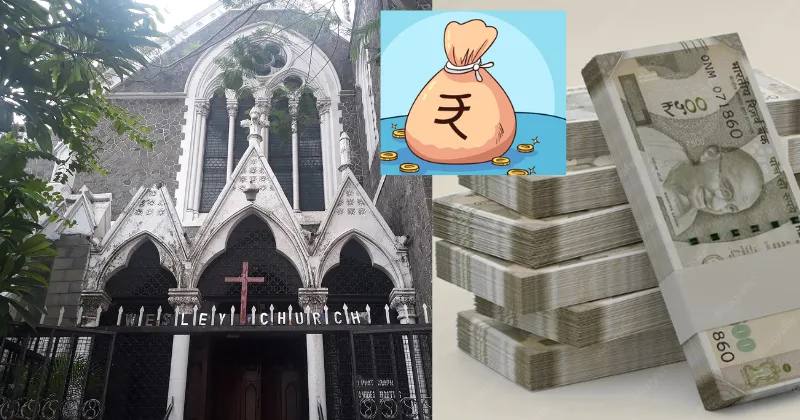
When a religious institution trades its spiritual mission for multi-crore real estate deals and rigged elections, is it a church or a corporate-political structure? Recent exposés within the Methodist Church in India reveal a ruthless power syndicate operating safely under the garb of religion
A sensational exposé has once again proven that Abrahamic religious institutions operate less as sanctuaries of faith and more as corporate political organisations functioning under the garb of religion. A recent unearthing of massive administrative anarchy and property mismanagement within the ‘Methodist Church in India’ (MCI) — one of India’s largest Christian organisations — reveals a textbook case of corporate maneuvering, political power plays, and systemic corruption.
Serious allegations indicate that the current office-bearers are blatantly flouting the Charity Commissioner’s rules and prevailing national laws to liquidate valuable real estate, manipulate internal elections, and silence dissenting voices, mirroring the tactics of a rogue political syndicate.
A detailed look at the irregularities exposes the corporate and political realities behind the religious facade.
The Real Estate and Financial Syndicate
At its core, the MCI is allegedly operating a multi-crore real estate and financial enterprise, bypassing legal frameworks for corporate gain:
Illegal Property Sales: Selling properties registered under ‘The Executive Board of the Methodist Church in India’ at the Mumbai Charity Commissioner’s office legally requires prior permission under Section ’36 A’. Instead, acting like aggressive corporate liquidators, current trustees are signing Memorandums of Understanding (MoUs) worth crores before obtaining permission, later forcing the buyers to secure the approvals.
Financial Embezzlement: Operating off the books, office-bearers are accused of showing diminished transaction amounts on government documents. The market-rate difference bypasses the trust’s accounts entirely, allegedly lining the pockets of Bishops and office-bearers. This corporate-style embezzlement has already triggered several notices from the Income Tax Department.
Suspicious Rebranding: The organisation’s original name was ‘The Executive Board of the Southern Asia’. However, the name change certificate presented by current leaders to ‘The Executive Board of the Methodist Church in India’ shows visible tampering. In a legally suspicious move, the new name is simply handwritten with a pen over the original text.
Shell Entities: To further their malpractices, the operators are acting like corporate fraudsters by establishing organisations under various different names across multiple locations, effectively misleading the government and cheating their own church members.
A Rigged Political Machine
The internal governance of the MCI resembles a corrupted political state rather than a spiritual community.
Lack of Electoral Transparency: The organisation operates on an unregistered rulebook known as ‘The Book of Discipline,’ the in-depth knowledge of which is purposely kept from church members. Elections are held via Ballot Paper without any government machinery or neutral observers. Leaders count the votes themselves, ensuring the process serves the convenience of a select few rather than democratic fairness. Furthermore, election rules are frequently altered mid-process.
Criminal Backgrounds and Moving Goalposts: While rules mandate that office-bearers possess good character without police or court cases, many current Bishops and high-ranking members have serious criminal court cases pending against them. Additionally, while Bharat has standard retirement ages, leaders have rewritten the rules to serve their own political longevity — pushing the Bishop retirement age from 60, to 65, and now to 70. Even then, if a leader crosses 70, they refuse to retire until the next General Conference held four years later—a mandate that fits no Indian law.
Contempt of the Supreme Court: In a brazen display of political impunity regarding Civil Appeal No. 5494/2025, the Hon Supreme Court of Delhi issued a clear order on April 7, 2025: “There shall be an order of status quo as of today between the parties, and the proposed General Conference shall go on but the decision shall not be given effect to until further orders are passed by the High Court.” Ignoring this status quo, decision for electing Bishops and other office-bearers was immediately implemented, they assumed their posts, and proceeded to hold the 37th Mumbai Regional Conference (July 25–27, 2025) and the 38th Mumbai Regional Conference (April 10–12, 2026), in direct contempt of the Supreme Court.
Authoritarian Suppression of Dissent
Like any political regime desperate to maintain power, the church leadership is actively suppressing whistleblowers. Those raising their voices face severe retaliation: canceled church memberships, manufactured obstacles in their children’s marriages, and public threats. Dissenters are denied opportunities to serve on committees or in worship services, and even if selected, their appointments are cancelled. Pastors (priests) who dare to side with the whistleblowers are transferred to highly inconvenient locations and have their salaries and dues withheld.
The Organisational Architecture
To understand how this machinery operates, one must look at its vast, inherited structure. Founded by Reverend John Wesley in 1766, the Methodist movement reached Bareilly, Bharat, on December 7, 1856, and Maharashtra in 1870. Registered under the Societies Act 1860 and the Bombay Public Trust Act 1950, the organisation (MCI) holds vast properties — mostly donated or leased by the British Government, with only a few acquired directly. Many of these properties are not even registered with the Charity Commissioner’s office and still bear the old ‘Southern Asia’ name.
The corporate hierarchy is divided into 12 Regional Conferences: Mumbai, North India (Bareilly), Delhi, Lucknow, Bangalore, Gujarat, Hyderabad, Jabalpur (MP), Chennai, Moradabad, Agra, and Kolkata (Bengal).
(Except for Mumbai, the remaining 11 are divided by regional languages, such as Gujarati for Gujarat and Hindi for Delhi).
The Power Hierarchy:
Bishops & Executive Council: The organisation is overseen by 6 Bishops (one for every two conferences, though currently only 5 are active) and an 8-member Executive Council and Board.
The Conference Pipeline: At the grassroots level, a Pastorate Conference is formed by 35 or more local church members, holding annual local elections to send 1 or 2 members to the Regional Conference. The 6 Regional Conferences meet annually for provincial transfers. Every four years, representatives from all regional Pastorate Conferences elect members to attend the General Conference.
The Power Grab: It is at the four-year General Conference that Bishops retire and are elected, and the Executive Council/Board is newly elected. According to organisational law, Bishops and Executive members cannot be directly elected. Yet, currently, those in power are bypassing this grassroots democratic pipeline, directly handpicking and removing Executive Board and Council members themselves, rendering the entire tiered election system highly suspicious.
The Roadmap for Justice
Refusing to be silenced by this corporate-political juggernaut, whistleblowers are fighting back on multiple fronts. They are fighting legal battles in court while simultaneously generating social awareness.
The movement is now escalating its demands to the highest levels of government. They are petitioning the Hon Prime Minister, the Home Minister, and the Chief Minister of Maharashtra, seeking a face-to-face meeting with the latter to expose the facts. Plans include chain hunger strikes to continually highlight the corruption, keeping the media—the fourth pillar of democracy—regularly informed.
Their ultimate demand is clear: a high-level government inquiry into these serious offenses and the immediate appointment of an official Administrator over the MCI by the Hon Charity Commissioner. They stand in expectation that the state will dismantle this political machinery and deliver justice, much in the same way justice was previously secured for the Jain community.