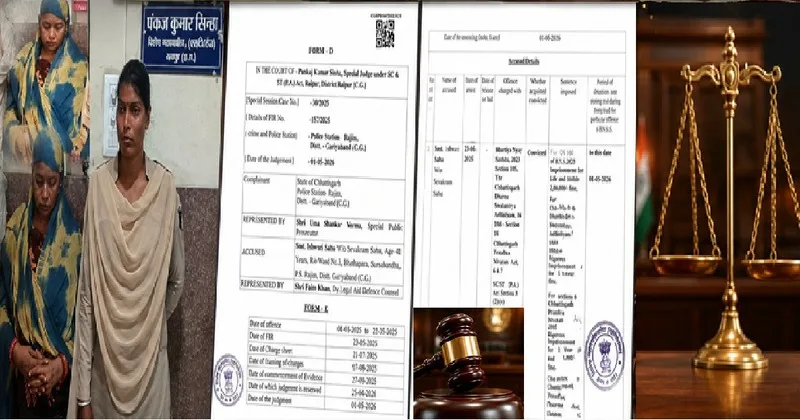
This case, emerging from Raipur in Chhattisgarh, signals a deep-seated crisis where superstition is being exploited to facilitate Christian conversions under the guise of medical treatment. The death of 18-year-old Yogita Sonwani raises a critical question: despite the existence of numerous laws, will innocent members of society continue to be ensnared in such traps, lured by the promise of “miracles” and subjected to conversion processes that, in many instances, ultimately prove fatal?
Indeed, a thorough investigation into the matter has revealed that the alleged church employs various stratagems to facilitate conversions. In this latest incident, the accused Ishwari Sahu, a woman residing in Sursabandha village in Chhattisgarh’s Gariaband district had positioned herself as a “healer” capable of curing mental illnesses without the use of conventional medicines.
In this specific case of attempted conversion, Yogita, who was already battling a mental illness was assured by Ishwari Sahu: “Seek treatment from me and Jesus’s miracle will manifest.” However, what transpired was not medical treatment, but rather an act of inhumane torture. Hot water and a so-called “miraculous oil” were poured over the young woman’s body in the name of Jesus’s grace and miracles; the accused would climb onto her body, apply pressure with her feet and force her to recite prayers to Jesus incessantly. Consequently, Yogita’s condition deteriorated rapidly.
Post-mortem Reveals the Truth
Subsequently, following Yogita’s death on May 22, 2025, the post-mortem report exposed a set of horrific facts details so shocking that they would make anyone’s blood run cold. The young woman had suffered broken ribs, blood had accumulated in her lungs and her internal injuries were so severe that she ultimately died from asphyxiation. Doctors unequivocally stated that this was not a natural death, but rather the direct result of a violent act. In other words, the very “Jesus-based treatment” which relied on miraculous oil massages and involved physically brutal methods adopted in the name of prayer to Jesus, became the direct cause of her death.
Pressure for Conversion in the Name of Faith
Another grave aspect of the case that emerged in court was the allegation that pressure was exerted for religious conversion. According to the statements of witnesses and the victim’s mother, the accused woman, Ishwari Sahu, repeatedly insisted- “Place your faith in Jesus Christ; He alone will heal you.” Furthermore, she asserted that upon recovery, the family would be required to convert to Christianity. The family was intimidated with the warning that if they disclosed any details to anyone, “Lord Jesus would be displeased.” Thus, under the guise of medical treatment, not only was physical pressure applied, but mental and religious coercion were also exerted, trapping the family within a vortex of fear and confusion.
A Web of Fear and Superstition
This incident starkly illustrates how individuals are ensnared in the superstition of “Jesus prayer” by exploiting their vulnerability during times of illness and helplessness. A person’s specific weakness is weaponized; those targeted for conversion are brought under the perpetrator’s influence and are gradually isolated from the outside world. This constitutes a psychological trap from which breaking free is not within everyone’s capacity.
The Court’s Firm Stance and Verdict
The special SC-ST court of Raipur has adopted a strict stance in this matter. Judge Pankaj Kumar Sinha has found the accused woman Ishwari Sahu guilty of the murder of 18-year-old girl Yogita Sonwani and has convicted the accused Ishwari Sahu and sentenced her to life imprisonment. Along with this, punishment was also given under the Freedom of Religion Act, Sorcery Act and SC-ST Act and a fine of Rs 2 lakh was imposed. The court clearly said that the accused claimed treatment without any medical qualification and also misled the family by using superstition and religious influence, hence it is mandatory to give the harshest punishment.
It is noteworthy that the laws regarding freedom of religion in Chhattisgarh have also recently been tightened, stipulating severe penalties for religious conversions induced through coercion or inducement. The penalties have been made even more stringent, particularly in cases involving women, minors and members of Scheduled Castes and Scheduled Tribes. This marks the first instance in Chhattisgarh where a conviction has been secured and a sentence pronounced under this specific legislation.
The Broader Issue of Religious Conversion in India
Indeed, this incident in Raipur points toward a larger national issue. In a diverse society like India, the subject of religious conversion, particularly concerning Christianity and Islam has long been a sensitive matter. These concerns deepen significantly when allegations arise that vulnerable individuals such as the infirm, the sick, or the economically disadvantaged are being influenced through promises of “treatment,” “miracles,” or “assistance,” or through intimidation. This is precisely why several states have enacted stricter laws concerning freedom of religion: to curb conversions brought about through force, inducement, or deception.
Incidentally, the very first voices of protest against such conversions in independent India emerged from the Chhattisgarh region, then part of undivided Madhya Pradesh prompting the state’s government at the time to constitute the Niyogi Commission. Regrettably, although the state was subsequently bifurcated, the Niyogi Commission’s report on Christian conversions continues to gather dust in some forgotten corner. Meanwhile, Christian missionaries (the Church) still appear to be ensnaring unsuspecting individuals into conversion, sometimes in the name of social service, sometimes through claims of miracles, sometimes via material inducements, sometimes by exploiting poverty and at other times by promising employment and a better lifestyle.