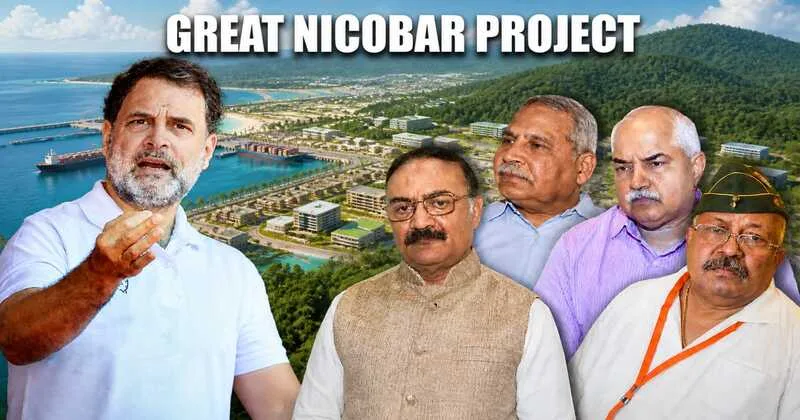
New Delhi/Vijayapuram: Former Indian armed forces officers have strongly denounced and refuted allegations made by Rahul Gandhi regarding the Great Nicobar Project, calling his claims misleading and strategically myopic. Retired military officials asserted that the project is vital for India’s maritime security, economic interests, and geopolitical positioning, particularly in countering China’s growing influence in the Indian Ocean Region.
Rahul Gandhi’s Allegations: Land, ecology and governance concerns
Leader of Opposition in the Lok Sabha, Rahul Gandhi, has raised a series of serious allegations against the Great Nicobar Project. Speaking to reporters in Vijayapuram, the Raebareli MP claimed that the project involves large-scale land grabbing, undermines tribal rights, and results in ecological damage. Rahul alleged that land in the Andaman and Nicobar Islands is being taken from local populations and handed over to industrialists. He stated: “Your land is being taken away from you and being given to Adani and other big businessmen.
The Forest Rights Act isn’t being implemented there. Settlers and tribals aren’t getting proper compensation. Quietly, India’s heritage is being stolen.” He further criticised governance in the region, alleging administrative high-handedness: “Here in Andaman, there is a water issue, and there’s the corruption from the LG’s side. He is like a king; he does whatever they want. He has named his house and office as Lok Bhavan, but he does not meet anyone. The public should be heard and respected. This is not a dictatorship.” Raising environmental concerns, Rahul described the project as “ecological theft,” claiming: “Trees worth lakhs of crores of rupees are being stolen, and the land that’s being snatched is the main issue”.
According to the government, the Great Nicobar Project aims to transform the island into a strategic maritime and economic hub. Its location, approximately 40 nautical miles from the East-West international shipping route, makes it crucial for reducing India’s dependence on foreign transshipment ports. The project is planned in three phases over 22 years and aligns with national security objectives. It also adheres to policies such as the Shompen Policy of 2015 and the Jarawa Policy of 2004, which mandate safeguarding the welfare and integrity of Particularly Vulnerable Tribal Groups (PVTGs).
Major General Vivekanandan: Safeguarding maritime freedom
Major General P Vivekanandan (Retd) directly countered Rahul’s claims, emphasising the strategic necessity of the project. Speaking to ANI, he said India must guard its maritime domain and ensure freedom of movement in critical sea lanes: “China has been trying to limit India’s maritime mobility by establishing ports around our nation, which is known as the ‘String of Pearls’. We need safeguard our maritime interests and protect our economic zones.” He highlighted that development in Great Nicobar has stagnated since 2008 and must now be accelerated: “Since 2008, we have stopped developing the Greater Nicobar Island. We must ensure this area is developed swiftly. Because not only do we have to guard that area, we also have to see that our freedom of movement in the area is not restricted by any unwanted element.”
Addressing economic concerns, he pointed to losses due to reliance on foreign ports: “There are concerns, particularly regarding the development of an intercontinental trans-shipment container terminal. We are having a huge economic loss.” On allegations involving industrial participation, he clarified: “Entities like Adani or other industrial players may have been co-opted, but that does not mean we are selling the area to them.” He also acknowledged environmental concerns but stressed that authorities are addressing them responsibly: “There are concerns about habitat, ecology, and the coastal environment, and these need to be addressed by working with local communities to find sustainable solutions, which the people organising this initiative are already focusing on. Our administrators are fully aware of these issues and are addressing them”.
Air Vice Marshal Srivastava: Strategic lessons from global conflicts
Air Vice Marshal PK Srivastava (Retd) underscored the project’s importance in the context of evolving global conflicts, particularly maritime chokepoints. Referring to the Iran-US tensions and blockade of the Strait of Hormuz, he said: “We witnessed a new weapon in the US-Iran war. Iran blockaded the Strait of Hormuz”. Drawing parallels, he emphasised the importance of monitoring the Strait of Malacca, one of the world’s busiest shipping lanes: “Through this project, we will be able to keep a watch on the Strait of Malacca. Once Great Nicobar develops, our commercial activity and military dominance & surveillance will increase”.
Rajeev Chaudhary: Economic and infrastructure imperatives
Former Director General of the Border Roads Organisation (DG BRO), Rajeev Chaudhary, strongly refuted Rahul Gandhi’s claims, calling them factually incorrect. “He is the LoP, and he has given very strong-worded messages, but none of is right or true”. He pointed out that the region has been neglected since independence and now requires urgent development: “This region was neglected since independence, and now, we are going into a strengthening of our strategic and economic hub in Great Nicobar. It was an essential project which was delayed for a long time”. Highlighting geopolitical competition, he warned: “You can’t permit China to come to Gwadar Port or Hambantota, and you are sitting quietly in Port Blair.” He also stressed the economic cost of relying on foreign ports: “We are losing economically, a high percentage of the GDP, in handling of foreign ports”.
Additionally, he noted the island’s proximity to Myanmar as an opportunity to strengthen regional ties.
Chaudhary also addressed environmental concerns, citing the clearance granted by the National Green Tribunal (NGT) and mitigation measures planned by the government. According to official data, 7.11 lakh trees across 49.86 sq km of forest are expected to be felled, while 97.30 sq km of land in Haryana has been identified for compensatory afforestation. He elaborated: “The 8-10 lakh trees from the 137 square km on the island will have to be cut. These trees will be planted in Haryana and MP, as per the policy in place, as there is no space to plant them on Great Nicobar.” On biodiversity protection: “The government plans to shift the Leatherback sea turtles to two nearby islands. The corals and coastal biodiversity will be preserved, and no destruction will happen”. He emphasised that there have been deliberate efforts to protect flora and fauna, including forests and marine ecosystems.
Addressing one of Rahul’s key concerns, tribal displacement, Chaudhary asserted that the government has planned carefully to avoid such outcomes: “The government has made a plan under which there will be zero displacement.” However, he acknowledged future contingencies: “In the later phases, if needed, the people from here will be shifted to other islands with their consent.” He reiterated confidence in the planning process: “The plan is foolproof, and nothing of the sort will happen, as it is being said by some important people about the displacement of tribes and nature”.
Veterans assert strategic imperative over political criticism
The debate over the Great Nicobar Project underscores the urgent need to prioritise national security, strategic foresight, and economic self-reliance over politically driven criticism. While Rahul Gandhi has framed the project as a case of “ecological theft” and corporate-driven land acquisition, retired military officials have firmly argued that such claims overlook the larger strategic, economic, and national security imperatives at stake. For the armed forces veterans, the project is not merely an infrastructure plan but a critical national asset, one that will enable India to monitor key maritime routes, effectively counter China’s “String of Pearls” strategy, reduce economic dependence on foreign ports, and significantly strengthen its Indo-Pacific presence. They maintain that safeguarding India’s maritime interests and ensuring freedom of movement in vital sea lanes must remain paramount and as the project progresses, these strategic priorities will continue to define India’s policy approach to development, environment and national security.