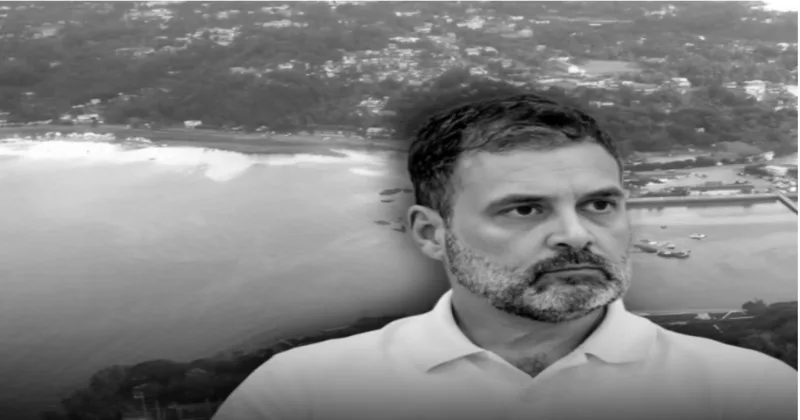
Rahul Gandhi should read his own party’s history before making any allegations against others. Recently, like his father and grandmother, he has been on vacation in the Andaman & Nicobar Islands, leaving aside his responsibilities. From there, he has once again begun making allegations against the Modi Government’s development projects in these islands.
However, last year in September, Sonia Gandhi also wrote a column in The Hindu on the infrastructure development initiatives undertaken by the Government. All this appears to be a deliberate attempt to create undue pressure on the Government through baseless criticism.
In any case, before presenting his arguments, Rahul Gandhi should also place before the people of the country a clear account of the tenures of his father and his grandmother. However, the Congress has consistently shown reluctance in doing so.
Some examples are as follows
- Indira Gandhi mistreated the primitive tribal communities of the Andaman & Nicobar. During her three-day visit to the islands in March 1981, local leaders arranged her interaction with the Jarawa and Onge tribes. Generally, these tribes live with minimal or no clothing and use natural materials such as leaves and bark. However, during Indira Gandhi’s visit, they were made to appear in fully dressed clothing. This was not only a violation of established norms of law but also an infringement on the rights of these tribal communities.
- During Indira Gandhi’s tenure as Prime Minister, on 11 March 1982, concerns were raised in the Rajya Sabha regarding the declining tribal population in the Andaman & Nicobar. When the concerned Union Minister gave evasive replies, Indira Gandhi herself had to intervene. It was unfortunate that she acknowledged the reality of the declining tribal population in the region. Moreover, she openly justified the interference with tribal customs during her visit, including presenting them in fully dressed attire and involving them in events like Republic Day parades. 1 This, however, was legally questionable and amounted to a clear violation of the rights of these tribal communities. Even more unfortunate was that she placed the blame not on the Government, but on the tribal communities themselves.
- Not only during Indira Gandhi’s tenure, but even during Rajiv Gandhi’s time, concerns were raised about the declining tribal population. In 1986, as Prime Minister, he convened a meeting of the Island Development Authority, which he chaired. It was decided in this meeting that a study group would be formed to examine the causes behind the declining tribal population. The meeting was attended by V.P. Singh (Finance Minister), Syed Mohammad Mufti (Tourism Minister), and Rajesh Pilot (Transport Minister).
- Under the Andaman and Nicobar Islands (Protection of Aboriginal Tribes) Regulation 1956, unauthorized contact or entry into tribal reserves is illegal. Despite this, Rajiv Gandhi’s wife Sonia Gandhi talked to Onge tribes and visited their homes in December 1986. – Sonia Gandhi’s inconsistency on this issue is also evident. On one hand, in 1986, she interacted closely with tribal communities, including women and children. On the other hand, in a 2012 NAC meeting, she directed that indigenous tribes like the Jarawas should be left untouched and protected. This raises the question of why a similar approach was not advocated earlier.
- In November 1985, Rajiv Gandhi gave an interview to Khaleej Times of Dubai. In which he shared a proposal to open up one of the Andaman and Nicobar to Indian and non-resident industrialist for investment.
- Rajiv Gandhi’s government decided to set up 2,000 industries in the Union Territory by the year 2000.
- The uproar that Rahul Gandhi is creating today, in fact, has its roots in the period of Rajiv Gandhi’s tenure as Prime Minister. At that time, a proposal was put forward to develop the Andaman & Nicobar as a free port – positioning them as a rival to Singapore and a potential replacement for Hong Kong. However, these ideas could not be implemented on the ground, largely because the approach adopted by his government raised serious concerns. The plan also involved attempts to turn the islands into a tax haven. Large portions of virgin forests were cleared, and around a dozen firms, including some multinational companies, undertook the cultivation of red oil palm over nearly 15,000 hectares. Such questionable 2 methods created doubts and ultimately undermined the credibility of the entire initiative.
- In September 2004, Tourism Ministry has sought the Cabinet nod to leased islands in Andamans to private international operators. It includes Havelock, Cinque, Little Andaman, Ross Island, Rut Land, North Mark Bay, Neil and South Andaman.