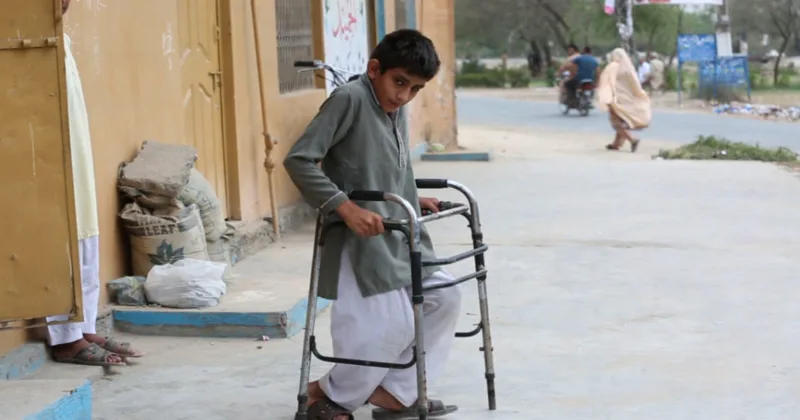
The fervent prayers of at least 4,00,000 workers involved in administering repeated doses of polio vaccine throughout Pakistan seemed to have gone unanswered on Friday. Two fresh cases were reported from Khyber Pakhtunkhwa (KP) province, one from Bannu and another from North Waziristan district. The two new cases took the total number of cases detected in 2026 to three.
The first case of the year was reported from Sujawal district on March 5 in the Sindh province. No cases were reported in the first two months, January and February, apparently because of cold weather when the polio virus remains less active. It becomes more active at higher temperatures and as such summer is considered as the high transmission season. It can thus realistically be expected that the number of cases can rise in the days, weeks and months ahead.
The numbers may seem very small right now but the real picture is decidedly much serious as per protocols established for declaring any country polio-free. According to these World Health Organisation (WHO) guidelines, a country can be declared polio-free only if does not report a single case of polio for three consecutive years, which is 365×3= 1,095 days at a stretch.
From February 2 to 8 this year, Pakistan ran its first nationwide polio campaign for 2026, vaccinating over 44.3 million children under the age of five. Across the border, Afghanistan launched a similar campaign in the same week. It was not a coincidence. It was by design, according to a report in Pakistan newspaper Dawn.
Pakistan, Afghanistan: Nations Having Polio
Incidentally, Pakistan and Afghanistan are the only two countries in the world where the wild polio virus is still considered endemic. That means the world cannot become polio free as long as these two continue reporting cases year after year as has been happening for almost three decades now.
Despite administration of polio vaccines through door to door. Despite millions of dollars spent by the WHO on running these programmes.
Epidemiologically, that is in terms of virus prevalence, Pakistan and Afghanistan are one bloc, mainly due to the porous Durand Line that constitutes the so-called border between the two nations. People move across the two nations in large numbers, even when the bilateral movement has gone down considerably due to hostilities between them.
As per the WHO guidelines, the Pakistan Polio Programme conducts multiple mass vaccination drives every year, as mandated, trying to take the vaccine to all children under five at their doorsteps. But refusals are a common problem faced by the health workers involved in these campaigns.
At present, Pakistan and Afghanistan are the only two countries in the world with active polio cases. Call it frustration, or call it caution, the WHO guidelines mandate polio-related travel restrictions on Pakistan. For the last 12 years since 2014, all international travellers from Pakistan have to carry a compulsory polio vaccination certificate. This becomes a special nuisance and protocol no immigration authorities can ignore while dealing with travellers from Pakistan as a result.
The conditions that allow the polio virus to grow and thrive are poor sanitation, unsafe water and overcrowded urban settings. All of these and more debilitating conditions prevail in cities like Karachi, where sewage and drinking water often mix. The virus lurks silently and multiplies constantly, circulating in the environment, long before the case/s become visible.
Karachi Booming With Viruses, Cases
In Karachi, a city that remained capital of Pakistan from 1947 to 1959, sewage samples mostly test positive, not only for polio virus but a host of other viruses too. This shows clearly that the virus is still presented in a significantly large number of population. Literally on the move along with hosts who look perfectly normal and have no signs of polio. Of course, they are capable of passing on the infection to vulnerable sections.
Incidentally, the polio drops are administered to children between zero (newborn babies) to five years of age only. However, the polio virus can hit weak children and manifest itself in children as old as 15.
Low number of case, as already stated above, are entirely misleading and give a false sense of well being and control. The virus is invisible, but continues in small pockets, hard-to-reach districts of Khyber Pakhtunkhwa, Balochistan and Sindh as well. It also remains present in unserved and underserved communities, those where vaccinations doesn’t reach, among mobile populations. All this results into fresh transmissions with end result of blown up cases detected by the health workers.
There are lakhs of children in Pakistan still that do not enter the polio vaccination system, with no vaccination drops ever being administered to them. In the language pertaining to polio programmes, they are called as zero-dose. These zeroes are way too dangerous, for themselves and others, as they are the children who have not received even a single dose of the vaccine. Like small fish that escape big holes in fishing nets, these children repeatedly slip through routine of polio immunisation. Be it regular or supplementary campaigns.
Waning Interest Among Poorly Paid Health Workers
The abject poverty of the people, and Pakistan as a nation state, is also responsible in no small measure for the state of affairs regarding polio campaigns. If it were left to the Federal and state governments of Pakistan, the polio campaign could have been abandoned perhaps. However, the reduced inflow of funds from WHO and some donor nations keeps the programme going.
A decade ago, riding on liberal funding from WHO, community health workers involved in these campaigns got Rs 32,000. The same workers now receive Rs 12,000, that too often weeks after the campaign ends. Their waning interest in actual administration of vaccines can be gauged from this fact alone.
During the first polio campaign of this year, Karachi reported a staggering 58 per cent of refusals, the largest share countrywide. Within Karachi, Gujro is considered a festering hotspot. The Gujro area acts as Karachi’s gateway with a floating population, people coming there from all parts of the country in search of jobs, and cheap living. An overwhelming population here comes to escape conflict in Waziristan and other violent areas of Khyber Pakhtunkhwa (KP).
Incidentally, like Karachi, KP also has a high rate of refusal besides posing dangers to health workers and the police parties escorting them. Most cases of attacks on polio workers, some even leading to deaths, have been reported from the province in recent years.
Refusal Areas Report High Incidence
Areas with a history of high polio incidence like Karachi, Peshawar, Quetta and south Khyber Pakhtunkhwa see the maximum number of refusals. There seems to be no way forward as rumours, misinformation and hostility to security forces remains high in these areas.
The government claims that Pakistan is now in the “last mile’’ of polio campaign but that claim seems exaggerated. It can actually say so only if it manages to vaccinate at least 95 per cent of its children. That means over 45 million (4.5 crore) children in each campaign but on paper it manages about 43 million (4.3 crore) only. The two million (20 lakh) or so that are not covered in the repeated vaccine administration is what constitutes the most critical “last mile’’.
Typically, between 800,000 and a million children are missed in each nationwide drive, according to officials involved in the campaign against polio virus.
Women spitting on health workers is the least of their worries as being accused of poisoning the children being given polio drops and being shot at are real and far more threatening hazards. Sometimes worried mothers would sneak the children out for administration of the drops if and when the men were not at home.
The vaccine causing infertility is a fairly common rumour. The fact of the polio vaccine being branded un-Islamic, aimed at reducing the population of a particular ethnicity are also heard in other parts.