Ramayan Dhar Dwivedi is a widely appreciated, melodious voice on Hindi poetry platforms. A young poet from Ayodhya, he is heard across the country in packed auditoriums. One of his deeply moving poems “jugnu jaisi jalti-bujhti, chhoti-chhoti ashayein” (small, flickering hopes like fireflies), is often listened to in profound silence.
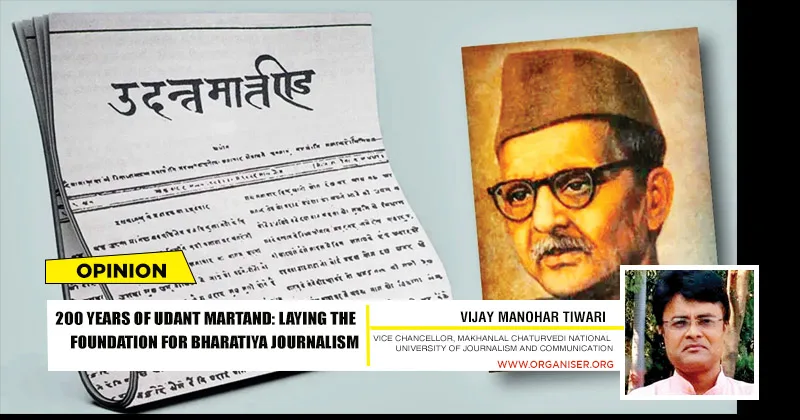
When British traders arrived in a declining Mughal Bharat, spreading their intricate web of control, Calcutta became their base. From there, they were scripting Bharat’s future with the ink of oppression. At that very time, a small flame of hope was lit — fragile yet meaningful, like the glow of a firefly. That flame took the form of the first Hindi newspaper, Udant Martand. The historic day was May 30, 1826, when it first emerged in print.
It is not known from whom Yugalkishore Shukla sought advice or inspiration for naming the paper. In a sense, Calcutta witnessed a “firefly” being published under the name “Martand” (the Sun), a brilliance whose radiance would fade within two years.
After establishing their control over Bengal, the British made Calcutta their principal centre. People from Northern Bharat began migrating there in search of trade and employment. Shukla, too, spent his early years working as a clerk in the Sadar Court of Calcutta before becoming a lawyer. But fate had planned something else for him.
Genesis Of the Newspaper
Why did the idea of publishing Udant Martand arise in his mind, particularly when it was not a profitable venture? This was especially true when its purpose was aligned with “the welfare of Bharat and Bharatiyas.” In the very first issue, the objective was clearly stated: “for the benefit of Hindustanis.” In contemporary terms, this single line set the narrative for the future course of Bharatiya journalism.
Every issue of Udant Martand, published for the benefit of ordinary Bharatiyas, carried a note at the end: It was printed every Tuesday at the Martand Press located in Kolhutola, Amratala Lane, house number 37, in Calcutta. Those wishing to receive it may send their names to the press, and copies would be delivered to them. The subscription price was two rupees per month. The newspaper, measuring approximately 30×20 cm and consisting of eight pages, reflected the spoken Hindi of the common people in Calcutta at that time.
Last year, Makhanlal Chaturvedi, National University of Journalism and Communication organised an exhibition in its Bhopal campus titled “Sadi Sakshi Hai” (A Century as Witness), showcasing front-page coverage of significant events in Bharat’s history. Many newspapers displayed there had ceased publication decades ago, while others had grown into large media houses over time.
Udant Martand was displayed separately, with special respect. A journalist visiting the exhibition attempted to read its title. He managed to decipher “Udant” with effort, but despite repeated attempts, could not read “Martand.” When informed that this was the first seed of Bharatiya journalism, on the strength of which today’s large, multi-edition, full-colour newspapers with vast circulation and expansive media empires have grown, he became deeply emotional. He stood there for a long time, gazing at every word of the print.
A gap of two hundred years is not small. The language of Calcutta in 1826 presented a challenge at every sentence, slowing the reader down repeatedly. Yet, he found this experience very interesting as to how languages evolve over time. Like rivers, languages flow continuously, merging with other streams along the way, altering their course and character. When viewed across a long span, these transformations become clearly visible. Just as we are unable to fully comprehend inscriptions unearthed from two thousand years ago, they still remain records of a glorious past.
And The Lamp Was Extinguished
After one year and seven months of publication, the lamp of Udant Martand was extinguished. The reason was the inability to secure financial support from the Government, traders, and readers. At that time, the British administration provided financial assistance to newspapers in Bengali, Urdu, and Persian, but not to Hindi publications. Even a monthly price of two rupees may have been beyond the means of Hindi-speaking readers in Calcutta.
Even today, newspapers in Bharat remain a unique product, often sold at prices significantly lower than their production cost. Media groups compensate for this gap through market revenues, ensuring that journalism continues. Only a few publications have sustained themselves without compromising their values, and they are the true inheritors of the tradition established by Udant Martand.
In such a situation, expecting newspapers to uphold high moral standards appears contradictory. They are expected to challenge governments, preserve the purity of language, expose corruption, maintain ethical conduct, and protect Dharma and Sanskriti. At the same time, society educates its children in English-medium institutions, seeks high-paying corporate careers, avoids personal sacrifice, and still expects newspapers to be nearly free, often accompanied by promotional schemes. One is left to wonder what kind of headline Yugalkishore Shukla might have written about this duality of expectations.
On December 19, 1827, in its 79th issue, he expressed his helplessness in these words: “Till today this Martand has risen; now it moves towards the setting horizon, its day nearing its end.” These words appeared like a final verse.
After Udant Martand, Bharat witnessed major historical upheavals—the Indian Rebellion of 1857, the Partition of Bengal 1905, the transfer of the British capital from Calcutta to Delhi in 1911, the fanatic Direct Action Day and the tragic events leading up to the partition of Bharat in 1947, marked by inhumane massacre, mass displacement, and tragic loss of life.

Episodes of Kalapani, imprisonment, executions, movements, satyagrahas, and resistance became part of a prolonged struggle, in which countless patriots sacrificed their lives. The small flame of Udant Martand continued to ignite similar flames across the country in the form of newspapers and journals. Gradually, it transformed into a powerful wave that ultimately contributed to the end of British rule.
This wave did not remain confined to the freedom struggle alone. It extended into various domains such as Hindi language, literature, history, archaeology, culture, and knowledge traditions. Its influence continued to grow, reaching significant milestones such as the outstanding contributions of the Nagari Pracharini Patrika in 1893.
There were times when, in the face of cannons, voices arose declaring the resolve to publish newspapers. There were also instances of individuals appearing with a gun in one hand and a pen in the other, embodying both resistance and expression. This journey of words suggests that Bharat’s struggle for independence began with noble aspirations, progressed through collective sacrifice and hardship, and eventually culminated in abhorrent negotiations for power.
Even today, beyond the gleaming, technologically advanced newsrooms of modern media houses, journalism remains fraught with uncertainties. In many ways, it is not very different from what it was two centuries ago in Kolhutola, in the narrow Amratala Lane of Calcutta. It was the stairs of haveli number 37, that Udant Martand took its first step. Economic hardship compelled the premature end of the first lamp of Hindi journalism. Even now, the editorial workforce in newspapers—despite their historic contributions to Bharat’s freedom struggle and nation-building—often has to traverse multiple layers of struggle to achieve dignity and recognition.
The essence of the brief life of Udant Martand lies in its struggle for truth—like flickering fireflies of hope, illuminating an endless sky.