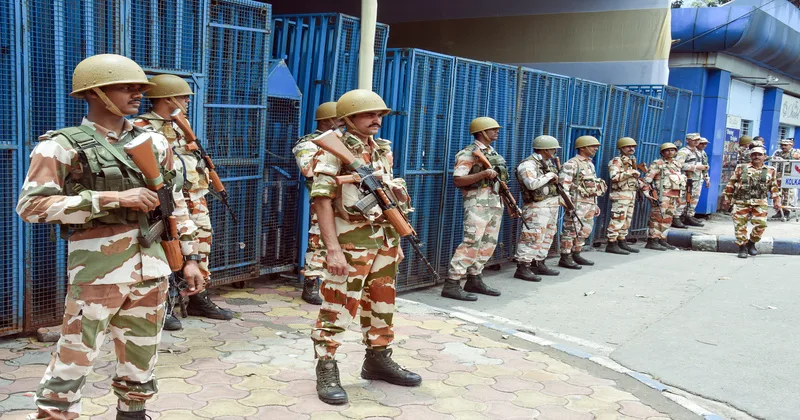
Kolkata: The Calcutta High Court has refused to entertain a plea by the All India Trinamool Congress challenging the deployment of central government personnel as counting supervisors, clearing the way for vote counting in West Bengal to proceed as scheduled on May 4.
The state’s electoral verdict will emerge from counting across 294 Assembly constituencies, where several crore votes, cast over two phases on April 23 and April 29, will be tallied under tight supervision.
What It Takes to Win: The Majority Mark
In the 294-member Assembly, the magic halfway mark is 148 seats. Any party or alliance crossing this figure will be in a position to form the government.
This makes every constituency crucial, particularly in closely contested regions where margins could be razor-thin and counting rounds stretch deep into the day.
Court Backs EC’s Authority
Backing the Election Commission of India, the court underlined that the poll body has full discretion in appointing counting personnel.
“This Court does not find any illegality in appointing counting supervisors and assistants from Central Government or Central PSU employees instead of State Government employees,” the bench observed.
The directive ensures that each counting table has at least one central or PSU official, a move the EC maintains is aimed at reinforcing neutrality and confidence in the process.
TMC’s Late Challenge Questioned
The petition, filed by the TMC, challenged a communication issued by the Additional Chief Electoral Officer requiring the inclusion of central staff at counting tables.
Senior counsel Kalyan Banerjee argued that the directive lacked jurisdiction and was based on mere apprehension.
However, counsel for the EC, DS Naidu, countered that the Representation of the People Act, 1951, permits such delegation of powers. He also flagged the timing of the plea—filed just days before counting—as indicative of an attempt to delay the process.
The TMC had argued that excluding state government staff from supervisory roles was arbitrary and raised concerns over bias. However, the court was not convinced, declining to interfere at a stage so close to counting.
Multi-Layered Oversight in Counting Halls
Justice Rao noted that multiple layers of oversight exist within counting halls, including micro-observers and counting agents of candidates, making manipulation implausible.
Apart from supervisors and assistants, counting centres will have micro-observers, returning officers, and authorised counting agents of candidates, sparing little or no space for ambiguity.
It also indicated that legal remedies remain open if any irregularities are observed during or after the counting process.
Court Rejects Allegations of Political Bias
The court firmly dismissed the TMC’s claim that central government employees could be influenced by the BJP or the Union government.
“Such an allegation is difficult to accept,” the court stated, underlining the institutional safeguards built into the counting process.
The High Court also flagged past precedents, noting that similar challenges to election-time administrative decisions had already been dismissed in earlier rounds of litigation. It pointed out that when such an order was previously taken to the Supreme Court of India, the Special Leave Petition was dismissed with the question of law kept open, effectively reinforcing judicial restraint at this stage of the electoral process.
On maintainability, the court was unequivocal: mere apprehension of bias cannot be a ground for interference, especially in the absence of concrete material. It held that such speculative concerns do not justify disrupting an ongoing election process.
With the legal hurdle now cleared, all eyes turn to May 4, when results from all 294 constituencies will decide who crosses the decisive 148-seat mark and takes control of the West Bengal Assembly.
The All India Trinamool Congress, however, has now approached the Supreme Court challenging the High Court’s ruling.