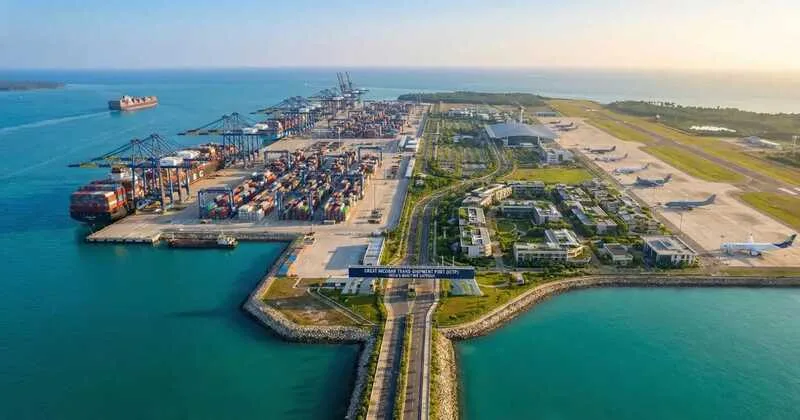
New Delhi: The ambitious Great Nicobar Project, positioned as a cornerstone of India’s maritime strategy, seeks to transform the southernmost tip of the Andaman and Nicobar Islands into a major hub of trade, connectivity and strategic influence. Designed as a multi-component infrastructure initiative, the project integrates port-led development with calibrated environmental safeguards and protection of indigenous communities, aligning economic growth with ecological responsibility and national interests.
At its core, the project combines four major components that an International Container Transhipment Terminal (ICTT) with a capacity of 14.2 million TEU, a greenfield international airport designed for 4,000 peak hour passengers, a 450 MVA gas and solar-based power plant, and a township spread across 16,610 hectares. Together, these elements form a comprehensive development blueprint intended to position Great Nicobar as a critical node in the Indian Ocean Region.
What is the Great Nicobar Project?
The Great Nicobar Project is being implemented in three phases over two decades: Phase I (2025–2035) covering 72.12 sq. km, Phase II (2036–2041) covering 45.27 sq. km, and Phase III (2042–2047) covering 48.71 sq. km. The total project area spans 166.10 sq. km, including 35.35 sq. km of revenue land and 130.75 sq. km of forest land. This phased development approach is designed to ensure systematic infrastructure expansion while embedding environmental safeguards and tribal welfare measures at every stage. The project remains compliant with Environmental Impact Assessment (EIA) regulations and statutory approvals, reflecting an attempt to balance development with ecological sensitivity.
A central pillar of the initiative is the International Container Transhipment Port at Galathea Bay. India currently lacks sufficient deep-water berths to accommodate large container ships, forcing a significant portion of cargo to be routed through foreign ports such as Colombo, Singapore and Klang. This results in considerable revenue losses and strategic dependency. The Galathea Bay port aims to address this gap. Located just 40 nautical miles from the East-West international shipping route and featuring natural depths exceeding 20 metres, the port is ideally positioned to attract both gateway and transhipment cargo. It is expected to reduce India’s reliance on foreign ports while enhancing national security, strengthening defence presence, and accelerating economic development in the region.
Complementing the port is a greenfield international airport, which is expected to significantly improve connectivity. The island’s ecological richness and proximity to global tourist destinations such as Phuket, Langkawi and Southeast Asian coastal cities make it a potential tourism hub. While Port Blair currently handles around 1.8 million passengers annually, the new airport is projected to initially handle 1 million passengers and scale up to 10 million passengers per year.
The township component is designed to support residential, commercial and institutional needs arising from port-led development. It will provide essential urban infrastructure for workers, service providers and associated industries, ensuring a self-sustaining ecosystem. Energy infrastructure is another critical element. The proposed 450 MVA power plant, combining gas and solar energy, aims to provide reliable and uninterrupted electricity. Currently, diesel generators dominate energy supply in the islands. The new system is designed for resilience, ensuring continuity even if one component fails, while incorporating renewable energy sources to support sustainability.
Economic imperatives and port-led growth
The economic rationale behind the Great Nicobar Project lies in India’s ambition to become a major maritime and logistics hub. By developing a world-class transhipment port, India seeks to capture a larger share of global shipping traffic and reduce dependence on foreign intermediaries. The project is expected to generate substantial revenue through cargo handling, logistics services and associated industries. It will also create employment opportunities and stimulate regional development. The integration of port, airport, township and power infrastructure reflects a holistic approach to economic planning, where each component reinforces the others. The island’s strategic location near one of the busiest shipping lanes in the world further enhances its economic potential.
With more than 90,000 merchant ships passing annually through the nearby Malacca Strait, carrying about 30% of global trade, the Great Nicobar Project is positioned to tap into a massive flow of maritime commerce. Additionally, the development aligns with India’s broader “Act East” policy, which aims to deepen economic engagement with Southeast Asia. By improving connectivity and infrastructure, the project can facilitate trade, tourism and investment flows between India and neighbouring regions.
Environmental clearance and safeguards
The environmental dimension of the Great Nicobar Project has been a focal point of debate, given that a substantial portion of the project area includes forest land. However, the project has received environmental clearance with safeguards in place, and recent legal scrutiny has upheld this approval.
A special bench of the National Green Tribunal disposed of challenges to the Great Nicobar mega infrastructure project on February 16, stating that it found “no good ground to interfere” with the environmental clearance. The tribunal observed that there were “adequate safeguards” built into the project’s approval process, reinforcing the government’s position that ecological concerns have been addressed within the regulatory framework.
The clearance follows multiple layers of statutory approvals under Environmental Impact Assessment (EIA) norms. The phased development strategy further allows for continuous monitoring of ecological impact and integration of mitigation measures at each stage. Environmental safeguards include afforestation measures, biodiversity conservation plans and systems to monitor ecological changes over time. The integration of renewable energy, particularly solar power within the 450 MVA energy system, reflects an effort to reduce reliance on fossil fuels and lower the project’s carbon footprint.
At the same time, the project framework emphasises the protection of indigenous communities, ensuring that development does not disrupt traditional livelihoods or social structures. The approach signals an attempt to balance infrastructure expansion with ecological sustainability and social responsibility in one of India’s most sensitive island ecosystems.
Geopolitical and strategic significance
Beyond economics, the Great Nicobar Project carries profound geopolitical implications. The Andaman and Nicobar Islands are located approximately 700 nautical miles southeast of the Indian mainland and add nearly 300,000 sq. km to India’s Exclusive Economic Zone under the United Nations Convention on the Law of the Sea. Their proximity to the Malacca Strait makes them a strategic vantage point for monitoring maritime traffic and projecting power in the Indo-Pacific region. As global competition intensifies, particularly with China’s expanding presence, the islands serve as a crucial asset for India’s maritime security. The islands share maritime boundaries with Myanmar, Thailand, Indonesia and Bangladesh, enhancing India’s regional connectivity and strategic reach. They also function as a first line of defence against potential threats from the eastern maritime frontier. Port Blair, the administrative capital, has the potential to evolve into a regional hub for naval cooperation, including disaster relief, medical aid, counter-piracy operations and search-and-rescue missions.
India’s maritime diplomacy is also anchored in these islands. Initiatives such as SAGAR, the Quad, and the Indian Ocean Rim Association (IORA) leverage the strategic location of the islands to foster regional cooperation. Naval exercises like MILAN and Malabar further reinforce India’s commitment to a free, open and rules-based maritime order. The project also complements regional frameworks such as BIMSTEC, strengthening India’s engagement in the Bay of Bengal subregion. The Great Nicobar Project represents a convergence of strategic foresight, economic ambition and ecological consciousness. By integrating infrastructure development with environmental safeguards and community protection, the project seeks to establish a model of sustainable growth. It reflects India’s evolving identity as a maritime power, where geography, strategy and diplomacy intersect. As the Indo-Pacific emerges as a theatre of both competition and cooperation, the Andaman and Nicobar Islands are poised to play a central role in shaping regional dynamics.