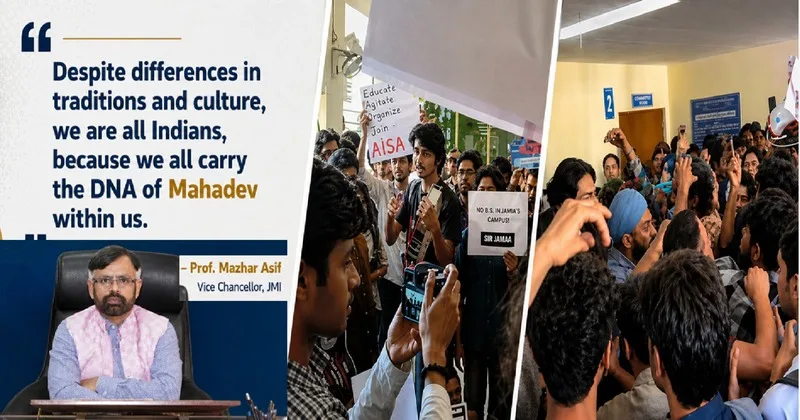
A statement made by Mazhar Asif, the Vice-Chancellor of Jamia Millia Islamia University, has recently sparked controversy. During an event, he remarked, “All Indians possess the DNA of Bhagwan Mahadev.” Following the circulation of this statement on social media, leftist student organizations and certain political parties have begun to voice their opposition.
Speaking at the event, the Vice-Chancellor stated: “Looking at everyone seated here, I do not believe that everyone shares the same mother tongue, upbringing, or culture. From a geographical perspective and I am speaking strictly within a geographical context here, it is possible that you may not even hail from the same region. Your religions, too, may differ. Yet, despite all these differences, we remain Indians. We are Indians because our DNA contains the DNA of Mahadev.” The video clip of the event shows that, immediately following this remark, the auditorium erupted in thunderous applause.
In the wake of this statement, the Students’ Federation of India (SFI) unit at Jamia issued a condemnation of the incident. The SFI student organization argues that the Vice-Chancellor’s statement is both unscientific and devoid of factual basis. However, when examined from an academic standpoint, is what Jamia Vice-Chancellor Mazhar Asif actually said truly unscientific? The emerging reality suggests otherwise; “To interpret this statement literally and subsequently dismiss it as unscientific would be entirely erroneous.” In the Indian context, as noted by Amit Malviya, the Head of the Bharatiya Janata Party (BJP) IT Cell- “Such sentiments serve as civilizational metaphors, rather than claims verifiable in a laboratory setting. They reflect a shared ancestry, cultural continuity, and a collective consciousness forged over the course of millennia.”
The outrage over Jamia VC Mazhar Asif’s remark that “we all have Mahadev’s DNA” says more about our shrinking tolerance for civilisational ideas than about the statement itself.
To interpret it literally and then dismiss it as “unscientific” is to miss the point entirely. In the…
— Amit Malviya (@amitmalviya) April 30, 2026
Indians Share a Single DNA : Scientific Evidence Exists
When viewed from this perspective and upon delving into its depths, one realizes that India’s history, while encompassing a multitude of distinct identities, is simultaneously bound together by profound interconnections. Who is ‘Mahadev’ in this context? If Jamia’s Vice-Chancellor, Mazhar Asif, is invoking Mahadev- the ‘God of Gods’ revered by Hindus and viewing all Indians as linked to that primordial tradition, then it must be acknowledged that this represents a traditional historical perspective moving in the right direction, one backed by robust evidence. Consequently, it cannot possibly be termed “unscientific,” as its detractors claim!
In the context of Indian society, the assertion that “all Indians share a single DNA”- while it may appear to some, on the surface, as merely an emotional or ideological expression is actually underpinned by concrete findings demonstrating that India’s entire population is connected, at a deep level, by a shared genetic foundation. While it is true that every individual possesses unique DNA, it is equally true that the entire Indian population has evolved as the result of a single, long-term biological process, shared ancestral groups and continuous intermingling. This forms the very basis upon which Dr. Mohan Bhagwat, the Sarsanghchalak of the Rashtriya Swayamsevak Sangh (RSS), arrives at the same conclusion: that “we all share a single DNA”- signifying that our origins, evolution and lineage are all linked to a common source.
Research in ‘Nature’ Magazine: All Indians Share a Single DNA
To gain a scientific understanding of this concept, the study titled “Reconstructing Indian Population History”- published in the journal ‘Nature’ in 2009 is of paramount importance. In this study, a team of scientists, including David Reich and Kumarasamy Thangaraj conducted a genomic analysis of the Indian population and concluded that nearly all of India’s castes, tribes, and linguistic groups are the product of a mixture of two major ancient components; the ANI (Ancestral North Indians) and the ASI (Ancestral South Indians).
Mahadev in Our DNA 🔱🔱
Jamia Vice Chancellor Asif Azhar at RSS Event
This was during an event associated with the Rashtriya Swayamsevak Sangh
What he said he absolutely correct 🔱🚩 pic.twitter.com/IxwetwvBSl
— Sheetal Chopra 🇮🇳 (@SheetalPronamo) April 30, 2026
The central conclusion of this study was that there is no Indian group that is entirely distinct from these two foundational components. According to this research, while the proportions of these two ancestral groups may vary across India’s diverse communities, their presence is nearly ubiquitous. To put this fact in simple terms, it becomes evident that regardless of an individual’s region, caste, or language, their genetic roots ultimately trace back to these very same shared sources that span the entire subcontinent.
Building upon this line of inquiry, the study titled “The Genomic Formation of South and Central Asia”, published in the journal ‘Science’ in 2018- placed the genetic makeup of Indians within an even broader perspective. This study posited that the contemporary population of South Asia is the result of a long-term admixture of three major ancient components: Indigenous Hunter-Gatherers, Iranian-related Agriculturalists and Steppe Pastoralists from Central Asia. In other words, the entire region, extending as far as Iran was historically Indian. The findings of this study indicate that all people residing in India are participants in this shared historical process, rendering their genetic foundations deeply interconnected.
Outward Diversity, Yet a Shared Genetic Foundation at the Core
Lalji Singh- the pioneer of DNA fingerprinting in India concluded, based on his work regarding the genetic structure of the Indian population, that while India may exhibit outward diversity, a shared genetic foundation lies at its very core. He pointed out that many key genetic markers found within the Indian genome are widely distributed across the entire country, indicating that India’s population evolved from a shared biological history.
Research conducted by Partha Majumder, an eminent scientist at the Indian Statistical Institute, points in the same direction. According to him, scientifically categorizing India’s population into rigid, distinct groups is unjustified, as the genetic variations present here are “continuous” rather than “discrete.” This implies that genetic variation in India occurs gradually from one region to another, making it evident that all groups constitute parts of a single, broad genetic continuum. It is this very “genetic continuity” that provides a scientific basis for the concept commonly expressed in layperson’s terms as: “We all share the same DNA.”
Genomic-Level Research Arrives at the Same Conclusion: All Indians Share a Common DNA
When examined at the genomic level, studies involving the Y-chromosome and mitochondrial DNA further corroborate this conclusion. The Y-chromosome which traces paternal lineage and mitochondrial DNA which traces maternal lineage, both indicate that there has been extensive intermingling of various lineages within India. For instance, the widespread distribution of Y-chromosome haplogroups such as R1a has been observed extending from North India through Central India and into certain southern regions; conversely, the extensive presence of indigenous elements within mitochondrial DNA suggests that a significant portion of the Indian population is linked to ancient, indigenous populations. These two types of genetic evidence demonstrate that India’s population is the result of a shared and long-standing biological process.
Renowned author Tony Joseph, in his book “Early Indians”, clearly states that all people living in India are descendants of a blend of migrants who arrived at various times and the populations that were already present. This conclusion of his corroborates the fact that no group within Indian society is entirely distinct or independent; rather, all are part of a shared historical and biological process.
Similarly, in his book “Who We Are and How We Got Here”, David Reich describes India as a region where “mixture has been the rule, not the exception.” According to him, there has been a continuous intermingling of various groups in India over thousands of years, which has forged a complex yet shared genetic structure. This assertion scientifically validates the idea that India’s population is bound together by a single, overarching biological tradition.
In essence, what Mazhar Asif the current Vice-Chancellor of Jamia Millia Islamia University is asserting today is correct. When all scientific, historical and anthropological evidence is viewed collectively, it becomes evident that “all Indians share the same DNA.” In reality, this sentiment serves to bind the entire Indian society together as a cohesive whole. Although India’s population may be linguistically, religiously and culturally diverse, its biological roots remain deeply intertwined. This is precisely why modern science, too, points toward the conclusion that India’s entire population shares a common genetic heritage- a concept aptly and simply described as “one DNA.”