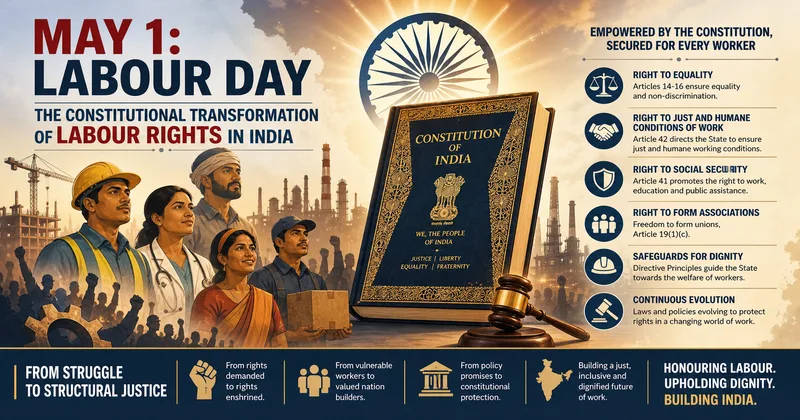
While India and the world celebrate May 1 as International Workers’ Day, it is important to reflect on the true position of labour in our constitutional framework. Workers are not merely contributors to economic growth; they are the foundation upon which nations are built.
However, this recognition was not always embedded in law. Historically, labour was viewed largely as a factor of production. It is through judicial intervention that this perspective underwent a fundamental transformation.
The Supreme Court of India, through a series of landmark judgments, has redefined labour as a subject of dignity, rights, and constitutional protection.
As the Court has repeatedly emphasized: “The right to life includes the right to live with human dignity.”
From Labour as Commodity to Labour as a Constitutional Subject
The turning point in labour jurisprudence can be traced to key decisions that expanded the scope of fundamental rights.
In Bandhua Mukti Morcha v. Union of India, the Court recognized bonded labour as a violation of the right to live with dignity under Article 21. This case placed human dignity at the core of labour law.
As Justice PN Bhagwati observed:
“The Constitution is a living instrument, and its interpretation must respond to the needs of the time.”
Similarly, in People’s Union for Democratic Rights v. Union of India, the Court held that non-payment of minimum wages amounts to forced labour under Article 23.
The judgment underscored that:
“Any form of economic compulsion that forces a person to work for less than minimum wage is forced labour.”
Expanding the Scope of Labour Rights
The judiciary continued to deepen this framework by linking labour rights with broader constitutional guarantees.
In Olga Tellis v. Bombay Municipal Corporation, the Court held:
“The right to livelihood is an integral facet of the right to life.” This transformed employment from an economic issue into a matter of survival and dignity.
Further, in Consumer Education and Research Centre v. Union of India, the Court observed:
“The right to health and medical care is a fundamental right under Article 21.”
This elevated workplace safety to a constitutional mandate.
Dignity and Equality at the Workplace
Labour jurisprudence also evolved to address dignity and equality within the workplace. In Vishaka v. State of Rajasthan, the Court emphasized that:
“Gender equality includes protection from sexual harassment and the right to work with dignity.”
The principle of fairness in wages was reinforced in Randhir Singh v. Union of India, where the Court held:
“Equal pay for equal work is not merely a doctrine but a constitutional goal.”
This was further strengthened in State of Punjab v. Jagjit Singh, extending the principle even to temporary workers.
Defining Labour in a Changing Economy
As the nature of employment evolved, the Court addressed the question of who constitutes a worker.
In Workmen of Nilgiri Cooperative Marketing Society v. State of Tamil Nadu, the Court stressed the importance of real control and supervision in determining employment relationships an issue increasingly relevant in today’s gig economy.
Dr BR Ambedkar had envisioned a Constitution that would not merely provide political democracy, but also social and economic justice.
He warned: “Political democracy cannot last unless there lies at the base of it social democracy.”
Labour rights, therefore, are not isolated provisions, they are central to achieving justice, equality, and dignity, as enshrined in the Preamble.
The journey of labour law in India reflects a profound constitutional evolution. What was once seen as a matter of economic regulation has now become a question of fundamental rights, dignity, and justice.
On this Labour Day, it is worth reaffirming that the strength of a nation lies not merely in its economic output, but in how it treats its workforce.
As the constitutional vision reminds us:
“Justice-social, economic, and political, must reach the last worker.”
Respect labour. Protect rights. Uphold dignity.