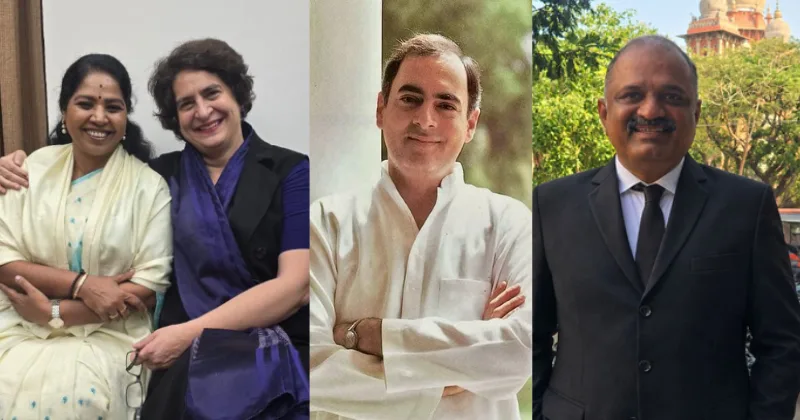
Mayiladuthurai Lok Sabha MP and advocate practising in the Madras High Court, R. Sudha, has questioned the authority of the present Bar Council of Tamil Nadu and Puducherry over the enrolment of A.G. Perarivalan as an advocate.
She stated that the existing office bearers had already ceased to hold office following the election of a new set of office bearers. “While the Bar Council itself is yet to be elected, how can a team which has ceased to be the office bearers conduct an enrolment function on April 27, 2026? What is the tearing hurry? Is it to benefit this one convict and allow him to be enrolled as an advocate?” she asked.
Describing April 27, when Perarivalan was enrolled, as a black day, Sudha said Section 24A, which prevents the enrolment of a convict as an advocate for two years, cannot be blindly relied upon to allow persons like Perarivalan, who was a member of the internationally banned terrorist outfit LTTE and was convicted for the assassination of the former PM Rajiv Gandhi.
‘Not a Blank Cheque’: Supreme Court Verdict Under Scrutiny
Sudha said the Supreme Court had ordered the release of Perarivalan due to an inordinate delay by the Governor in deciding his remission plea under Article 161 of the Constitution.
I strongly condemn the Bar Council of Tamil Nadu and Puducherry for the enrolment of A.G. Perarivalan, who is the convicted assassin of the former Prime Minister of India, Shri. Rajiv Gandhi Ji. I have written to the President of India, Vice-President, @PMOIndia Prime Minister,… pic.twitter.com/9YMElLxW25
— R.Sudha (@AdvtSudha) April 29, 2026
She argued that the verdict should not be treated as a “blank cheque” to act without restraint. “The court’s verdict in the case should not be interpreted as a blank cheque to do whatever one wants to put the honourable legal profession itself to shame. The SC did not foresee a situation where the convict would join a law course and then join the Bar Council’s rolls saying the two-year prohibitory period was over,” she said.
Concerns Over Impact on Legal Profession
Expressing concern, Sudha said Perarivalan’s entry into the legal profession could have wider implications. She warned that granting him access to state and societal resources as a lawyer would be “disastrous” and demoralising for youngsters entering the profession.
“It will be a rude shock to the families of those who were killed along with Rajiv Gandhi,” she added.
Appeal to President Seeks Probe, Suspension of Enrolment
In a nine-page letter addressed to the President of India, Sudha has sought the appointment of a retired judge to examine how Perarivalan’s enrolment application remained pending for over six months before being cleared in a hurried manner on April 27, 2026.
She further requested that, pending such consideration, his enrolment be kept in abeyance and that he not be allowed to practise before any court.
The MP also urged that the matter be referred to a larger bench of the Madras High Court, which is already hearing a related case on the enrolment of individuals with pending cases.
Background: From Convict to Advocate
A.G. Perarivalan was one of the convicts in the 1991 assassination of former Prime Minister Rajiv Gandhi. Arrested at the age of 19, he spent 31 years in prison before being released in 2022.
In 1998, a TADA court sentenced him to death, a verdict upheld by the Supreme Court in 1999. However, in 2014, the Supreme Court commuted his death sentence to life imprisonment, citing an 11-year delay in deciding his mercy petition, in line with its ruling in the Shatrughan Chauhan case.
During his imprisonment, Perarivalan pursued extensive education, completing degrees in Computer Applications and multiple diploma courses, and later studied law at Dr BR Ambedkar Law College in Bengaluru. He passed the All-India Bar Examination in 2025.
Enrolment and Political Reactions
Perarivalan was enrolled as an advocate with the Bar Council of Tamil Nadu and Puducherry in April 2026, in a programme attended by Madras High Court Chief Justice Sushrut Arvind Dharmadhikari.
He is expected to focus on legal aid for prisoners, including issues related to wrongful detention, delays in justice, and undertrial rights.
However, Congress leaders have questioned the development, calling it a reflection on the moral credibility of the legal system. They also raised concerns over the nature of cases he may handle in the future.
The issue has also drawn attention to the Congress party’s electoral alliance with the DMK, which has faced allegations of links in the broader political discourse surrounding the assassination case.
Critics argue that prison is a reformation centre where convicts can pursue their education and, after release, they are expected to be good and law-abiding citizens. But this is the first time that one once convicted in former Prime Minister Rajiv Gandhi’s assassination case—a prominent constitutional position where the attackers would have been given exemplary punishment—is wearing the black robes and the attire of an advocate to represent clients.
There are apprehensions about this, and it raises serious questions about the credibility of Bharat’s legal system. And what kind of cases would he be handling, like his own or appearing for breaking India forces conspiring against Indian leaders and constitutional heads?