ECI: QR-code access to vote counting centres will be new norm
June 24, 2026
  • Read Ecopy
  • Circulation
  • Advertise
  • Careers
  • About Us
  • Contact Us
Android AppiPhone AppArattai
Organiser
  • ‌
  • Bharat
    • Assam
    • Bihar
    • Chhattisgarh
    • Jharkhand
    • Maharashtra
    • View All States
  • World
    • Asia
    • Europe
    • North America
    • South America
    • Africa
    • Australia
  • Editorial
  • International
  • Opinion
  • RSS @ 100
  • More
    • Op Sindoor
    • Analysis
    • Sports
    • Defence
    • Politics
    • Business
    • Economy
    • Culture
    • Special Report
    • Sci & Tech
    • Entertainment
    • G20
    • Azadi Ka Amrit Mahotsav
    • Vocal4Local
    • Web Stories
    • Education
    • Employment
    • Books
    • Interviews
    • Travel
    • Law
    • Health
    • Obituary
  • Subscribe
    • Subscribe Print Edition
    • Subscribe Ecopy
    • Read Ecopy
  • ‌
  • Bharat
    • Assam
    • Bihar
    • Chhattisgarh
    • Jharkhand
    • Maharashtra
    • View All States
  • World
    • Asia
    • Europe
    • North America
    • South America
    • Africa
    • Australia
  • Editorial
  • International
  • Opinion
  • RSS @ 100
  • More
    • Op Sindoor
    • Analysis
    • Sports
    • Defence
    • Politics
    • Business
    • Economy
    • Culture
    • Special Report
    • Sci & Tech
    • Entertainment
    • G20
    • Azadi Ka Amrit Mahotsav
    • Vocal4Local
    • Web Stories
    • Education
    • Employment
    • Books
    • Interviews
    • Travel
    • Law
    • Health
    • Obituary
  • Subscribe
    • Subscribe Print Edition
    • Subscribe Ecopy
    • Read Ecopy
Organiser
  • Home
  • Bharat
  • World
  • Operation Sindoor
  • Editorial
  • Analysis
  • Opinion
  • Culture
  • Defence
  • International Edition
  • RSS @ 100
  • Magazine
  • Read Ecopy
Home Politics

ECI Explainer: QR-code access to vote counting centres will now become template for elections in future

New QR-enabled identity verification and a three-tier security grid aim to eliminate unauthorised access at counting centres during upcoming Assembly elections and beyond. Election Commission is looking far ahead to embed these security systems in SOPs

Kirti PandeyKirti Pandey
Apr 30, 2026, 11:38 pm IST
in Politics, Bharat
Follow on Google News
Representative Image

Representative Image

FacebookTwitterWhatsAppTelegramEmail

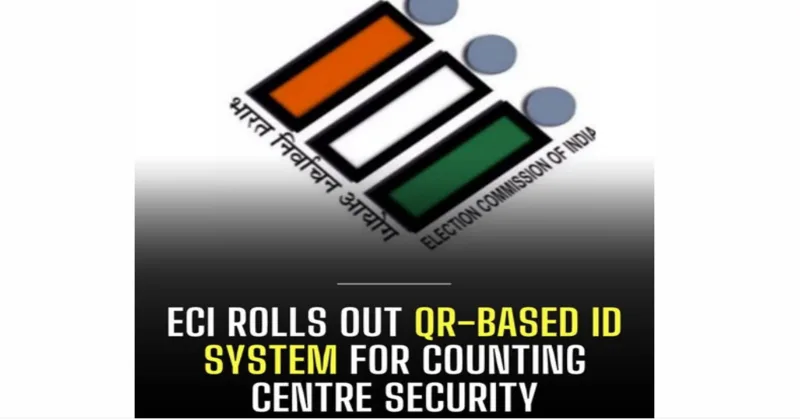
New Delhi: In a significant tightening of election security protocols, the Election Commission of India (ECI) has announced that it will introduce a QR code-based Photo Identity Card system to regulate and monitor entry into counting centres, starting with the vote counting scheduled on May 4, 2026.

The move comes amid heightened focus on safeguarding the integrity of the counting process, which remains one of the most sensitive stages of elections. The new system is designed to eliminate the possibility of unauthorised persons gaining access by stealth, deceit, or accident to counting venues, a concern that has surfaced periodically in past electoral cycles.

ECI Introduces QR-Based ID System to Strengthen Security at Counting Centres

🔹To eliminate the possibility of any unauthorised persons from entering counting centres, the Election Commission of India has introduced a QR code–based Photo Identity Card module on ECINET…

— PIB India (@PIB_India) April 30, 2026

Where It Will Be Implemented First

The QR-based access system (https://www.pib.gov.in/PressReleasePage.aspx?PRID=2256955&reg=3&lang=2) will be deployed during counting for the Assembly elections in Assam, Kerala, Tamil Nadu, West Bengal and Puducherry that will take place on May 4, along with by-elections in seven Assembly constituencies spread across five states.

Read More: VHP urges Himachal Govt to free temples, act on religious conversions and cow smuggling

The Election Commission has made it clear that this is not a one-off measure. The system will be institutionalised and extended to all future elections, including the Lok Sabha and state Assembly polls, indicating a structural shift in how access control is managed at counting centres nationwide.

How the QR-Based System Will Work

At the core of the new mechanism is a digital authentication layer built into Photo Identity Cards generated through the ECINET platform. Each authorised individual will carry a QR-coded ID, which can be scanned to verify authenticity in real time.

The verification process is part of a three-tier security framework

At the outer and intermediate layers, identity cards issued by the Returning Officer will continue to be checked manually, ensuring continuity with existing procedures.

At the innermost security cordon, near the counting hall itself, access will be strictly contingent on successful QR code scanning. Without digital verification, entry will not be permitted.

This layered approach combines manual scrutiny with digital authentication, reducing the chances of impersonation, duplication, or misuse of entry credentials.

Who Will Need the QR-Based IDs

The system will cover all categories of individuals authorised to enter counting centres. This includes Returning Officers, Assistant Returning Officers, counting staff, technical personnel, candidates, election agents and counting agents.

By bringing all stakeholders under a single, standardised verification framework, the ECI is aiming to plug gaps that can arise from fragmented or paper-based access systems.

Media Access and On-Ground Arrangements

While the QR system will apply broadly, media personnel will continue to be allowed entry based on authority letters issued by the Commission, in line with existing norms. It also explains why the EC has chosen to space the last polling and final counting date at least 4 days apart.

To streamline coverage and avoid crowding near sensitive zones, dedicated media centres will be set up near counting halls at each counting centre. This is expected to create a buffer between operational areas and media activity, while still ensuring access to information.

Implementation on the Ground

The Commission has directed Chief Electoral Officers, District Election Officers, and Returning Officers to ensure strict and uniform implementation of the new system.

This includes deploying trained personnel at designated checkpoints, ensuring QR scanners are operational, and maintaining seamless coordination between different layers of security.

Officials have also been instructed to treat compliance as critical to upholding the “highest standards of transparency, security and efficiency” in the counting process.

Part of a Larger Push for Electoral Security

The QR-based ID system is not an isolated reform. The ECI noted that it forms part of a broader series of over 30 initiatives undertaken in the past year to modernise and secure various aspects of election management.

These measures have increasingly leaned on technology to enhance traceability, accountability and real-time verification, particularly in high-stakes phases such as polling and counting.

Why This Matters

Counting centres are high-pressure environments where candidates, agents, officials and media converge, often in large numbers. Any lapse in access control can lead to confusion, disputes or allegations that undermine public trust.

By introducing a digitally verifiable identity system backed by layered security checks, the ECI is attempting to minimise human error, prevent unauthorised entry, and create an auditable access trail.

As elections grow more complex and closely contested, such measures are likely to become standard practice rather than exceptions.

Counting Day Statistics That You Need To Know

On May 4, the counting exercise will span a vast electoral canvas across five poll-bound states and multiple bypoll segments, covering hundreds of Assembly constituencies and crores of votes cast over multi-phase polling.

In West Bengal alone, all 294 Assembly seats are going to the count, with a fiercely contested field involving over 2,000 candidates and an electorate exceeding 7 crore voters, making it the largest and most politically charged battleground of the day.

Tamil Nadu (234 seats) and Kerala (140 seats) together add another 374 constituencies, with turnout traditionally high and contests often bipolar but intense.

Assam (126 seats) brings in a mix of triangular and regional fights across its districts.

Puducherry’s 30 seats, though smaller in scale, are closely watched due to tight margins and coalition stakes.

Approximately 824 Assembly seats across these five states/UT and by-elections (8 across states like Goa, Gujarat, Karnataka, Maharashtra, Nagaland, and Tripura) with polling aligned to the main phases will be counted on May 4

Taken together, the counting day will involve verification and tabulation of votes running into tens of millions, processed through thousands of EVMs and VVPAT slips under tight supervision, with each constituency typically seeing multiple candidates, often ranging from 5 to over 20, depending on the region.

It is a massive logistical exercise that demands accuracy putting the onus on ECI to focus on secure counting. This is a major electoral event covering a significant portion of India’s electorate. The sheer scale underscores why the ECI has moved to stricter, tech-enabled access control at counting centres this year.


 

Topics: State Assembly elections 2026Election Commission of IndiaECIQR code
ShareTweetSendShareSend
✮ Subscribe Organiser YouTube Channel. ✮
✮ Join Organiser's WhatsApp channel for Nationalist views beyond the news. ✮
Previous News

VHP urges Himachal Govt to free temples, act on religious conversions and cow smuggling

Next News

Manipur: NIA arrests second Kuki militant accused in October 2023 SDPO killing in Moreh

Related News

A large crowd of Bangladeshis residing in West Bengal gathers at the Hakimpur border crossing in the Basirhat subdivision of North 24 Parganas district to cross over to Bangladesh

Unnatural Demographic Change: Securing Bharat against the silent invasion

SIR and Article 324: Supreme Court strengthens the constitutional spine of Indian Democracy; Reaffirms ECI’s authority

Andhra Pradesh State Chief Electoral Officer (CEO) Vivek Yadav, I.A.S., Additional Chief Electoral Officer Venkateswara Rao, and Assistant CEO Srinivasa Rao held a special meeting with representatives of various major political parties on May 26.

EC meets political parties as Andhra Pradesh process SIR 2026 for 4.16 crore electors

BJP leader Nitin Nabin

BJP’s New Political Phase: Nitin Nabin spearheads organisational expansion, electoral success

Tamil Nadu: Madras HC issues notice to ECI, Joseph, Stalin, EPS over plea alleging use of children in TVK campaign

Chennai, Apr 23 (ANI): Voters queue up as they wait to cast their votes during the first phase of the Tamil Nadu Assembly election, in Chennai (ANI Photo)

Tamil Nadu 2026 Election Row: ECI begins probe into ‘Illegal Voting’ by foreign passport holders

Load More

Latest News

Karan Singh Kept in Dark: Sheikh Abdullah Never Informed J&K’s Sadr-e-Riyasat of Syama Prasad Mookerjee’s Death (This image is generated by AI)

Syama Prasad Mookerjee Death Mystery: Karan Singh says Sheikh Abdullah never informed him

On the occasion of Dr Syama Prasad Mookerjee’s State-Level Balidan Diwas , Chief Minister Shri Mohan Charan Majhi and others at an event organized at Jayadev Bhawan on June 23, 2026

“Article 370 abrogation fulfilled Dr Syama Prasad Mookerjee’s dream,” says Odisha CM Majhi at Balidan Divas programme

Prakash Raj in Fresh Controversy as Court Issues NBW in Voter Registration Case (This image is generated by AI)

Karnataka: Prakash Raj faces legal scrutiny over alleged multiple voter IDs; Bengaluru Court issues NBW

The fall of Keir Starmer highlights a broader crisis in British governance, where leadership changes have failed to reverse long-term national decline

From Brexit to Starmer: Why Britain’s crisis lies beyond changing leaders in Westminster

Tribute to Rani Durgawati on her Martyrdom Day

Rani Durgavati Martyrdom Day: Immortal Warrior rani, defender of Tribal Pride, national honour & Sanatan values

President Droupadi Murmu confers the Padma Shri on former civil servant R.V.S. Mani on June 23, 2026.

Former MHA official RVS Mani honoured with Padma Shri for contributions to internal security

Tamil Nadu: Temple funds only for temple property; TVK govt concedes before Madras High Court

Keralam’s former Industries Secretary, Mohammed Haneesh IAS (Right Side)

Keralam Cashew Scam: Former Industries Secretary Md Haneesh apologises before High Court after contempt proceedings

Tamil Nadu: Assembly Speaker directs all bureaucrats to strictly follow warrant of precedence after Mayor-MLA row

Kamakhya Mandir

Kamakhya Mandir’s Ambubachi Mela: The ancient tradition that honours the menstruation of mother Earth

Load More
  • Privacy
  • Terms
  • Cookie Policy
  • Refund and Cancellation
  • Delivery and Shipping

© Bharat Prakashan (Delhi) Limited.
Tech-enabled by Ananthapuri Technologies

  • Home
  • Search Organiser
  • Bharat
    • Assam
    • Bihar
    • Chhattisgarh
    • Jharkhand
    • Maharashtra
    • View All States
  • World
    • Asia
    • Africa
    • North America
    • South America
    • Europe
    • Australia
  • Editorial
  • Operation Sindoor
  • Opinion
  • Analysis
  • Defence
  • Culture
  • Sports
  • Business
  • RSS @ 100
  • Entertainment
  • More ..
    • Sci & Tech
    • Vocal4Local
    • Special Report
    • Education
    • Employment
    • Books
    • Interviews
    • Travel
    • Health
    • Politics
    • Law
    • Economy
    • Obituary
  • Subscribe Magazine
  • Read Ecopy
  • Advertise
  • Circulation
  • Careers
  • About Us
  • Contact Us
  • Policies & Terms
    • Privacy Policy
    • Cookie Policy
    • Refund and Cancellation
    • Terms of Use

© Bharat Prakashan (Delhi) Limited.
Tech-enabled by Ananthapuri Technologies