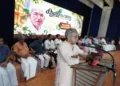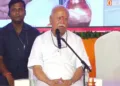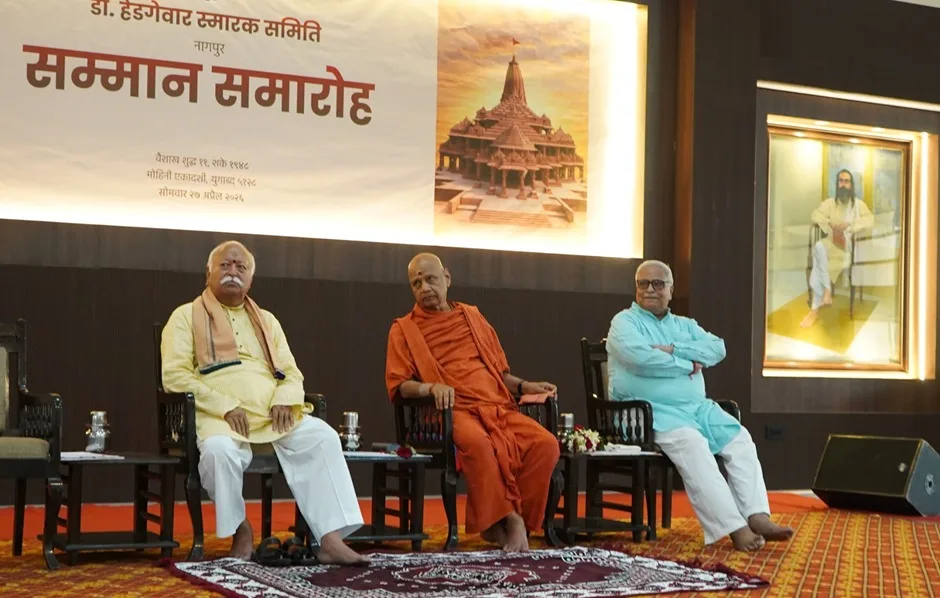
NAGPUR: Process of transformation in Bharat began after the coronation of Chhatrapati Shivaji Maharaj. With time, the Mughal Empire declined and the arrival of the British began. A prolonged phase of conflict gradually came to an end, though the journey towards independence continued for a long period. This process of transformation, initiated during Shivaji Maharaj’s coronation, continued steadily, with Bharat progressing step by step, said Rashtriya Swayamsevak Sangh Sarsanghchalak Akhil Bharatiya Karyakarni Sadasya Bhaiyyaji Joshi at a programme organised to honour those distinguished personalities under whose guidance the grand temple at the birthplace of Shri Ram in Ayodhya was constructed.
He noted that the symbols left behind by various invaders have been sources of pain, and efforts to remove such marks began in due course. In this context, the construction of the temple at the birthplace of Shri Ram Mandir in Ayodhya represents the beginning of removing one such symbol of historical humiliation. He emphasised that this was not a short struggle but a prolonged one spanning nearly 400 years, involving the sacrifice of over one lakh people, followed by a legal process that ultimately led to the construction of the temple.
He further said that while Bharat has numerous temples dedicated to Bhagwan Ram, the significance of Ayodhya lies in removing a historical blemish. Without erasing such symbols of humiliation, the spirit of the nation cannot be fully strengthened. Therefore, the temple stands as a symbol of the restoration of dignity and honour of Hindu society, and its importance extends beyond Ayodhya or Uttar Pradesh to the entire nation.
Referring to the ideals of Bhagwan Ram, he noted that the concept of Ram Rajya continues to guide discussions on ideal governance even today. The Ayodhya temple, he said, is not merely an architectural structure but a symbolic representation of national consciousness and values, contributing to the broader process of nation-building.
He added that the grand temple has been constructed through continuous effort over the past five years. Recognising the immense contribution of those involved, selected individuals were invited to Nagpur for symbolic felicitation, though the actual number of contributors was far greater.
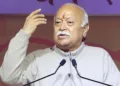
Addressing the gathering RSS Sarsanghchalak Dr Mohan Bhagwat said, Shri Ram Temple in Ayodhya has been built more magnificent than imagination, and we too must perform our work in the same spirit, better, grander, and more beautiful than imagined, so that Dharma may be established in the world.
He asserted that Bharat’s upliftment will be carried out by its own people; no other country will uplift Bharat. Rather, Bharat will rise and uplift the entire world. This, he said, is ordained, and we must contribute towards its fulfilment.
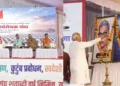
The programme, held at Maharshi Vyas Sabhagruh in Reshimbagh, was attended by Govinddev Giri Maharaj, Bhayyaji Joshi (President, Dr Hedgewar Smarak Samiti), and Shridhar Gadge (Vice President, Dr Hedgewar Smarak Samiti), among others.
Dr Bhagwat said that the temple was constructed by the will of Bhagwan Shri Ram. Just as Govardhan could not be lifted until everyone contributed their sticks, similarly, the Mandir too was built through the collective contribution of every individual of Bharat. Now, he said, Bharat must rise as a nation that will impart Dharma to the world. He remarked that earlier people would mock the idea that Hindustan is a Hindu Rashtra, but today even those who laughed are acknowledging it. There is no need for formal declaration, he added—just as the sun rises in the east without proclamation, Bharat being a Hindu Rashtra is a reality.
He noted that opposition generates zeal, while neglect creates determination to prove oneself. However, favourable conditions can sometimes lead to complacency. While favourable circumstances are beneficial for the nation and society, one must not become complacent. Ram Rajya, he said, is not established by the ruler alone but also by the conduct of the people. The felicitation programme was an expression of gratitude to all those who contributed to the construction of the temple. They have done their work; now we must do ours.
Dr Bhagwat further said that the rise of Bharat is inevitable for the resurgence of Sanatan Dharma, a vision articulated 150 years ago by Sri Aurobindo. He added that as each individual contributes, divine strength will continue to flow towards fulfilling this resolve. He traced the process of resurgence back to 1857, stating that it has been ongoing since then. He also referred to a 2014 article in The Guardian, which noted that Indians had finally said goodbye to British influence, though politically independence had been achieved in 1947.
He questioned what truly constitutes Bharat and what kind of resurgence is needed, noting that such doubts persisted for a long time. He emphasised that without a large-scale movement, the Ram Mandir would not have been built, and without the right leadership and contributors, its foundation could not have been laid. The temple stands today because of the collective effort of countless individuals, supported by divine grace.
Reflecting on the Sangh’s 100-year journey, he said that it began without resources, publicity, power, or infrastructure. Yet, Dr Keshav Baliram Hedgewar inspired swayamsevaks with unwavering faith that Hindustan is a Hindu Rashtra. Despite ridicule, swayamsevaks continued their work with dedication and belief, moving forward steadily without losing direction.
He concluded by stating that just as the qualities of Bhagwan Shri Ram and the nature of Ram Rajya’s citizens are described in the Ramayana, the task now is to build “Ayodhya” within every heart and establish a national temple through individual conduct. Each person and family must embody those ideals and spread them in society through example. If this is done, he said, Bharat will certainly rise to guide the world in Dharma—it is only a matter of how soon, which depends on collective effort.
Champat Rai, General Secretary of Shri Ram Janmabhoomi Teerth Kshetra, stated that while there was faith and conviction, the scale of the final structure exceeded initial imagination. The objective was to build a temple with a lifespan of at least 1,000 years. Drawing inspiration from ancient temples such as those in Rameswaram, Madurai, Thanjavur, and Konark, it was decided that no iron would be used in construction.
He explained that not even a gram of iron has been used in the temple, either above or below the ground. Experts advised that cement does not last beyond 150 years, leading to minimal use of cement, especially underground. Instead, stones have been joined using copper, which has a lifespan comparable to stone.
He noted that such techniques are not commonly documented or taught, making the construction both a research-driven and execution-intensive effort. The project was undertaken by Larsen & Toubro, with the support of around 250 vendors and approximately 6,000 artisans working across different locations in Ayodhya.
Highlighting the collective nature of the effort, he said the temple was built through voluntary contributions from society. Within 42 days, nearly 10 crore people contributed funds, with around one lakh volunteers reaching out door-to-door. Approximately Rs 3,000 crore was collected through contributions routed via around 25,000 branches of banks such as State Bank of India, Bank of Baroda, and Punjab National Bank, reflecting a remarkable example of societal participation in nation-building.
Govinddev Giri Maharaj said that the Ram Mandir is a symbol of Bharat’s pride and the honour of every citizen, and all should consider themselves fortunate to have witnessed its completion in their lifetime.
He further stated that while the Dr Hedgewar Smarak Samiti may have termed this as a felicitation, it is accepted as a prasād of Param Pujya Doctorji. The inspiration of Dr. Keshav Baliram Hedgewar has been guiding this work for a century, enabling society to reach a stage that once seemed extremely difficult, especially in an environment where even the existence of Bhagwan Shri Ram was questioned in courts.
Quoting the spirit of “Tera Vaibhav Amar Rahe Maa, Hum Din Chaar Rahein Na Rahein,” he said that countless individuals have worked with dedication for a century. The temple is not merely the result of recent construction efforts but the culmination of a century-long yajna, whose purnahuti this temple represents. He also paid respects to Mahant Nritya Gopal Das, describing him as a representative of the entire saint community.
He further emphasised that while the resolve of “Mandir Wahin Banayenge” has been fulfilled, the task of establishing Ram Rajya still remains. The Ram Mandir is not a full stop but a comma, much work lies ahead. The trust governing the temple has also envisioned future efforts towards the establishment of Ram Rajya. Those honoured, he said, must recognise that this is an interim milestone, not the final destination.
Describing Bhagwan Shri Ram as the supreme ideal of national life, he said that from Setu to Himalaya, the one word that binds Bharat is “Ram.” He highlighted that even Lord Ram underwent hardships, including exile, which tested and defined His virtues.
He added that the Sangh functions as an open university of patriotism, instilling the spirit of national service among swayamsevaks. While significant progress has been made, much remains to be done. What has been achieved is commendable, but what has been lost must not be forgotten. Continuous effort, he stressed, remains essential.
On this occasion, several distinguished personalities associated with the Ram Mandir construction and related efforts were honoured, including Nripendra Mishra, Ashish Sompura, Nikhil Sompura, Arun Yogiraj, Champat Rai, Govinddev Giri Maharaj, Vasudev Kamat, and others, representing the collective effort behind the historic endeavour.