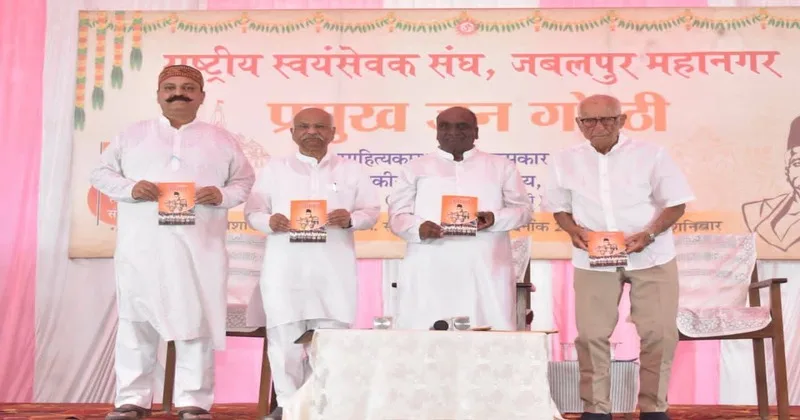
Sangh was founded with a clear purpose, and celebrating its centenary is not its ultimate goal, said Akhil Bharatiya Karyakarini member Suresh Soni while addressing a pramukh jan gosthi of of litterateurs and historians, along with the release of the first volume of the book Sanghika, was organised under the aegis of Rashtriya Swayamsevak Sangh, Jabalpur Mahanagar.
He emphasised that Bharat’s ancient philosophy and culture are inherently welfare-oriented for the entire world, but over time this tradition became fragmented. Re-establishing this holistic vision, he said, remains the core objective of the Sangh, and this journey will continue until the goal is achieved.
Suresh Soni further stated that the work of the Sangh will continue until society and the Sangh become one. Referring to Swami Vivekananda, he noted that before the Chicago address, Vivekananda travelled across Bharat to understand society and concluded that character building, social unity, and awakening of national consciousness were essential. These ideas were translated into practice by Dr Keshav Baliram Hedgewar.
He also referred to various streams of the freedom movement—revolutionary, non-violent, and military, stating that political struggle alone was not sufficient; social reform was equally necessary. Dr Hedgewar, he said, understood all these dimensions and advanced organisational work accordingly.
Addressing contemporary challenges, Suresh Soni pointed out that excessive individualism is a key weakness of society today, whereas Sanatan culture is rooted in the idea of universal welfare. He noted that Sangh shakhas function as practical centres to inculcate these values, with more than 80,000 locations across the country hosting regular activities. Several organisations inspired by the Sangh’s thought, such as Bharatiya Mazdoor Sangh, Akhil Bharatiya Vidyarthi Parishad and Seva Bharati, are actively contributing to social development.
He observed that sustained efforts have led to growing social awakening and cultural unity, reflected in achievements like the Ram Temple. While the ultimate goal is yet to be fully realised, a conducive environment has been created.
Describing Hindutva as a solution to global crises, Suresh Soni cited the Vedic dictum “Ekam Sat Vipra Bahudha Vadanti” to underline unity in diversity. He highlighted that from saints like Narsi Mehta, Tyagaraja, Kabir, Surdas to Shankaradeva, the essence remained the same despite differences in language.
He emphasised that without Dharma, human life loses its essence, and stressed the need for value-based societal transformation. Calling for a return to Indian ethos, he advocated strengthening family systems, promoting social harmony, adopting Swadeshi lifestyle, and nurturing the spirit of “Vasudhaiva Kutumbakam.”
He also urged individuals to contribute to environmental protection by planting trees, respecting rivers and natural resources, and maintaining cleanliness, along with fulfilling civic duties with dedication to national interest.
The programme concluded with an interactive session where Suresh Soni addressed queries raised by scholars and participants.
The first volume of Sanghika, authored by Dr Anand Singh Rana is based on the history of the Sangh in Mahakaushal region. The book was reviewed by Deepak Dwivedi, while the introductory remarks were delivered by Prof. Alkesh Chaturvedi.
Highlighting the role of intellectuals, chief guest Sharadchand Palan underlined the importance of litterateurs and historians in nation-building. A musical presentation was also rendered by Nupur Deshkar.