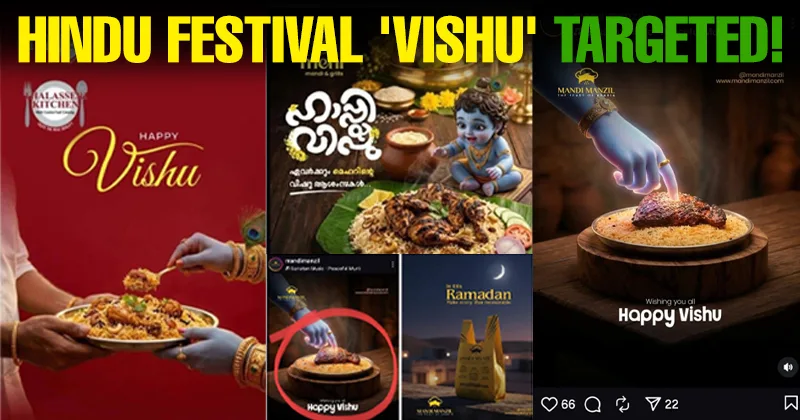
On Kerala’s most sacred Hindu new year, a wave of near-identical advertisements flooded social media — all bearing the image of Bhagwan Krishna, all promoting Arabic Non-Vegetarian restaurants, all arriving at the same moment. The pattern demands answers.
The Conspiracy Plot
Vishu Day: April 14, 2026
At the precise hour when millions of Hindu families across Kerala woke up to auspicious Vishukkani Darsan, the auspicious arrangement of gold, flowers, fruit, and the sacred image of Bhagwan Vishnu; something else was being arranged with equal deliberateness.
Across Instagram and Facebook, a coordinated wave of promotional advertisements erupted from Arabic restaurants scattered across the state. Each one carried the luminous, innocent face of baby Krishna. Each one used that divine image to sell non-vegetarian Arabic cuisine. And each one wished Hindus a “Happy Vishu.” Taken individually, any one of these posts might be dismissed as a marketing team’s cultural miscalculation. Taken together, same day, same deity, same visual grammar, same commercial hook — they present a pattern that many in Kerala’s Hindu community are refusing to dismiss as coincidence. This is not a story about hurt sentiments alone. This is a story about method, timing, and the slow, deliberate testing of a community’s tolerance in a state with a long and well-documented history of organised cultural aggression. “When the same ‘mistake’ is made by a dozen different hands, at the same moment, using the same divine image — it is no longer a mistake. It is a message.”
The Anatomy of the Conspiracy Campaign
The advertisements that surfaced on Vishu 2026 share a striking uniformity of design intention. Restaurants from Kannur in the north to Cherthala in the south, from Perinthalmanna in Malabar to Kottakkal in the interior, and even establishments operating in the Gulf, all deployed strikingly similar creative concepts within the same 24-hour window.
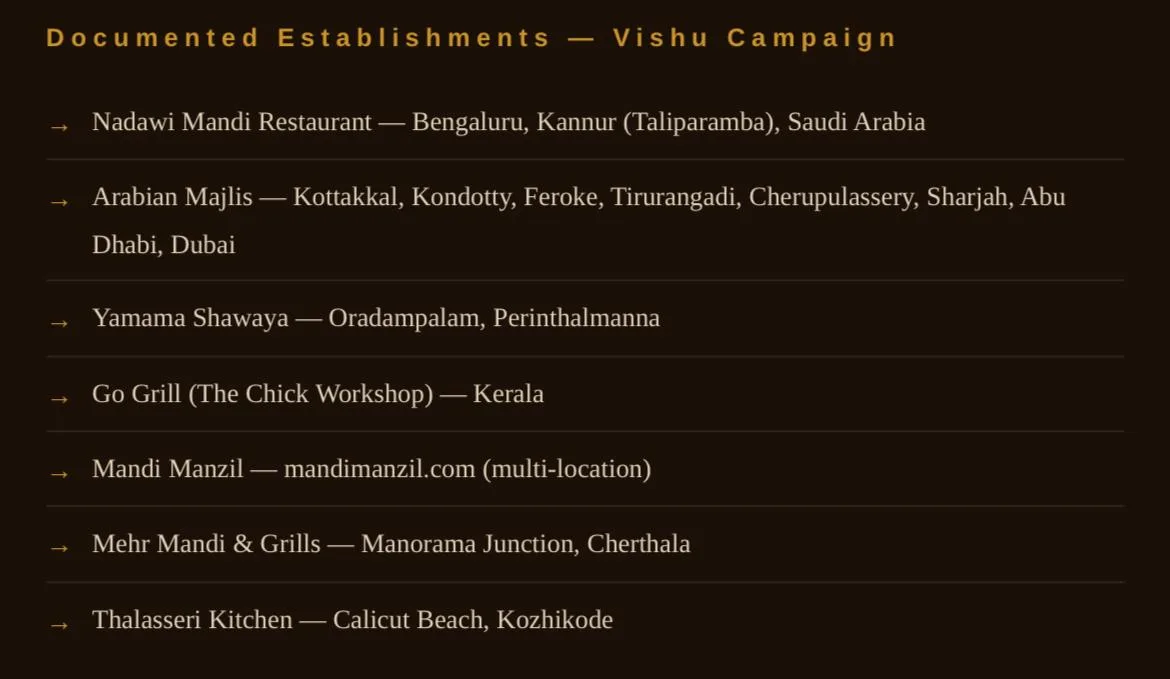 The geographic spread is notable; it is not a regional phenomenon confined to one district or one community cluster. It spans Kerala’s entire demographic map and even extends into the Gulf diaspora belt. The posts appeared not across weeks, but within hours of each other on a single, symbolically loaded day. The visual language is equally uniform: a cute, animated Baby Krishna — one of Hinduism’s most universally beloved divine representations — is placed at the centre of promotional imagery for non-vegetarian Arabic cuisines. The deity is rendered playful, childlike, and approachable. And in that very approachability lies the calculated nature of the provocation, it is designed to be difficult to directly object to without appearing extremist.
The Mechanics of Coordinated Provocations Against Hindu Beliefs
Intelligence analysts and social media researchers who study organised influence operations have long identified a specific playbook: acts that carry clear symbolic aggression are packaged with just enough plausible deniability to survive the first cycle of outrage. The perpetrators bank on the moderate majority urging restraint, while the intended psychological impact, the demonstration of impunity, lands precisely as designed.
ANALYSIS: The simultaneity of these posts across geographically dispersed, independently branded restaurants points unmistakably toward a common source — whether a shared creative agency, a WhatsApp campaign coordination group, or a deliberate network signal. In digital marketing, organic trends do not produce this level of thematic uniformity across competitors on a single calendar day without coordination.
The choice of Bhagwan Krishna is not random. Unlike deities associated primarily with upper-caste or Brahminical Kerala, Krishna is the people’s god — beloved across every caste, class, and region of Kerala’s Hindu population. His image in Vishu imagery is universal. Targeting him maximises the intended cultural impact while simultaneously making the advertisers appear “inclusive” and “festive” to the uninitiated observer.
Kerala’s history of Religious Extremism is not to be forgotten
Those who urge Keralites not to “read too much into this” conveniently forget that Kerala is not an ordinary state with an ordinary recent history. It is a state where organised radical networks have operated, evolved, been banned, rebranded, and continued — often with political shelter from ideologically aligned state administrations.
● 1990s–2000s
Abdul Nasser Madani and the People’s Democratic Party operated as a significant radical political force in Kerala. Madani is later convicted in connection with the 1998 Coimbatore blasts.
● 2010s
The Popular Front of India establishes deep roots in Kerala, functioning as a mass organisation with documented links to political violence across the state, particularly targeting RSS and BJP workers.
● 2022
The Government of India bans the Popular Front of India under UAPA following nationwide raids revealing arms training camps, financial irregularities, and seditious material.
● Post-2022
PFI cadre and leadership reportedly reconstituted under multiple successor fronts. Intelligence agencies warn that the organisational network remains largely intact beneath new names.
● Vishu 2026
Coordinated use of bhagwan Krishna’s sacred image in non-vegetarian commercial advertising across the state — on the most auspicious day of the Hindu calendar in Kerala.
This context does not establish criminal guilt for any specific restaurant owner. Many may be unwitting participants — handed a template by a creative agency or a WhatsApp forward from a community group. But that is precisely how soft cultural operations work. The footsoldiers need not know the architect.
A Test Dose?
Several senior Hindu cultural organisation leaders, speaking on condition of anonymity, used the same phrase independently when asked about the Vishu campaign: “test dose.” In the lexicon of organised cultural aggression, a test dose is a calibrated provocation designed not necessarily to cause maximum immediate damage, but to measure the resistance — or its absence — in the targeted community. “They are not testing whether Hindus will be hurt. They already know the answer to that. They are testing whether Hindus in Kerala will respond in any organised, sustained, consequential way — or whether the outrage will dissolve in 48 hours.” — Senior Cultural Organisation Leader, identity withheld. The question that follows is grimmer. If the answer is that Hindu Kerala absorbs the insult and moves on — as it has with disturbing regularity over the past three decades — what comes next? What does the escalation look like? Exodus?
The Kashmir Parallel
A warning bell for Kerala, invoking Kashmir in any context involving Hindu cultural displacement risks being dismissed as alarmism. But Kashmir is not a myth. It is a documented, living catastrophe that unfolded not through sudden military conquest, but through decades of demographic pressure, political complicity, cultural erasure, targeted violence, and — critically — the silence of the nation until it was too late for the Pandits who remained. Kerala is not Kashmir. Its demographics, its administrative structure, and its Hindu population’s size and economic strength are fundamentally different. But the warning embedded in the Kashmir story is not about geography — it is about the consequences of a community repeatedly choosing comfort over confrontation, choosing not to make a scene, choosing to believe that organised provocations are isolated incidents. Every cultural boundary that is crossed without consequence becomes the new floor. The next provocation begins where the last one ended.
What must happen now?
The response to the Vishu 2026 campaign cannot end with social media outrage that dissipates by the weekend. Several actions are both justified and necessary.
FIRST: A systematic documentation of every establishment that ran these advertisements must be compiled, with dates, account handles, and screenshots preserved. This is evidentiary material, not merely content for sharing.
SECOND: Hindu organisations — VHP, RSS, Dharma Sansad bodies, and the broader Sangh Parivar presence in Kerala — must jointly demand a formal explanation from the establishments involved and from the creative agencies that designed the campaigns. Commercial law, if not religious sentiment law, is clear: a deity’s image used for commercial purposes without community consent is exploitative. t
THIRD: Political representatives — particularly the NDA’s growing legislative presence in Kerala — must raise this in the Assembly and demand that the state government identify whether any coordination mechanism existed behind this campaign.
FOURTH: The Hindu consumer must make a deliberate choice about where to spend money. Economic consequence is the language that organised commercial networks understand with perfect clarity. “Kerala’s Hindus have numbers, economic weight, and democratic voice. The only question is whether they will use them — or continue to perform outrage online while changing nothing on the ground.” — Kerala Intelligence Review Editorial Analysis
Conclusion: The Silence God’s Own Country Cannot Afford
Vishu is not merely a festival. It is the Malayali Hindu’s declaration that a new year begins with the sight of the divine, the first vision of the morning belongs to God, to gold, to the harvest, to the sacred. It is an act of civilisational affirmation, of cultural memory, of continuity with a tradition that predates every empire that has tried to supplant it. That’s called Vishukkani. To have that sacred morning invaded by a coordinated campaign that deploys the most beloved face of that tradition for commercial exploitation is not merely insensitive. When the pattern, the timing, and the geography are examined together, it is a statement. It says: we can use your gods for our profit, on your holiest day, across your entire state, and there is nothing you will do about it. Kerala must prove that statement wrong. Not with violence. But with organisation, with memory, with consequence, and with the quiet, steady resolve of a civilisation that refuses to sleepwalk into irrelevance on its own soil. The Vishu lamp was lit this year, as it has been lit for a thousand years. The question is whether the light it casts will illuminate what is being built in the shadows around it.