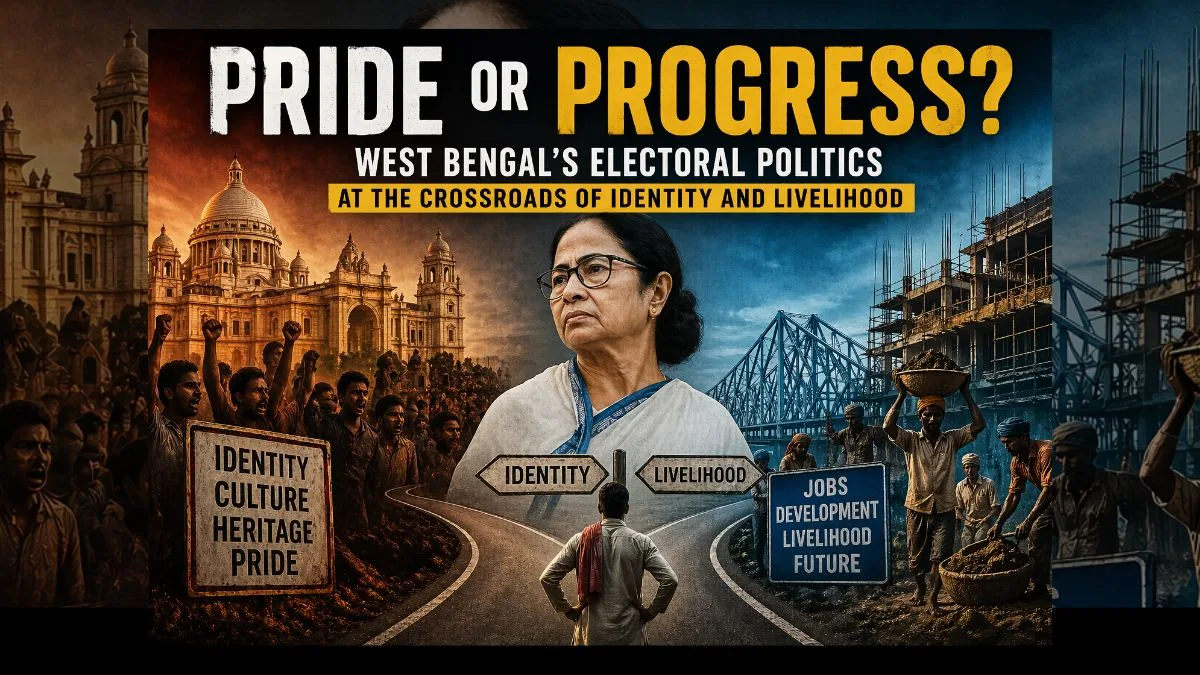
As West Bengal sees another Assembly election, the familiar grammar of its politics has returned. The ruling All India Trinamool Congress (AITC) sharpens its pitch around federal rights, social justice and resistance to central overreach. The Communist Party of India (Marxist) (CPI-M) attempts to rebuild its organizational base after electoral decimation. The Bharatiya Janata Party (BJP) looks once again to expand its footprint in a state where it has historically struggled to secure durable power. Smaller parties echo themes of identity, language and regional pride, seeking relevance in an intensely polarized environment.
Yet, outside the rallies, outside the slogans, outside the rhetorical battles over “Bengali asmita” and Centre–State tensions, a different West Bengal speaks. In tea stalls, workshops, panchayat offices, agricultural fields and middle-class drawing rooms, the vocabulary is not identity—it is unemployment. It is corruption. It is stalled Dearness Allowance (DA). It is rising costs. It is uncertain incomes. It is anxiety. The dissonance between political messaging and lived reality has rarely been sharper.
Identity as Political Currency
West Bengal’s politics has always carried strong ideological undertones. From the nationalist ferment of the late nineteenth century to the three-decade-long Left rule, and now to the populist-welfarist consolidation under the All India Trinamool Congress, political narratives here have rarely been technocratic. They have been moral, emotional, and civilisational.
The current moment is no exception. Language politics, federal rights, resistance to alleged central encroachment, and the defence of Bengali identity have become central planks of the electoral discourse. Recent tensions surrounding the Election Commission’s voter roll exercise—branded by the AITC as “constitutional overreach” and described by opposition parties as potentially resembling a backdoor NRC—have further intensified identity-based mobilization.
Identity, in this narrative, is not just cultural—it is existential. But identity politics carries a paradox. It can unify. It can protect. It can energize. Yet it can also distract. When identity becomes the principal currency of electoral competition, governance risks becoming secondary.
The Supreme Court’s Subtle Intervention
In this context, a recent observation by the Supreme Court of India has added an important dimension to the debate. The Court noted that governments cannot indefinitely rely on freebies while neglecting the creation of sustainable employment. Though not directed at any particular state, the comment resonated strongly in West Bengal, where welfare schemes have become central to the political economy of the last fifteen years.
The state government argues that welfare ensures social justice, gender empowerment and poverty alleviation. Schemes providing direct benefits to women, students, and marginalized communities have undoubtedly had redistributive effects. Politically, they have been effective. But redistribution without production is fragile.
When welfare substitutes for employment rather than supplements it, fiscal stress deepens, aspirations stagnate, and economic dynamism weakens. The Court’s intervention, even if oblique, asks a deeper question: Is the model sustainable?
The Employment Question
At the heart of Bengal’s unease lies the crisis of employment. Unemployment in West Bengal is not merely a statistical issue; it is a sociological one. Educated youth face limited formal sector opportunities. Government recruitment processes have been clouded by allegations of irregularities and “cash-for-jobs” scams, eroding public trust. For many families, a government job was once the gold standard of social mobility. Today, that aspiration is entangled in litigation and suspicion.
Trade unions warn of increasing informalization of labour. Contractualisation, outsourcing in municipal corporations, and private participation in traditionally public functions have generated protests. ASHA workers have repeatedly raised concerns over inadequate remuneration. Government employees continue to agitate over denial or delay in Dearness Allowance, a politically sensitive issue that cuts across party lines.
The government counters by highlighting efficiency gains and by pointing to industrial peace—boasting of zero man-days lost due to strikes and lock-outs. Yet, the absence of strikes does not automatically signal the presence of satisfaction. It may equally reflect the absence of organized power in an increasingly informal workforce.
The fundamental question remains: Where are the jobs?
Identity cannot substitute employment. Pride cannot replace income. Emotional mobilization cannot compensate for economic stagnation.
Education: Expansion without Excellence?
Education has long been Bengal’s civilisational pride. From the Bengal Renaissance to the intellectual leadership of the twentieth century, the state’s reputation was built on academic excellence.
Today, the landscape is mixed.
There has been a mushrooming of higher education institutions. Universities and colleges have expanded numerically. Enrolment has increased. But quantity does not guarantee quality. Concerns over faculty shortages, politicization of campuses, delayed examinations, and declining research standards have surfaced repeatedly.
More worrying is the employability gap. Degrees are proliferating; opportunities are not.
The disconnect between education and employment creates a pipeline of frustration. A young graduate who cannot find dignified work does not find solace in identity politics. He or she asks a simpler question: What next?
Health: Why Are Patients Leaving?
Perhaps the most visible indicator of public dissatisfaction is the growing number of Bengalis seeking medical treatment outside the state—in cities like Hyderabad and Chennai.
This migration is paradoxical. West Bengal, particularly Kolkata, has some of the finest medical professionals in the country. The legacy of its medical institutions is formidable. Yet patients increasingly prefer private healthcare hubs elsewhere. Why?
The answers range from infrastructure gaps in public hospitals, long waiting periods, trust deficits, and perceptions—rightly or wrongly—of better facilities outside the state. The result is both economic and symbolic loss. When patients leave, money leaves. Confidence leaves. Reputation leaves.
Healthcare is not merely a service—it is a signal of governance capacity. If citizens vote with their feet in matters of life and death, the political class must pause.
Income Security and Rising Costs
Beyond jobs and services lies the everyday arithmetic of survival. Inflationary pressures, rising utility costs, and stagnant wages have sharpened household anxieties. Informal workers lack predictable incomes. Small businesses struggle with compliance burdens and fluctuating demand. Agricultural incomes remain uncertain, vulnerable to market volatility and climatic stress.
Income security is not about handouts alone. It is about predictable opportunity. Welfare schemes can cushion shocks. But they cannot create wealth. They can mitigate distress. But they cannot generate dynamism.
The Politics of Freebies
The debate over freebies versus sustainable development is not unique to West Bengal. Across India, competitive populism has become embedded in electoral culture. Yet in Bengal, the model has acquired distinctive political centrality. The ruling party frames welfare as empowerment. Critics describe it as fiscal imprudence. Supporters call it social justice. Opponents call it dependency.
The truth likely lies somewhere in between. Welfare, in a state with deep historical inequalities, is necessary. But welfare cannot become the sole engine of political legitimacy. A state cannot transfer its way to prosperity indefinitely.
The Supreme Court’s observation serves as a reminder that constitutional governance requires balance—between compassion and productivity, between redistribution and growth.
Voter Rolls and Political Anxiety
The Election Commission’s exercise to revise voter rolls has injected further tension into the political climate. The All India Trinamool Congress has described aspects of the process as potentially resembling a backdoor NRC, a characterization supported by the CPI-M and the Indian National Congress.
For the ruling party, this is a battle over constitutional federalism and citizenship rights. For the opposition, it is either an opportunity to question administrative credibility or to align tactically.
But for the ordinary voter, the concern is simpler: Will this affect my ability to vote? Will my name remain on the rolls? Will political instability follow? Institutional distrust adds another layer to economic insecurity.
Symbolism versus Solutions
The deeper issue is not whether identity matters. It does. Language, culture and regional pride are integral to Bengal’s historical consciousness. They carry emotional and historical weight. But elections ultimately test governance.
Will 2026 be fought on slogans of pride? Or on roadmaps for industrial revival? On narratives of federal resistance? Or on credible employment strategies? On emotive cultural appeals? Or on health infrastructure upgrades?
The choice before political parties is stark:
- Continue mobilizing around identity while addressing bread-and-butter issues peripherally or
- Reorient the campaign toward concrete economic and social commitments
Is the Future Doomed?
To ask whether West Bengal’s future is doomed is to confront both fear and possibility.
The state possesses undeniable strengths: human capital, cultural vibrancy, strategic geography, intellectual tradition, and diaspora networks. It has entrepreneurial pockets and resilient informal economies. It has political consciousness unmatched in many regions. But strengths require stewardship.
If political competition remains trapped in symbolic confrontation—Centre versus State, language versus language, pride versus pride—while unemployment deepens, education quality erodes, healthcare confidence declines, and income insecurity persists, the state risks slow attrition. Doom is not inevitable. Decline is not destiny. But drift is dangerous.
The upcoming election is therefore more than a routine democratic exercise. It is a referendum on priorities. Are political parties willing to move beyond emotional mobilization to structural reform? Are they prepared to articulate how jobs will be created, how corruption will be curbed, how education will be aligned with employment, how healthcare infrastructure will be strengthened, how income security will be stabilized?
Or will identity remain the most convenient diversion?
The Moral Imperative of Governance
Democracy is not merely about winning elections. It is about governing responsibly. Identity politics can energize voters. Welfare can support the vulnerable. But governance requires integration—of growth, equity, transparency and institutional trust.
In West Bengal today, the conversation outside political platforms is clear. People want dignity of work. They want functional schools and hospitals. They want predictable incomes. They want fairness in recruitment. They want administrative integrity. The question is whether the political class is listening.
As 2026 approaches, the slogans will grow louder. The rallies will become more theatrical. The accusations sharper. The symbolism richer.
But in the quiet spaces—in the tea stalls, the workshops, the government offices waiting for DA arrears, the homes of job-seeking graduates, the hospital corridors where families debate travelling out of state—the real election issue is already decided. It is not identity versus identity. It is symbolism versus survival.
And unless that conversation shifts decisively toward employment, education, health and income security, the politics of pride may continue to win elections—while the economics of neglect quietly erode the future.