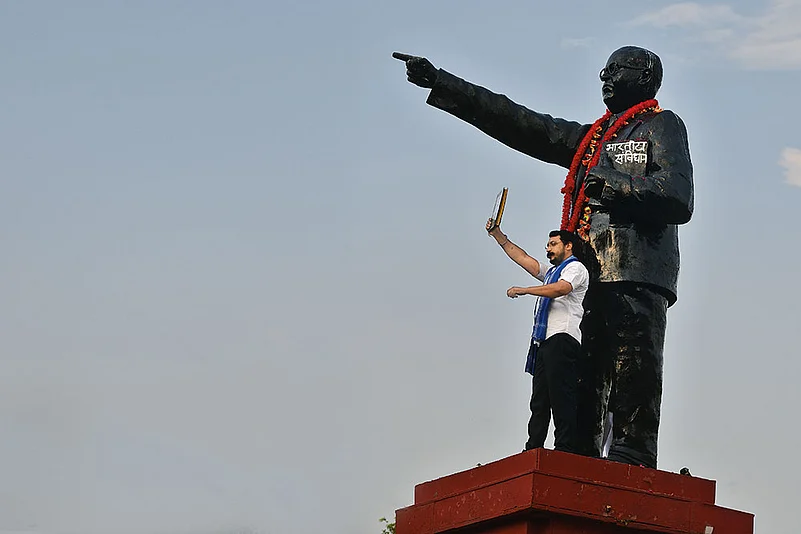
A politically charged and constitutionally contentious demand has reignited a long-settled debate at the heart of India’s democratic framework. Chandra Shekhar Azad Ravan, the face of the Bhim Army and leader of the Azad Samaj Party, has called for the introduction of separate electorates for Dalits, an idea that was not only rejected during the framing of the Constitution but also explicitly barred under its provisions.
The remarks, made during a speech in the Lok Sabha, have triggered sharp reactions, largely because they challenge a foundational principle of India’s electoral democracy: the idea of a unified electorate where every citizen votes on a common roll.
Ravan argued that reservation policies have failed to deliver meaningful empowerment to marginalised communities and dismissed them as mere slogans. In their place, he advocated what he described as a “direct and courageous solution”, separate electorates that would allow Dalits to elect their own representatives independently.
However, a closer look at constitutional law, historical precedents, and the views of key architects of modern India reveals that this demand is neither new nor constitutionally tenable.
Constitutional Position: Article 325 leaves no ambiguity
The demand for separate electorates collides head-on with Article 325 of the Constitution of India, which categorically mandates a single electoral roll for every constituency.
The provision clearly states that no individual shall be excluded from electoral rolls or placed in a separate roll on grounds of religion, race, caste, or sex. The intent is unmistakable: to eliminate identity-based segregation in the electoral process and uphold the principle of equal political participation.
This clause was not an afterthought. It was introduced deliberately during the Constituent Assembly debates to ensure that the divisive legacy of separate electorates, seen during colonial rule, would find no place in independent India.
When the provision was brought forward in June 1949, it was adopted without resistance, underscoring the broad consensus among the framers of the Constitution that separate electorates had no role in a modern democratic republic.
Ambedkar’s position on separate electorate
The present demand draws upon the legacy of B. R. Ambedkar, even though his views on the issue evolved over time.
In the earlier phase of his political thinking, Ambedkar did support the idea of separate electorates. This position, however, was shaped by the constraints of colonial India, where representation was limited.
As the process of constitution-making progressed, Ambedkar reconsidered this approach. During the debates of the Constituent Assembly, he supported the adoption of a common electoral roll, signalling a shift towards a more integrated democratic framework.
He noted that independent India’s democracy should be anchored in the principle of equal political participation, “one person, one vote” rather than systems that differentiate voters along communal or caste lines.
Colonial Origins: A tool of division
The concept of separate electorates did not originate as a tool of empowerment but as a mechanism of political control under British rule.
The Morley-Minto Reforms introduced separate electorates for Muslims, allowing them to elect representatives exclusively from within their community. This marked the beginning of institutionalised communal representation in India’s political system.
Over time, this framework deepened divisions, encouraging political mobilisation along religious lines rather than shared national interests. The system was later expanded to include other communities, further entrenching identity-based politics.
The long-term consequences were profound. Separate electorates played a significant role in sharpening communal identities, ultimately contributing to the demand for partition and the creation of Pakistan in 1947.
It is against this historical backdrop that the framers of the Constitution chose to decisively abandon the system.
The Gandhi-Ambedkar clash and the Poona Pact
The debate over separate electorates became particularly significant in the early 1930s, especially after the announcement of the Communal Award, which proposed separate electorates for several communities, including the Depressed Classes.
At the time, B. R. Ambedkar saw separate electorates as a possible way to ensure political representation for Dalits within a limited and unequal system. Mahatma Gandhi, however, had reservations about this approach, expressing concern that such arrangements might deepen social divisions.
This difference in perspective led to a period of intense discussions. Gandhi undertook a fast, which added urgency to the situation and prompted wider engagement among political leaders.
The outcome was the Poona Pact, a negotiated settlement that replaced separate electorates with reserved seats for Dalits within a joint electoral system.
The Pact expanded representation for Dalits while maintaining a common electorate, an approach that later influenced the framework adopted in India’s constitutional democracy.
A return to a rejected idea?
Ravan’s argument rests on the claim that elected representatives from reserved constituencies remain constrained by party structures and fail to independently represent their communities. He cited Kanshi Ram’s critique in Chamcha Yug to suggest that the current system produces leaders who are accountable to political parties rather than to their social base.
While this critique touches on a concern, the nature of political representation, it does not automatically validate the solution being proposed.
Separate electorates, by design, create isolated political silos. They restrict voter choice, limit cross-community engagement, and risk reinforcing the very divisions that the Constitution sought to eliminate.
Moreover, the claim that reservations have entirely failed overlooks the broader structural changes they have facilitated, including increased political participation and representation of historically marginalised groups.
From a legal standpoint, the demand for separate electorates is untenable without a fundamental constitutional amendment, one that would alter the basic structure of India’s electoral system.
Given that the principle of equality and universal suffrage forms part of the Constitution’s core framework, any such attempt would likely face serious judicial scrutiny.
Politically, the demand raises questions about the direction of identity-based mobilisation in contemporary India. While issues of representation and empowerment remain critical, the methods adopted to address them carry long-term implications for social cohesion and democratic stability.
A debate settled, yet reopened
The re-emergence of the separate electorate demand highlights a recurring tension in Indian democracy: how to balance group representation with national unity.
This is not an unresolved question. It is one that has already been debated, contested, and settled through decades of political struggle and constitutional deliberation.
The framers of the Constitution, led by figures like B. R. Ambedkar, chose a path that rejected segregation in favour of integration, one that sought to empower communities without fragmenting the electorate.
The call for separate electorates may be framed as a push for empowerment, but it runs counter to both constitutional law and historical experience. India’s democratic model is built on inclusion through a shared electoral process, not separation along identity lines.
The debate, therefore, is not just about one political statement. It is about whether the country is willing to revisit a system that history has already tested and found deeply divisive.
In reaffirming the principle of a common electorate, the Constitution drew a clear line. Any attempt to cross it will have to contend not just with legal barriers, but with the weight of history itself.