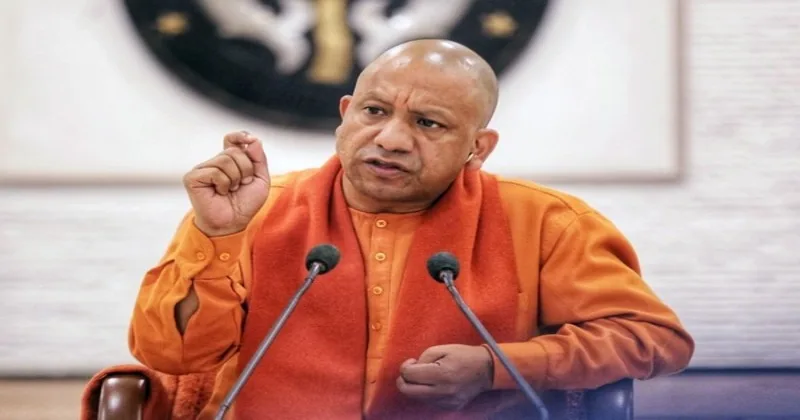
The political atmosphere in Uttar Pradesh intensified as Chief Minister Yogi Adityanath led a protest march against the defeat of the Constitution Amendment Bill aimed at implementing women’s reservation. The march, titled Jan Aakrosh Mahila Padyatra, was organised to express public anger, particularly among women, over the bill’s failure in the Lok Sabha. The proposed Constitution (131st Amendment) Bill sought to introduce a quota for women in legislatures and increase the strength of the Lok Sabha to 816 seats. However, its defeat in the Lower House last week has triggered a sharp political backlash, especially from the Bharatiya Janata Party (BJP), which has positioned itself as a strong advocate for women’s representation in governance.
The padyatra saw the participation of several BJP leaders and party workers, including Deputy Chief Ministers Keshav Prasad Maurya and Brajesh Pathak. Addressing the gathering outside the Uttar Pradesh Legislative Assembly after the march, Adityanath launched a strong attack on opposition parties, particularly the Congress and the Samajwadi Party (SP). He accused them of maintaining an “anti-women” stance and failing to support a crucial reform. According to CM Yogi Adityanath, the opposition had an opportunity to change its image, but instead “misused” the platform provided by Prime Minister Narendra Modi.
The Chief Minister said the protest shows that women called ‘aadhee aabadee’ (half the population) are angry with the opposition for repeatedly opposing policies meant for them. He claimed that women across the country are expressing anger through protests and public demonstrations. Uttar Pradesh CM Yogi also extended his criticism to other opposition parties, including the Trinamool Congress (TMC) and the Dravida Munnetra Kazhagam (DMK), accusing them of collectively blocking progressive reforms intended to empower women.
At the moment, the BJP is attempting to consolidate its support base among women voters by projecting itself as the champion of women’s rights and empowerment. The failure of the bill has provided the party with an opportunity to sharpen its political narrative against the opposition.
Yogi Adityanath said Prime Minister Narendra Modi focuses on four key groups, i.e., women, the poor, youth, and farmers. He added that by making policies for these groups, the country has made strong progress. According to the UP Chief Minister Yogi, women hold and occupy a central place in this framework, with multiple government schemes which are designed to ensure their dignity, safety, and economic independence.
To support his argument, Adityanath cited several flagship schemes launched by the central government under Modi’s leadership. He described these initiatives as foundational steps toward women’s empowerment. The Swachh Bharat Mission, he said, goes beyond cleanliness and plays a critical role in protecting the dignity of women by promoting the construction of toilets. Similarly, the Pradhan Mantri Ujjwala Yojana, which provides free LPG connections to poor households, was highlighted as a major intervention that improves women’s health and reduces the burden of traditional cooking methods. He also referred to the Ayushman Bharat scheme, stating that it not only ensures access to healthcare but also contributes to financial stability for families, indirectly benefiting women. “These schemes are not just welfare measures; they are instruments of empowerment,” Adityanath said. “They lay the foundation for self-reliance among women and strengthen their role in society.”
Opposition Under Fire
Adityanath accused opposition parties of opposing or undermining such initiatives for political reasons. He argued that their resistance to the women’s reservation bill reflects a broader pattern of ignoring women’s issues. “There are numerous programmes being implemented for the welfare of women, yet the Congress, SP, and other INDIA bloc parties oppose them,” he said.
While the padyatra concluded in Lucknow, UP CM Adityanath made it clear that the protest would not end there. He called for the movement to be expanded into a statewide campaign, reaching every district, division, and booth level. “This is not just a protest; it is a campaign that must be carried forward across the state,” he said, urging party workers to take the message to grassroots levels.
The Uttar Pradesh government, in an earlier statement, said that the march was a response to the deep hurt felt by millions of women after the bill failed. It added that the protest shows real public anger, not just politics.
The controversy surrounding the women’s reservation bill has quickly evolved into a major political flashpoint. For the BJP, it presents an opportunity to mobilise women voters and reinforce its image as a pro-women party. For the opposition, it poses a challenge to counter the narrative and explain their position on the bill.
With elections on the horizon in several states and the national political climate heating up, the issue is likely to remain at the forefront of political discourse. The BJP’s decision to take the matter beyond Parliament and onto the streets can be seen as a calculated effort to turn legislative defeat into a mass movement.
As the debate continues, the focus is likely to remain on women’s representation, policy intent, and political accountability. Whether this movement translates into legislative success or electoral gains remains to be seen, but it has undoubtedly added a new dimension to the ongoing political narrative in Bharat.