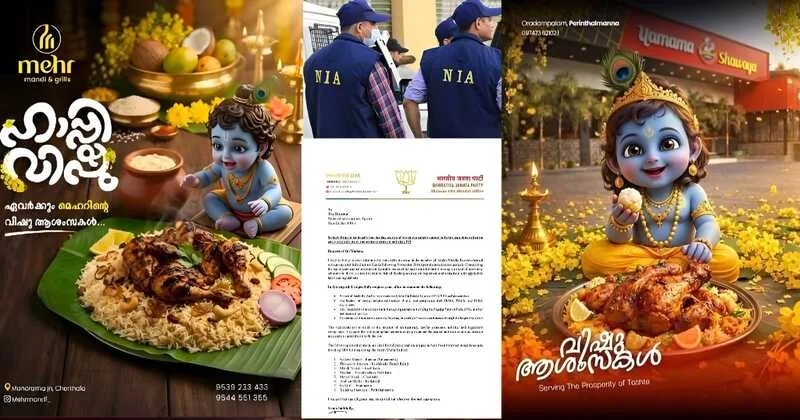
Thrissur/New Delhi: A petition seeking a central probe into the funding and operations of several Arabic/West Asian-themed restaurants in Keralam has been submitted to the National Investigation Agency (NIA), amid the ongoing controversy over Vishu-themed advertisements that hurt Hindu religious sentiments.
The representation was filed by Praseed Das, Intellectual Cell Convenor of the Bharatiya Janata Party Thrissur City District office, urging authorities to examine the sources of funding for such establishments opened in Keralam after the 2016 demonetisation period. The petition also calls for scrutiny of possible links to banned or extremist organisations, including the Popular Front of India (PFI), and requests a detailed investigation into financial transactions within the hospitality sector.
In the letter addressed to the NIA Director in New Delhi, Das highlighted what he described as a “noticeable increase” in Arabic and West Asian-themed restaurants across Kerala in recent years. He sought verification of foreign inward remittances and compliance with laws such as FEMA, PMLA, and FCRA. The petition further called for an examination of benami transactions and the routing of unaccounted money through the sector.
Significantly, the petition links these concerns to the recent Vishu advertisement controversy, alleging that certain establishments were involved in “acts insulting Bhgwan Shri Krishna” during the Vishu festival. It lists multiple restaurants across Keralam, including Nadawi Mandi, Thalassery Kitchen, Mandi Manzil, Raydan Restaurant, Mehar Mandi & Grills, Arabian Majlis Restaurant, Go Grill, and Yamama Shawaya Hotel.
The petition comes against the backdrop of a series of police cases registered across Keralam over Vishu-themed promotional content by restaurants that depicted Bhagwan Krishna alongside non-vegetarian dishes. These visuals, widely circulated on social media, triggered protests and complaints alleging that they hurt the religious sentiments of Hindu devotees.
Multiple cases, arrests and NIA probe demand intensify
In Malappuram district, the Keralam Police recently registered a case under Section 192 of the Bharatiya Nyaya Sanhita following the circulation of a Vishu poster showing chicken fry placed before an image of Krishna. The content was shared through the social media handles of Arabian Majlis Restaurant in Kottakkal and Raydan Restaurant, leading to a complaint by the VHP.
In a separate incident in the same district, police action led to arrests in connection with a similar advertisement. The case involved Yamama Shawaya Hotel near Perinthalmanna, where a Vishu-themed image depicted a child-like Krishna seated before a plate containing a meat dish. Following complaints, the Mankada police registered a case on charges of promoting communal disharmony and arrested three individuals, Mustafa of Pookottoor, Shahul Hameed, and Muhammed Shahil of Eramthode. Electronic devices used in creating and circulating the content were also seized.
Earlier, in Alappuzha district, a case was registered against Mehar Mandi & Grills in Cherthala after a Vishu advertisement featuring Krishna alongside a non-vegetarian dish went viral. The complaint, filed by a lawyer, alleged deliberate provocation. Police booked Arshad, identified as a co-owner of the restaurant, under Section 192 of the Indian Penal Code and took him into custody as part of the investigation.
Similar incidents have also been reported from other parts of Keralam, including Kozhikode and Kannur, where posts were shared and later removed following backlash. Authorities have indicated that investigations are ongoing to determine the intent behind these advertisements, the role of those involved in their creation, and whether there was any coordinated effort.
The petition to the NIA adds a new dimension to the controversy, shifting focus from individual cases of offence to broader questions about funding, regulation, and oversight of the hospitality sector. It calls for a comprehensive inquiry “in the interest of transparency and lawful economic activity,” and urges authorities to take appropriate action based on their findings.