

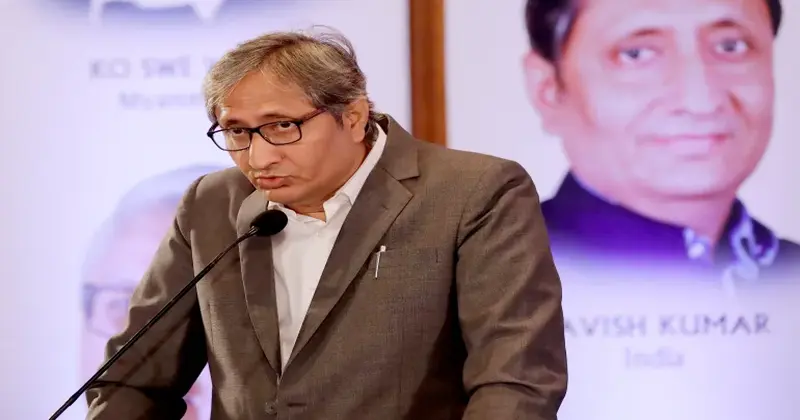
In India’s deeply polarized media landscape, the claim of neutrality is often more powerful than neutrality itself. Few figures embody this paradox more vividly than Ravish Kumar, a journalist who has built his public persona on the assertion of being an independent, impartial voice. Yet, a closer examination of his recent commentary—particularly on the controversy involving Pawan Khera and Riniki Bhuyan Sarma—reveals a troubling pattern: a selective engagement with facts that raises serious questions about the credibility of his self-proclaimed neutrality.
At the heart of the controversy lies a series of allegations made by Pawan Khera against Riniki Bhuyan Sarma, the wife of Himanta Biswa Sarma. Khera accused her of possessing multiple foreign passports and owning properties in Dubai—claims that, if true, would warrant serious legal and political scrutiny. However, what followed was not a substantiated exposé, but a cascade of unverified assertions supported by documents riddled with inconsistencies.
It is in this context that Ravish Kumar’s intervention becomes particularly problematic. In his commentary, he questioned the FIR filed against Khera, arguing that the appropriate course of action would have been to refute the allegations or order an investigation rather than initiate police action against the accuser. On the surface, this may appear as a principled stand in favour of free speech and accountability. But a deeper look reveals that this argument is built on a selective reading of events, conveniently ignoring key developments that undermine his position.
To begin with, the demand for “refutation” that Ravish Kumar emphasizes had already been met. Himanta Biswa Sarma publicly addressed the allegations, pointing out glaring discrepancies in the documents presented by Khera—ranging from spelling errors in names to inconsistencies in biometric data. These were not minor technical lapses but fundamental flaws that cast serious doubt on the authenticity of the claims. Additionally, Riniki Bhuyan Sarma herself categorically denied the allegations, asserting that the images used in the documents were AI-generated.
For a journalist who prides himself on thoroughness, ignoring such direct and public rebuttals is not a trivial oversight—it is a deliberate omission. By continuing to frame the issue as one where the allegations were not adequately countered, Ravish Kumar constructs a narrative that is not aligned with the available facts.
Equally questionable is his critique of the FIR filed against Pawan Khera. In any democratic system governed by the rule of law, the filing of an FIR is not an act of vendetta but a procedural mechanism to address grievances and initiate investigation. When serious allegations are made in the public domain—especially those that can damage an individual’s reputation—legal recourse is not only justified but necessary.
If Khera had credible evidence to support his claims, the logical step would have been to present it before a competent legal authority or file a complaint himself. Instead, he chose to make public allegations without substantiating them in a court of law. When faced with legal action from Riniki Bhuyan Sarma, he sought anticipatory bail from the Telangana High Court—a move that itself raised jurisdictional questions when the matter was intrinsically linked to Assam. The subsequent scrutiny by the Supreme Court of India only underscored the procedural irregularities involved.
Ravish Kumar’s discomfort with these legal developments further exposes the asymmetry in his analysis. While he advocates for an investigation, he appears to disregard the fact that the FIR itself is the first step in that very process. To argue against the filing of an FIR while simultaneously demanding an investigation is not just contradictory—it reflects a superficial understanding of legal procedures or worse, a willingness to distort them to fit a preconceived narrative.
The broader implications of this episode extend beyond one journalist or one controversy. They touch upon a deeper malaise within sections of the Indian media, where ideological leanings often shape editorial choices. In Ravish Kumar’s case, the pattern is difficult to ignore. His commentary frequently aligns with positions taken by the Indian National Congress, raising legitimate questions about whether his “impartiality” is more performative than real.
This is not to suggest that journalists must be devoid of personal beliefs—such an expectation would be both unrealistic and undesirable. However, there is a fundamental difference between having a perspective and allowing that perspective to override facts. Journalism, at its core, is about presenting a truthful account of events, even when those truths are inconvenient to one’s ideological preferences.
In the present case, the facts paint a clear picture. Allegations were made without credible evidence. Those allegations were publicly refuted with specific counterpoints. Legal action was initiated through established procedures. Yet, Ravish Kumar’s narrative selectively amplifies certain aspects while downplaying or ignoring others, creating a distorted representation of reality.
Moreover, his framing of the issue as a matter of principle—where the state is portrayed as suppressing dissent by targeting an accuser—fails to acknowledge the equally important principle of accountability. Freedom of expression does not grant immunity from the consequences of making unverified and potentially defamatory claims. A responsible journalist would recognize this balance; an ideological commentator might choose to overlook it.
The timing of the controversy, amid electoral dynamics in Assam, adds another layer of complexity. Political parties often resort to aggressive tactics during elections, and allegations—whether substantiated or not—become tools in a larger strategy. In such a charged environment, the role of the media becomes even more critical. It must act as a filter that separates fact from fiction, not as an amplifier of unverified claims.
Unfortunately, in this instance, Ravish Kumar appears to have done the opposite. By lending credence to a narrative that lacks factual grounding, he not only undermines his own credibility but also contributes to the erosion of public trust in journalism as an institution.
If Ravish Kumar wishes to advocate for a particular political perspective, he is entirely within his rights to do so. But the pretense of impartiality, when contradicted by consistent patterns of selective reporting, ultimately does more harm than good. It misleads audiences, distorts public discourse and diminishes the very standards that journalism seeks to uphold.
In the final analysis, the issue is not about one journalist’s opinion or one political controversy. It is about the integrity of public discourse in a लोकतांत्रिक society. When facts are subordinated to narratives and impartiality becomes a rhetorical device rather than a guiding principle, the consequences extend far beyond the individuals involved.
Ravish Kumar’s recent commentary serves as a reminder that credibility in journalism is not claimed—it is earned through consistency, fairness and an unwavering commitment to truth. Without these, the claim of impartiality remains what it increasingly appears to be: a myth carefully constructed, but steadily unraveling under the weight of its own contradictions.