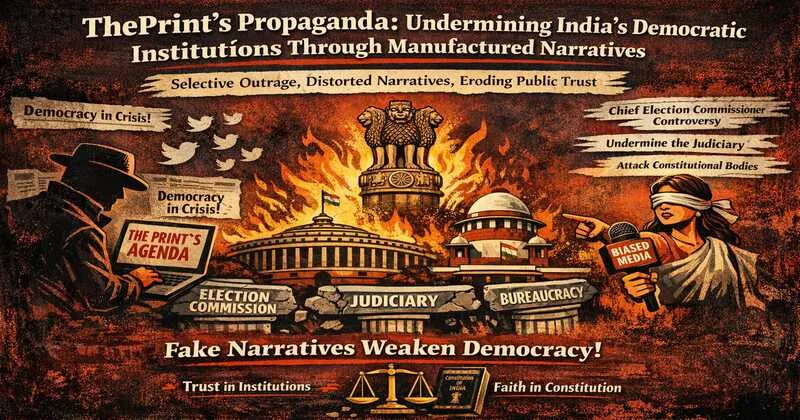
In recent years, a section of India’s commentariat has increasingly positioned itself not as a constructive critic of democracy, but as an architect of distrust. The latest commentary targeting India’s constitutional framework, particularly regarding the Chief Election Commissioner, exemplifies this deeper malaise, in which perception is elevated above fact and narrative takes precedence over nuance.
At the heart of this discourse lies a sweeping and unsubstantiated claim: that individuals occupying high constitutional offices lack “shame” and “dignity.” Such assertions are not merely excessive; they are symptomatic of a deeper ideological impatience with institutions that refuse to conform to a pre-determined worldview. In the absence of credible evidence, isolated instances are stitched together to construct a larger, politically convenient narrative of institutional decay.
The controversy surrounding the appointment of the Chief Election Commissioner must be examined within the constitutional framework. Article 324 of the Constitution vests the “superintendence, direction and control of elections” in the Election Commission. In the landmark judgment of TN Seshan v. Union of India, the Supreme Court emphatically upheld the Election Commission’s institutional independence and authority, observing that it is a constitutional body insulated from executive interference in the discharge of its functions. The Court recognised that the strength of Indian democracy lies in the robustness of such institutions.
Further, in Union of India v. Association for Democratic Reforms, the Supreme Court expanded the scope of electoral transparency, holding that the voter’s right to know is a fundamental right under Article 19(1)(a). Importantly, this judgment reaffirmed the Election Commission’s proactive role in ensuring free and fair elections, demonstrating judicial confidence in the institution rather than suspicion.
More recently, in Anoop Baranwal v. Union of India, the Supreme Court addressed concerns regarding the appointment process of Election Commissioners. While issuing interim directions involving a committee comprising the Prime Minister, the Leader of the Opposition, and the Chief Justice of India, the Court simultaneously acknowledged that Parliament retains the authority to legislate on the subject. This observation is critical; it reinforces that the constitutional scheme ultimately places faith in democratic law-making, not judicial overreach or media speculation.
Thus, to question the validity of an appointment process that is backed by parliamentary legislation is, in effect, to cast doubt on the constitutional distribution of powers itself.
Equally important is the judicial emphasis on institutional trust. In State of Bihar v. PP Sharma, the Supreme Court cautioned against creating a climate of suspicion around public institutions, observing that governance cannot function if every authority is presumed to act with mala fides. Similarly, in Subramanian Swamy v. Union of India, while upholding the criminal defamation law, the Court underscored the importance of protecting the reputation of individuals and institutions alike, recognising it as an integral facet of Article 21.
More recently, in Kartar Singh v. State of Punjab and subsequent jurisprudence, the Court has consistently emphasised that constitutional institutions must be judged on the basis of their functioning and legal mandate, not on speculative or ideological grounds.
Against this settled constitutional position, the insistence that constitutional functionaries must continuously “prove” their neutrality not through institutional performance, but through alignment with a particular ideological expectation appears deeply misplaced. Institutions derive legitimacy from constitutional design and judicial affirmation, not from transient narratives.
The attempt to paint India’s Election Commission, judiciary, and bureaucracy with the same brush of alleged bias reveals a pattern of systematic generalisation. Democracies thrive on disagreement, but they are sustained by institutional trust. To portray the entire governance architecture as compromised, without substantive evidence, runs contrary to the very spirit of constitutional democracy as articulated by the Supreme Court.
This pattern is not new. Historical analogies, particularly references to the era of “committed bureaucracy” during Indira Gandhi’s tenure, are invoked selectively and without context. The intent is not to illuminate, but to insinuate continuity between past aberrations and present realities, ignoring the constitutional safeguards and judicial evolution that have since strengthened institutional independence.
The consequences of such sustained narrative-building are far-reaching. Democracy is not merely a structure of institutions; it is a living civilisational ethos rooted in trust, continuity, and collective responsibility. The Supreme Court itself has repeatedly emphasised that public confidence is the cornerstone of institutional legitimacy. Eroding this confidence through selective and unverified assertions risks weakening the democratic fabric.
It is therefore imperative to draw a clear distinction between criticism and cynicism. Criticism, as recognised in constitutional jurisprudence, is essential for accountability and reform. Cynicism, however, delegitimises institutions without evidence and undermines constitutional order.
The issues concerning the Chief Election Commissioner, like all constitutional questions, must be resolved through established legal and institutional mechanisms. Prejudging these processes and shaping public opinion through selective narratives undermines due process and distorts democratic discourse.
India’s democratic institutions have evolved through decades of constitutional resilience, political churn, and civilisational continuity. They are not infallible, but they are far from fragile. The Supreme Court’s consistent jurisprudence reflects a deep institutional faith, one that must not be casually eroded by ideological narratives masquerading as objective analysis.
What is at stake today is not merely the credibility of a single office, but the larger question of whether India’s democratic framework will be assessed through constitutional principles and judicial wisdom or through selective perception.
The answer will determine not just the quality of our discourse, but the strength of our democracy.

![Kolkata [West Bengal], Apr 29 (ANI): Voters queue up as they wait to cast their votes at a polling station in the 161 Ballygunge Assembly constituency for the second phase of the West Bengal Assembly elections 2026, in Kolkata on Wednesday. (@ECISVEEP/ANI Photo)](https://organiser.org/wp-content/uploads/2026/05/20260429331l-1-120x86.webp)