
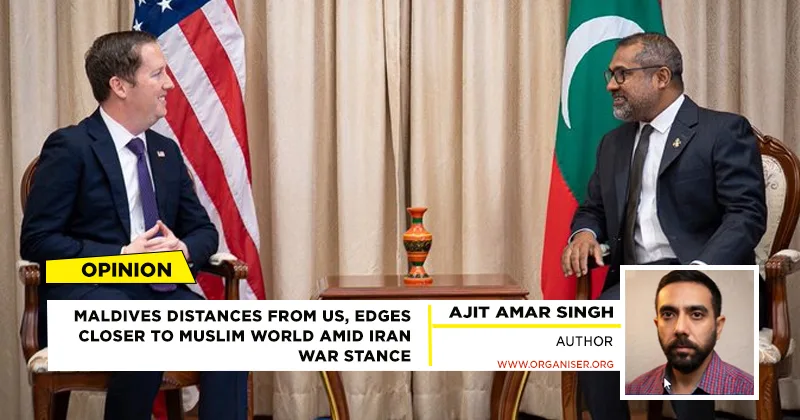
Maldives President Mohamed Muizzu’s deliberate snub of US Ambassador to India Sergio Gor during the latter’s visit to Male on March 23, 2026 – when a scheduled meeting was cancelled at the last minute by the Maldivian side – has become the latest marker of a broader foreign policy shift away from Washington and toward the Muslim world, especially in the context of US‑Israel actions against Iran and the wider Middle East war. Gor, a 39‑year‑old Trump confidante and Washington’s Special Representative for South and Central Asia, met Maldivian Foreign Minister Abdulla Khaleel and Defence Minister Ghassan Maumoon but left the country without meeting Muizzu, underscoring the Maldivian leadership’s reluctance to be drawn into sensitive US‑led security and diplomatic agendas in the region.
Muizzu’s Stance on US‑Israel and the Iran War
Muizzu has publicly stated that the Maldives has “nothing to discuss” with the visiting US envoy about the ongoing war in the Middle East, explicitly framing the country’s stance as one of principled restraint and solidarity with the broader Muslim world. In a press conference during Gor’s visit, he reiterated that the Maldives will “welcome leaders and senior officials of all countries, except for Israel,” signalling a clear red line in bilateral contacts rooted in its self‑image as a small Muslim state sensitive to Arab and Gulf opinion. The Maldivian government has also issued a formal statement expressing “profound concern” at the escalation of hostilities in the Middle East and reaffirming its support for the peaceful settlement of disputes, effectively aligning its rhetoric with other Muslim‑majority states that have criticised the US‑Israel posture toward Iran and Gaza.
Foreign Policy Pivot to the Islamic World
In early 2026, Muizzu publicly declared that his government will “prioritize relations with Islamic states” when shaping foreign policy, sharpening the emphasis on ties with Saudi Arabia, the UAE, Qatar and other Gulf Cooperation Council (GCC) partners. This pivot is driven by the Maldives’ dependence on Gulf countries for development finance, investment, tourism and air connectivity: recent analyses estimate that air links with Saudi Arabia, the UAE and Qatar underpin a significant share of Maldivian tourism and investment inflows, which on the order of 25-30% of tourist arrivals and related forex come from GCC sources. Within this framework, the Maldives’ inclusion in the Saudi‑led “Mecca Route Initiative” and similar religious‑tourism and investment schemes has been highlighted as a strategic win, allowing Male to frame its foreign policy around Islamic solidarity rather than Indo‑Pacific power balancing.
Growing Distance from the United States
Although the Maldives and the United States formally marked 60 years of diplomatic relations in 2026, Muizzu’s refusal to engage Gor in a substantive bilateral meeting has exposed a clear cool‑down in tone, even as Washington continues to stress “areas of cooperation” on regional security and counter‑terrorism. The Maldivian side has offered the official line that the President “does not want to be pressured by visitors on Maldives politics and development,” a narrative used to downplay domestic criticism while quietly signalling that Muizzu’s administration is wary of US engagement on Iran‑linked issues and broader Indo‑Pacific security architectures. This distancing comes at a time when the US is deepening its Indo‑Pacific strategy with India and other partners, and the Maldives’ reluctance to be fully integrated into that orbit, especially on Iran‑related security and intelligence cooperation, has become a point of friction.
Domestic Crisis and India’s Leverage
At home, Muizzu’s political position is under severe strain. On April 4, 2026, the Maldives held municipal elections and a constitutional referendum simultaneously, with devastating results for his People’s National Congress (PNC): the Opposition Maldivian Democratic Party (MDP) swept all five city mayoral races, while the public rejected by roughly 60% of votes a proposed constitutional change to hold concurrent presidential and parliamentary elections, a move perceived as a bid to consolidate power. Economically, the Maldives faces a deep fiscal crunch. The government has repaid a $100 million Eurobond and a $400 million Islamic Sukuk bond, leaving Male in urgent need of a $400 million loan rollover from India for at least two to three years. New Delhi has so far only approved two six-month roll‑overs under the existing framework, and the Union Cabinet has not yet green‑lit a longer‑term extension, leaving Malé’s request in limbo amid India’s own cautious assessment of Muizzu’s political volatility and contradictory strategic shift.
India’s Role: Rescue Finance vs Strategic Ambiguity
Despite Muizzu’s anti‑India “India‑Out” campaign in 2023 and his 2024 demand for the withdrawal of Indian military personnel, relations have staged a partial comeback. In July 2025, Prime Minister Narendra Modi announced a Rs 4,850‑crore (about $580 million at prevailing rates) line of credit for the Maldives and launched Free Trade Agreement talks, marking what Indian officials describe as a “reset” aimed at stabilising the relationship after years of turbulence. The Greater Male Connectivity Project, funded by India, is positioned as a flagship infrastructure initiative linking the capital Male with nearby islands, including the critical industrial zone of Thilafushi. However, Muizzu has complicated this picture by awarding the first phase of the Thilafushi port project to China Harbour Engineering Company on February 5, 2026, effectively reneging on an earlier understanding that India would develop the port, which is meant to be the commercial backbone of the Male‑Thilafushi corridor. This move has raised concerns in New Delhi that Malé is using Indian financial support to shore up its economy while simultaneously deepening security and infrastructure ties with China, thereby hedging its bets between the US‑India axis and the China‑Muslim‑world axis.
Why This Matters for India and the Region
For India, the Maldives remains a make-or-break node in the central Indian Ocean. The atoll nation sits astride major shipping lanes, and the Greater Male Connectivity Project, plus the Thilafushi port, are key to India’s maritime connectivity and logistics footprint in the region. With Muizzu actively distancing from the US and prioritising Islamic world ties- especially at a time when Washington is keen to draw small state partners into its Middle East and Indo‑Pacific security frameworks- India is left in a delicate position. New Delhi must simultaneously keep Malé financially afloat (through credit lines and possible new Exim‑style loans), deter an over‑reliance on China, and manage an Indian Ocean partner that is openly sceptical of US‑Israel actions toward Iran and Israel itself.
A Small State, Big Balancing Act
The Maldives’ refusal to meet Sergio Gor is not just a diplomatic incident; it is the most visible symptom of a wider recalibration in which Muizzu’s administration seeks to anchor its identity in the Muslim world, distance itself from US‑Israel positions on Iran and Israel, and use India’s financial and infrastructural support as a stabiliser amid domestic political and economic crises. In Indian‑policy terms, this means accepting that Male may remain a cautious, hedging partner- leaning on India for money and security while selectively engaging the US and wholeheartedly courting Gulf and wider Islamic partners rather than a stable, co‑aligned ally in any US‑led or India‑centric Indo‑Pacific architecture. As New Delhi weighs the $400‑million loan rollover request and watches the trajectory of Muizzu’s Islamic‑centric foreign policy, the Maldives’ drift away from direct engagement with US envoys will likely remain a litmus test of how far this small island state is willing to go in decoupling from Washington while threading the needle between India, China and the Muslim world.