The site, eight kilometres northeast of Varanasi today, is not only a Buddhist pilgrimage site. It is a layer of three distinct religious traditions, each of which claims the ground beneath the ground as its own and each of which is, in its own way, correct.
What follows is a feature on Sarnath arranged in time, tracing the soil itself from its Hindu belief origins, through its Jain sacred geography and into the fifteen centuries of Buddhist civilisation whose monuments archaeologists are still excavating. The manuscript tradition of all three communities records this site. None of them is wrong about it.
Sarangnath: The Hindu Name and Its Ancient Roots
The word “Sarnath” is a contraction. Epigraphist and ASI archaeologist Rai Bahadur Daya Ram Sahni, who authored the definitive 1914 Catalogue of the Museum of Archaeology at Sarnath, confirmed in the belief literature that Shiva bears the appellation Sarangnath—Bhagwan of the Deer. It is the site’s proximity to Kashi, the eternal city of Mahadeva, that gave the ground a Shaivite character before Buddhism. Both threads of etymology are older than any inscription so far recovered from the site.
The Sarangnath Mandir and the Two Shivalingas
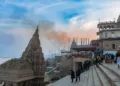
One kilometre from the Buddhist ruins, the Sarangnath Mahadev Mandir stands as the most direct physical evidence of this Hindu stratum. The Mandir is unique in North India for housing two Shivalingas within a single argha. The first was established by Sarang Rishi himself; the second was consecrated by Adi Guru Shankaracharya, who passed through the Varanasi region as part of his campaign to re-establish Vedantic Hinduism across the subcontinent. An adjoining sacred pond known as the Sarangnath Kund is used for ritual bathing. Every year in the month of Sawan (July–August), the Mandir draws devotees from across the country who believe that Bhagwan Shiva resides here with Maa Parvati throughout the entire month.
The legend attached to the Mandir is this: when Parvati married Shiva, her brother, the rishi Sarang was absent. Learning of the marriage, he travelled toward Kashi, exhausted and fell asleep near a forest of deer. In his dream, he saw Varanasi as a city of pure gold. He reached Shiva, asked to remain in this place forever and undertook penance. Shiva was pleased and promised that he would be known as Sarangnath Mahadev, that both would be worshipped together at the spot and that during Sawan each year, Shiva himself would return. The two lingas in a single argha commemorate that compact.
A second, parallel etymology runs through the Jataka literature. According to Alexander Cunningham himself identified Sarnath as a contraction of Saranganatha- ‘natha of the sarangas,’ where saranga means antelope or spotted deer. In the Buddhist reading, this natha is not Shiva but the Bodhisattva. Siddhartha is remembered in the Jataka tradition as having been reborn as a deer king who offered his own life to a hunter in exchange for a pregnant doe. The king was so moved that he declared the forest a sanctuary. Both the Hindu and Buddhist etymologies point to the same animal, the same forest and the same quality of protection extended to the vulnerable.
It is what Rai Bahadur Daya Ram Sahni meant when he wrote and what the uploaded manuscript confirms, that ‘Sarnath’ is a name drawn from the Hindu epithet of Shiva that is also simultaneously a Buddhist epithet, two traditions reaching for the same ground with the same word.
The Jain Claim: Singhpuri and the Eleventh Tirthankara
The Jain tradition does not dispute the Buddhist or Hindu presence at Sarnath. It simply points one kilometre east to a village called Singhpur, ancient name Simhapuri and notes that this ground is the birthplace of Shreyansanatha, the eleventh Tirthankara of the present cosmic time cycle (Avasarpini). According to the Kalpa Sutra and regional Jain chronicles, Simhapuri was a royal city in the Ikshvaku dynasty ruled by a king named Vishnu, whose queen Vishna Devi, conceived Shreyansanatha under the Shravan Nakshatra on the sixth day of Jyeshtha Krishna. He was born on the twelfth day of Phalgun Krishna. His symbol is the rhinoceros. His height is recorded as 80 dhanusha.
More than just birth links Sarnath to Shreyansanatha. According to the Sarnath Jain Tirth tradition, four of his five Kalyanaka auspicious life events central to every Tirthankara’s biography occurred at Simhapuri – Chyavan (entry into the mother’s womb), Janm (birth), Diksha (renunciation of royal life) and Kevala Jnana (attainment of omniscience). Only the fifth, Moksha (liberation at death), took place elsewhere. This makes Sarnath a site of near-total spiritual biography for Shreyansanatha rarer even than most Jain sacred sites.
The Varanasi region as a whole is extraordinary in Jain cosmological geography. Jain pilgrimage accounts the Sarnath as a Jain Tirth, recording that four Tirthankaras were born within the greater Kashi territory: Suparshvanatha (seventh), Chandraprabha (eighth), Shreyansanatha (eleventh), and Parshvanatha (twenty-third). The concentration of divine births in a single region is understood in Jain soteriology as evidence of the area’s primordial sanctity as a cradle of liberation. Mahavira, the twenty-fourth and final Tirthankara, also delivered sermons in Varanasi and Sarnath during his wanderings.
The Digambar Mandir of 1824 and the Older Shvetambara Ruins
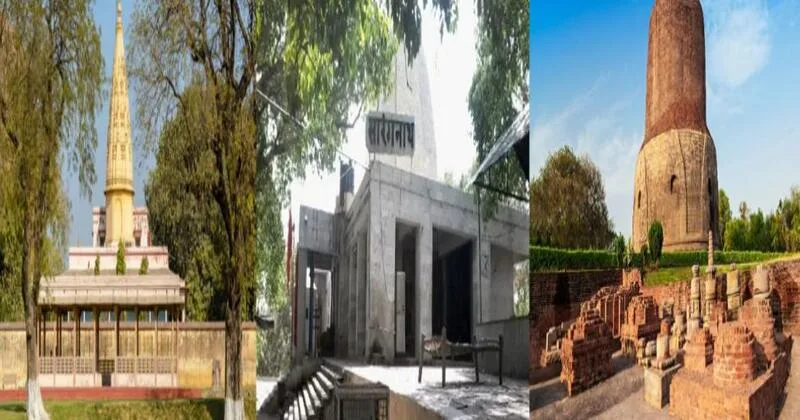
The Digambar Jain Mandir standing at Sarnath today was built in 1824 CE by the Jains specifically to mark and protect the birthplace of Shreyansanatha. It houses a large murti carved from black Saligram stone, considered by the community to predate the Mandir building itself. Its interior walls carry murals completed in 1943 depicting the life of Mahavira Swami, the twenty-fourth Tirthankara, a biographical narrative in paint laid over an architecturally commemorated biography in stone. Adjacent to the Digambar structure lie ruins of an older Shvetambara Mandir, attesting to a continuous Jain presence at the site across both major sects. The presence of both sectarian traditions at the same location, celebrating the same Tirthankara, which notes that both Digambara and Shvetambara pilgrims gather for shared festivals such as Mahavira Jayanti.
The 1612 Tirthakalpa manuscript by Jinaprabha Suri, the Jain pilgrim text that constitutes the earliest incontrovertible written reference to the Buddhist ruins at Sarnath, mentions a Jain Mandir in Varanasi situated close to a famous Bodhisattva sanctuary at a place called dharmeksa. The manuscript’s primary concern is Jain geography; the Buddhist ruins are a landmark used to orient the reader. A Jain text carrying within it the first written evidence of what Buddhist archaeology would later spend two centuries excavating.
The Buddhist Civilisation, Fifteen Centuries in a Deer Forest
Around 528 BCE, a thirty-five-year-old man who had attained enlightenment at Bodh Gaya walked north on foot toward Varanasi. He had been told that five former companions, ascetics he had separated from during his years of extreme austerity, were staying at Isipatana, the Deer Park outside the city. The event that followed is recorded in the Dhammacakkappavattana Sutta, the foundational text of the Buddhist canon and in the Sanskrit Lalitavistara Sutra- the First Turning of the Wheel of Dharma, the initial public articulation of the Four Noble Truths and the Eightfold Path. The five disciples were Kaundinya, Assaji, Bhaddiya, Vappa, and Mahanama, all Brahmins who had known Siddhartha previously. Kaundinya was the first to understand. On that same occasion, the Buddha laid the foundation of the first Buddhist Sangha. Before the first rain season had passed, the community numbered sixty monks, whom the Buddha sent in sixty directions to spread the Dharma.
What the Buddha chose for this sermon was not incidental territory. According to the Lalitavistara Sutra, he specifically chose the Deer Park by the Hill of the Fallen Sages outside Varanasi. The name Isipatana, the place where holy men descended, refers to a legend in which devas came down from heaven at the birth of the Buddha-to-be to announce it to five hundred rishis, who then rose into the air and fell back to earth at this spot. The deer park itself traces to the Jataka tale of the Bodhisattva’s self-sacrifice as a deer king.
The Third Century BCE : Ashoka’s Vision
When Emperor Ashoka visited Sarnath around 234 BCE, he wasn’t just passing through. He was a man transformed, haunted by the carnage of the Kalinga War and drawn toward the place where the Buddha had first taught. He left something lasting behind a pillar of finely polished sandstone so luminous that a Chinese pilgrim, visiting four centuries later, likened it to jade.
Atop that pillar sat the Lion Capital, four lions back-to-back, watching the four directions, their base ringed with a horse, bull, elephant, and lion, each separated by a 24-spoked wheel. Excavated in 1905, the capital now stands in the Sarnath Museum. In 1947, Nehru proposed the wheel from the abacus for India’s flag. By 1950, the lions had become the national emblem. Ashoka’s stone had become the face of a modern republic.
The Kushana and Gupta Eras: Art with Golden Thread
The Kushana dynasty brought new energy in around 81 CE. A monk named Bhikshu Bala donated a colossal red sandstone Bodhisattva to Sarnath, a gift of devotion on a monumental scale. But the real flowering came with the Guptas.
Gupta sculptors at Sarnath developed something wholly their own, robes so finely carved they seem to dissolve into skin, expressions of quiet inwardness, figures that appear almost weightless. The Dhamekh Stupa was encased in exquisite stonework. Monasteries grew into full communities with halls, cells and even a hospital, according to one nineteenth-century excavator.
The crowning achievement was a seated Buddha in the teaching gesture of 160 centimetres of sandstone, half-closed eyes, two deer at his feet, five disciples below. Scholars have called it the most famous Gupta Buddha image and one of the finest representations of the Buddha in all of Asian art. Pilgrims carried replicas home. Artists across Southeast Asia, China, Korea and Japan copied the form.
Pilgrims, Patrons and the Long Decline
Two Chinese pilgrims, Faxian in the early fifth century and Xuanzang around 640 CE, left written records that are now historical documents. Xuanzang found over 1,500 monks, a towering vihara, hundreds of votive shrines and a living site pulsing with devotion. He also recorded a Jataka deer-king legend still being told there, showing how the site’s sacred meaning had layered across a thousand years.
The Pala dynasty kept Sarnath alive into the twelfth century. One of the last recorded acts of patronage was by Queen Kumaradevi, who built lodgings for monks, a quiet, human gesture near the end. What followed was destruction. Ghurid forces arrived in 1194. For centuries after, the ruins were quarried for building material and about 48 statues were stripped for bridges, and bricks were carted away as railway ballast. What Ashoka built in devotion, time and neglect nearly erased, yet enough survived to remind us what once stood there.
The Triveni of Faiths: Why Three Traditions Claim the Same Ground
The uploaded manuscript compiled as a scholarly note on Sarnath heritage uses the precise Sanskrit term triveni to describe the religious character of this site, a triple confluence, the same word used for the meeting of three sacred rivers. The claim is not metaphorical. Three distinct traditions brought their most consequential stories to this stretch of forest northeast of Varanasi, and each found the ground already prepared for them.
For Shaivite Hinduism, the ground was Sarangnath, the Lord of the Deer’s own territory, sanctified by the penance of a rishi and honoured annually when Shiva returns for Sawan. The Sarangnath Mahadev Temple, with its two lingas in one argha, remains a living site of continuous worship.
For Jainism, the ground was Simhapuri, a royal city of the Ikshvaku dynasty, where the eleventh Tirthankara passed through four of the five supreme moments of any liberated soul’s biography. The Digambar Mandir, built in 1824, and the ruins of the older Shvetambara structure beside it attest to a Jain presence that predates the Buddhist archaeological record and outlasted Buddhist occupation.
For Buddhism, the ground was Isipatana, Rishipattana, Mrigadava- the Deer Park where the Wheel was first turned. Fifteen centuries of civilisation, monasteries, stupas, the finest sculpture of the Gupta golden age, the Lion Capital that would eventually ornament every Indian banknote and passport grew from the afternoon when five former ascetics listened to a former companion and understood.
None of these traditions is a newcomer. Each was built physically and textually on ground that the others had already consecrated. The earliest manuscript reference to the Buddhist ruins was written by a Jain pilgrim. The name the Buddhist tradition uses for the deer park derives from the same Sanskrit root as Shiva’s epithet. The Jain Tirthankaras were born into an Ikshvaku royal lineage whose territory was in Hindu geography, the outer precincts of Kashi, the city of Shiva never leaves.
What Sarnath offers the historian, the archaeologist, and the pilgrim is not a site where one religion displaced another, but a site where three religious imaginations, across three thousand years, kept arriving at the same forest and finding it, each time already sacred. That is the weight of the ground beneath the Dhamekh Stupa. The wheel in all three traditions never stopped turning.