Supreme Court to Hear Challenge to Muslim Personal Law Act
June 19, 2026
  • Read Ecopy
  • Circulation
  • Advertise
  • Careers
  • About Us
  • Contact Us
Android AppiPhone AppArattai
Organiser
  • ‌
  • Bharat
    • Assam
    • Bihar
    • Chhattisgarh
    • Jharkhand
    • Maharashtra
    • View All States
  • World
    • Asia
    • Europe
    • North America
    • South America
    • Africa
    • Australia
  • Editorial
  • International
  • Opinion
  • RSS @ 100
  • More
    • Op Sindoor
    • Analysis
    • Sports
    • Defence
    • Politics
    • Business
    • Economy
    • Culture
    • Special Report
    • Sci & Tech
    • Entertainment
    • G20
    • Azadi Ka Amrit Mahotsav
    • Vocal4Local
    • Web Stories
    • Education
    • Employment
    • Books
    • Interviews
    • Travel
    • Law
    • Health
    • Obituary
  • Subscribe
    • Subscribe Print Edition
    • Subscribe Ecopy
    • Read Ecopy
  • ‌
  • Bharat
    • Assam
    • Bihar
    • Chhattisgarh
    • Jharkhand
    • Maharashtra
    • View All States
  • World
    • Asia
    • Europe
    • North America
    • South America
    • Africa
    • Australia
  • Editorial
  • International
  • Opinion
  • RSS @ 100
  • More
    • Op Sindoor
    • Analysis
    • Sports
    • Defence
    • Politics
    • Business
    • Economy
    • Culture
    • Special Report
    • Sci & Tech
    • Entertainment
    • G20
    • Azadi Ka Amrit Mahotsav
    • Vocal4Local
    • Web Stories
    • Education
    • Employment
    • Books
    • Interviews
    • Travel
    • Law
    • Health
    • Obituary
  • Subscribe
    • Subscribe Print Edition
    • Subscribe Ecopy
    • Read Ecopy
Organiser
  • Home
  • Bharat
  • World
  • Operation Sindoor
  • Editorial
  • Analysis
  • Opinion
  • Culture
  • Defence
  • International Edition
  • RSS @ 100
  • Magazine
  • Read Ecopy
Home Bharat

Muslim Personal law under SC scanner: Supreme Court flags limits, seeks govt reply on 1937 act challenge

The Supreme Court on April 16, agreed to hear a PIL challenging provisions of the Muslim Personal Law (Shariat) Application Act, 1937, while cautioning against judicial overreach into legislative territory. The court also described the idea of a Uniform Civil Code as a “constitutional ambition” during the hearing

WEBDESKWEBDESK
Apr 17, 2026, 09:00 am IST
in Bharat, Law
Follow on Google News
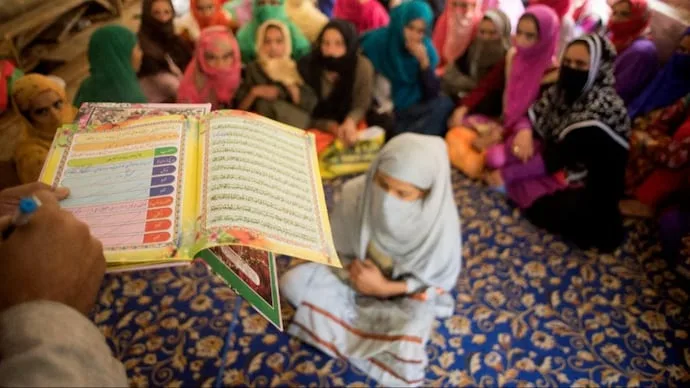
The petitioner argued that the provisions are not an essential religious practice and restrict individuals' right to dispose of self-acquired property

The petitioner argued that the provisions are not an essential religious practice and restrict individuals' right to dispose of self-acquired property

FacebookTwitterWhatsAppTelegramEmail

The Supreme Court on April 16, agreed to hear a Public Interest Litigation challenging provisions of the Muslim Personal Law (Shariat) Application Act, 1937, while making detailed observations on the limits of judicial intervention and the constitutional boundaries between Parliament and the judiciary.

A Bench comprising Chief Justice Surya Kant, Justice Joymalya Bagchi, and Justice Vipul M. Pancholi issued notice to the Union Ministry of Minority Affairs and sought its response on the plea filed by Poulomi Pavini Shukla and Nyaya Naari Foundation.

At the very outset, the Bench expressed hesitation on the scope of the challenge. Chief Justice Kant observed that the court could not step into legislative territory. “We can neither legislate nor create amendments,” he said, adding that replacing personal laws with the Indian Succession Act could amount to judicial legislation.

The court, however, agreed to proceed after senior advocate Prashant Bhushan argued that the provisions violate the fundamental right to equality under Article 14, particularly in matters of inheritance affecting Muslim women.

Calling the broader debate significant, the Chief Justice remarked that the idea of a Uniform Civil Code is a “constitutional ambition” and added, “it has nothing to do with religion.”

During the hearing, the Bench also questioned the maintainability of the petition in its current form. Chief Justice Kant asked, “Can someone who is not a Muslim file such a petition?” and stressed that “actual sufferers” must be brought on record.

He directed the petitioner side to implead affected women, stating, “You will have to add the affected women as party or intervenors so that it does not appear to be an issue of other persons challenging a faith.”

Justice Bagchi also made important observations on the nature of reform in personal law systems, stating, “It should seem as a reformation from within the faith itself.” He further added, “We have to see if it is within the domain of judiciary to bring in social reform.”

Bhushan argued that the provisions under Shariat law result in clear discrimination. “In the absence of a uniform civil law, around 100 million Muslim women are being discriminated against. Women receive half or even less than what male counterparts receive,” he submitted.

He further added, “This is purely civil in nature. It cannot be treated as an essential religious practice protected under Article 25.”

The Bench, however, raised caution on judicial substitution of legal frameworks. Justice Bagchi observed, “Threshold of reading down is higher since you are asking us to delete something. In some cases we decide the area was empty. Here Shariat law exists.”

Chief Justice Kant also pointed to institutional limits, stating, “That will go into legislating.”

Bhushan responded that the court could read down provisions and allow a neutral succession law to apply. “Once this is struck down, the Indian Succession Act can apply,” he argued.

The Bench, however, remained cautious, noting that such a move would require careful judicial restraint. “Some aggrieved person has to come,” the CJI reiterated, while acknowledging that “public interest element is there.”

Justice Bagchi also noted that even if reform is necessary, it must meet constitutional thresholds. “Even if part of religious practice, it has to be tested under constitutional guarantees,” he observed in response to arguments on equality.

The court ultimately issued notice and posted the matter for further hearing, directing the petitioners to bring “actual sufferers” on record and ensuring that the matter is properly constituted before deeper examination.

The Bench said it would proceed cautiously, balancing constitutional rights, personal laws, and the limits of judicial intervention.

Topics: Supreme CourtUniform Civil code (UCC)Muslim Personal Law Shariat Act 1937Shariat Act challengeMuslim women inheritance rights
ShareTweetSendShareSend
✮ Subscribe Organiser YouTube Channel. ✮
✮ Join Organiser's WhatsApp channel for Nationalist views beyond the news. ✮
Previous News

Balochistan Crisis Deepens: 9 civilians allegedly disappear, VBMP protest crosses 6,135 days

Next News

Beyond the Tracks: PM Modi highlights data-driven railway transformation, safety improves by 89% in a decade

Related News

Supreme Court of India

‘RTI activism has become business’: SC denies anticipatory bail, questions activist’s authority to monitor road project

The AMU Judgment: Why the Supreme Court must revisit Article 30

Tamil Nadu Assembly (File Photo)

Tamil Nadu speaker drops action against 21 rebel AIADMK MLAs after EPS withdrawal, targets 4 who joined TVK

Supreme Court remarks have revived the UAPA bail debate, with supporters citing national security concerns

UAPA Bail Debate: Striking a delicate balance between individual liberty and national security

Supreme Court invokes Article 142, issues strict timelines to curb delay in High Court judgments

Supreme Court invokes Article 142, orders strict timelines for High Court judgments to end delays in justice delivery

SIR and Article 324: Supreme Court strengthens the constitutional spine of Indian Democracy; Reaffirms ECI’s authority

Load More

Latest News

Indian Coast Guard (ICG) team with indigenous Air Cushion Vehicles (ACVs) in Goa on June 18, 2026

Indian Coast Guard inducts Indigenous Air Cushion Vehicle (ACV) for coastal security operations

Lebanon must get out of the clutches of Hezbollah

Demand to Free 22 Muslim Prisoners Sparks Fresh Political Controversy in Tamil Nadu (This image is generated by AI)

Tamil Nadu: After Muslim quota push, calls for early release of long-term Muslim prisoners stirs political storm

Prime Minister Narendra Modi with US President Donald Trump

A Handshake, Not a Hug: Why PM Modi must assert India’s strategic red lines in his crucial meeting with Trump

Next Radical Move by Muslim League in Kerala? Plants Jamaat-e-Islami Men in Congress Ministers’ Offices; Youth Protests

Golden Temple after Operation Blue Star in 1984

The immoral attempt by Congress to link BJP to Operation Blue Star

Madras High Court

Madras HC stays Church near temple in Coimbatore; petitioner alleges post-TVK govt push, flags malafide intentions

India’s first made-in-India C-295 aircraft marks a shift from state control to nation-building through public-private partnership

From Nationalisation to Nation Building: The difference between socialism and integral humanism

Representative Image

Karnataka’s fake teacher salary scam: RTI exposes closure of departmental inquiry against tainted officials

PPP Chairman Bilawal Bhutto Zardari

Pakistan: Bilawal Bhutto Zardari’s PPP to form govt in Gilgit-Baltistan with 11 seats after elections for 24-member

Load More
  • Privacy
  • Terms
  • Cookie Policy
  • Refund and Cancellation
  • Delivery and Shipping

© Bharat Prakashan (Delhi) Limited.
Tech-enabled by Ananthapuri Technologies

  • Home
  • Search Organiser
  • Bharat
    • Assam
    • Bihar
    • Chhattisgarh
    • Jharkhand
    • Maharashtra
    • View All States
  • World
    • Asia
    • Africa
    • North America
    • South America
    • Europe
    • Australia
  • Editorial
  • Operation Sindoor
  • Opinion
  • Analysis
  • Defence
  • Culture
  • Sports
  • Business
  • RSS @ 100
  • Entertainment
  • More ..
    • Sci & Tech
    • Vocal4Local
    • Special Report
    • Education
    • Employment
    • Books
    • Interviews
    • Travel
    • Health
    • Politics
    • Law
    • Economy
    • Obituary
  • Subscribe Magazine
  • Read Ecopy
  • Advertise
  • Circulation
  • Careers
  • About Us
  • Contact Us
  • Policies & Terms
    • Privacy Policy
    • Cookie Policy
    • Refund and Cancellation
    • Terms of Use

© Bharat Prakashan (Delhi) Limited.
Tech-enabled by Ananthapuri Technologies