Sabarimala: SC says religion can’t be “hollowed out” for reform
June 8, 2026
  • Read Ecopy
  • Circulation
  • Advertise
  • Careers
  • About Us
  • Contact Us
Android AppiPhone AppArattai
Organiser
  • ‌
  • Bharat
    • Assam
    • Bihar
    • Chhattisgarh
    • Jharkhand
    • Maharashtra
    • View All States
  • World
    • Asia
    • Europe
    • North America
    • South America
    • Africa
    • Australia
  • Editorial
  • International
  • Opinion
  • RSS @ 100
  • More
    • Op Sindoor
    • Analysis
    • Sports
    • Defence
    • Politics
    • Business
    • Economy
    • Culture
    • Special Report
    • Sci & Tech
    • Entertainment
    • G20
    • Azadi Ka Amrit Mahotsav
    • Vocal4Local
    • Web Stories
    • Education
    • Employment
    • Books
    • Interviews
    • Travel
    • Law
    • Health
    • Obituary
  • Subscribe
    • Subscribe Print Edition
    • Subscribe Ecopy
    • Read Ecopy
  • ‌
  • Bharat
    • Assam
    • Bihar
    • Chhattisgarh
    • Jharkhand
    • Maharashtra
    • View All States
  • World
    • Asia
    • Europe
    • North America
    • South America
    • Africa
    • Australia
  • Editorial
  • International
  • Opinion
  • RSS @ 100
  • More
    • Op Sindoor
    • Analysis
    • Sports
    • Defence
    • Politics
    • Business
    • Economy
    • Culture
    • Special Report
    • Sci & Tech
    • Entertainment
    • G20
    • Azadi Ka Amrit Mahotsav
    • Vocal4Local
    • Web Stories
    • Education
    • Employment
    • Books
    • Interviews
    • Travel
    • Law
    • Health
    • Obituary
  • Subscribe
    • Subscribe Print Edition
    • Subscribe Ecopy
    • Read Ecopy
Organiser
  • Home
  • Bharat
  • World
  • Operation Sindoor
  • Editorial
  • Analysis
  • Opinion
  • Culture
  • Defence
  • International Edition
  • RSS @ 100
  • Magazine
  • Read Ecopy
Home Bharat

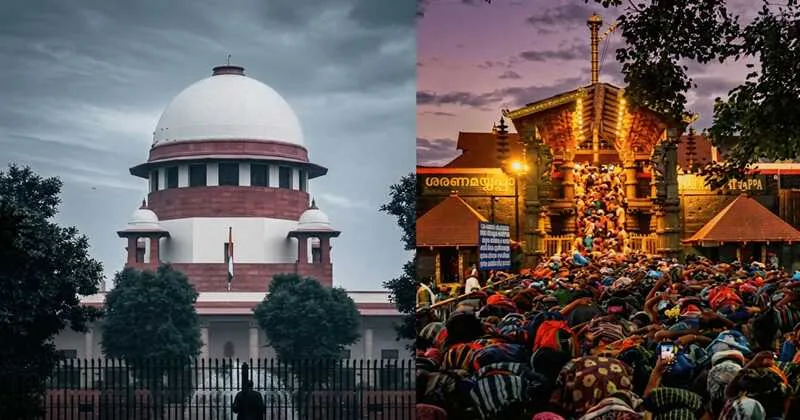
Religion cannot be “Hollowed Out” in the name of social reform, says Supreme Court in Sabarimala case

The Supreme Court has observed that religion cannot be “hollowed out” in the name of social reform while hearing review petitions in the Sabarimala case. The Bench is examining the delicate constitutional balance between religious freedom and the scope of judicial intervention in matters of faith

Dr Vishnu AravindDr Vishnu Aravind
Apr 16, 2026, 01:30 pm IST
in Bharat, Kerala
Follow on Google News
During Sabarimala review hearings, Supreme Court underscores limits of reform and cautions against diluting core religious beliefs

During Sabarimala review hearings, Supreme Court underscores limits of reform and cautions against diluting core religious beliefs

FacebookTwitterWhatsAppTelegramEmail

New Delhi: No religion can be “hollowed out” in the name of social welfare and reform, the Supreme Court observed on Wednesday while hearing petitions seeking a review of its earlier order permitting the entry of women of child-bearing age into Keralam’s renowned Sabarimala mandir. A nine-judge Bench emphasised that essential religious practices cannot be stripped away under the pretext of reform, noting that one of the most complex challenges before the judiciary is to declare the deeply held beliefs of millions as incorrect.

The Bench, led by Chief Justice of India Surya Kant, is currently examining a set of crucial constitutional questions arising from the Sabarimala case, particularly those concerning the balance between the right to freedom of religion and the scope of social reform. In its landmark 2018 judgment, the Supreme Court had ruled that women of all age groups should be allowed entry into the Sabarimala mandir. At the time, a five-judge Bench had held that restrictions based on age could not be regarded as essential religious practices, and had likened the exclusion of women between the ages of 10 and 50 to a form of untouchability.

Court questions limits of judicial intervention

During the hearing on Wednesday, the Bench engaged in a detailed discussion on whether Public Interest Litigations (PILs) should be entertained in matters concerning religion. Chief Justice Surya Kant remarked that one of the most difficult tasks faced by the Court is determining how to declare beliefs held by large sections of society as erroneous. Justice MM Sundresh raised a pertinent concern, questioning whether the Court could adjudicate such sensitive issues without first hearing the voices and representations of the millions of individuals directly affected. Justice BV Nagarathna echoed similar reservations, observing that PILs should not be entertained when petitioners act merely as interlopers without a genuine stake in the matter. She cautioned that judicial intervention must not result in hollowing out a religion under the guise of reform.

Debate over constitutional balance

Appearing on behalf of the Travancore Devaswom Board, which administers the Sabarimala mandir, senior advocate Abhishek Manu Singhvi elaborated on the constitutional interplay between Articles 25 and 26. He argued that both provisions must be harmoniously interpreted to preserve the delicate balance between individual rights and institutional autonomy. Article 25 guarantees every individual the freedom of conscience and the right to freely profess, practise, and propagate religion. At the same time, Article 26 grants religious denominations the authority to manage their own religious affairs. However, Article 25(2)(b) empowers the State to enact laws aimed at social reform and to ensure access to religious institutions for all sections of society.

Singhvi contended that while members of all Hindu communities may claim a right to enter mandirs, religious institutions must retain the autonomy to regulate their internal practices and rituals. He stressed that any legislative or judicial intervention must ensure that the core identity and character of a religion remain intact.

Also Read: Amravati Video Scandal: How Islamists from coaching centres managed to trap over 300 girls and made 180 obscene videos?

Justice Joymalya Bagchi posed a crucial question during the proceedings, asking whether this interpretation would imply that essential religious practices are beyond the scope of legislative change. In response, Singhvi argued that it is not the role of the judiciary to determine what constitutes an essential religious practice. He strongly criticised the “essential religious practices” test, asserting that it effectively grants judges the authority to define the core elements of a religion. According to him, once courts begin using terms such as “essential” or “integral,” they inevitably enter the domain of religious interpretation, thereby allowing external adjudicators to decide what forms the essence of a faith. Singhvi maintained that religious practices must be evaluated from the perspective of the community that adheres to them, rather than through external or judicial standards. He further argued that any practice that is conscientiously held as part of a religion should be afforded constitutional protection, subject only to the limitations imposed by public order, morality, health, and other fundamental rights under Article 25.

Social Reform Versus Religious Autonomy

Justice MM Sundresh also questioned the rationale behind the inclusion of the term “social reform” in Article 25(2)(b). Addressing this, Singhvi explained that such provisions were introduced to enable the eradication of entrenched social evils. Laws enacted under this clause, he said, are intended to promote reform while maintaining constitutional safeguards. The case continues to centre around the long-standing practice at the Sabarimala mandir, where women of menstruating age have traditionally been barred from entry. Devotees regard the presiding deity, Bhagwan Ayyappa, as a celibate, and the restriction has historically been justified on that basis.

In the 2018 judgment, then Chief Justice of India Dipak Misra had held that devotion cannot be subjected to discrimination, and that patriarchal notions must not override the principle of equality in matters of faith.

However, the Travancore Devaswom Board has consistently maintained that the restriction is not discriminatory towards women. It has urged the Court to refrain from adjudicating on matters of religious belief and practice, arguing that such issues fall within the domain of faith rather than judicial scrutiny.

As the hearings continue, the Supreme Court is tasked with resolving a complex constitutional dilemma, how to reconcile the principles of equality and social reform with the autonomy and integrity of religious traditions, without undermining either.

 

Topics: Sabarimala caseArticle-25Religious freedomArticle 26Supreme Court Of IndiaTravancore Devaswom Board
ShareTweetSendShareSend
✮ Subscribe Organiser YouTube Channel. ✮
✮ Join Organiser's WhatsApp channel for Nationalist views beyond the news. ✮
Previous News

Boat carrying Rohingyas capsized in Andaman Sea; Reflects illegal migration & security risks posed by the refugees

Next News

Karnataka Horror: Juhaib arrested by police for assaulting Hindu woman and forcing her to marry

Related News

Nine Member Constitution Bench questions the legitimacy of PIL-driven intervention in Sabarimala traditions, raising sharp observations on faith, locus standi and judicial process.

Sabarimala Case: ‘Mind your business’, SC slams petitioner Naushad Khan of Young Lawyers Association

Representative image

No dispute on women entering Mosques since Prophet’s time: Justice Amanullah during SC hearing

Centre backs mandir autonomy, stresses limited state role and respect for diverse religious practices

Sabarimala Case: Centre tells Supreme Court it opposes state control of Mandirs, backs autonomy

Supreme Court of India bench hears Sabarimala review pleas as Justice B. V. Nagarathna questions non-devotee challenges to rituals

Sabarimala Case: “Believers don’t question rituals; non-believers can’t challenge them,” says Justice B. V. Nagarathna

Corporatisation of grooming gangs: Need clarity over correctness

National anti-conversion law demand sparks debate on rights & social harmony

Growing demand for a strict national anti-conversion law sparks debate on constitutional rights & social harmony

Load More

Latest News

Pakistan Prime Minister Shehbaz Sharif face the brunt as Punjab draws excess water from Indus basin and Sindh suffers from scarcity

Pakistan: Indus water drifts to Punjab & erupts political rift; Acute crisis in Dadu canal & drought in Sindh

Cobra Commandos land in Manipur to curb insurgency and restore peace

CoBRA Commandos Deployed in Manipur: CRPF draws red line for insurgents, Promises decisive action

North 24 Parganas: A large crowd of Bangladeshis residing in West Bengal gathers at the Hakimpur border crossing in the Basirhat subdivision of North 24 Parganas district to cross over to Bangladesh

Unnatural Demographic Change: Hint that would create a heat

Odisha: RSS Sangh Shiksha Varg concludes in Sambalpur; Dr. Mahapatra cites century-long effort to unite hindu society

‘TMC Will Not Survive’: Sukhendu Sekhar Ray Warns of Bigger Revolt as Bengal Rebellion Threatens to Reach Parliament

‘TMC will not survive’: MP Sukhendu Sekhar Ray warns MLA revolt could soon engulf parliament

Former Chief Minister Siddaramaiah and his wife Parvathi is accused in MUDA site allotment case

Karnataka: Congress govt under fire over Yathindra’s appointment amid pending MUDA-linked controversy

High Level Committee on Demographic Change: Fructification of sustained efforts

Gaurdian Journalist Hannah Ellis-Petersen covering the protest of the Cockroach Janata Party(CJP)

Guardian Journalist Ellis-Petersen amplifies Cockroach Party protest: Exposing anti-India propaganda of western media

A large crowd of Bangladeshis residing in West Bengal gathers at the Hakimpur border crossing in the Basirhat subdivision of North 24 Parganas district to cross over to Bangladesh

Unnatural Demographic Change: Securing Bharat against the silent invasion

Prime Minister Narendra Modi

BJP’s Victory with Vision: An idea of India that is Indian

Load More
  • Privacy
  • Terms
  • Cookie Policy
  • Refund and Cancellation
  • Delivery and Shipping

© Bharat Prakashan (Delhi) Limited.
Tech-enabled by Ananthapuri Technologies

  • Home
  • Search Organiser
  • Bharat
    • Assam
    • Bihar
    • Chhattisgarh
    • Jharkhand
    • Maharashtra
    • View All States
  • World
    • Asia
    • Africa
    • North America
    • South America
    • Europe
    • Australia
  • Editorial
  • Operation Sindoor
  • Opinion
  • Analysis
  • Defence
  • Culture
  • Sports
  • Business
  • RSS @ 100
  • Entertainment
  • More ..
    • Sci & Tech
    • Vocal4Local
    • Special Report
    • Education
    • Employment
    • Books
    • Interviews
    • Travel
    • Health
    • Politics
    • Law
    • Economy
    • Obituary
  • Subscribe Magazine
  • Read Ecopy
  • Advertise
  • Circulation
  • Careers
  • About Us
  • Contact Us
  • Policies & Terms
    • Privacy Policy
    • Cookie Policy
    • Refund and Cancellation
    • Terms of Use

© Bharat Prakashan (Delhi) Limited.
Tech-enabled by Ananthapuri Technologies