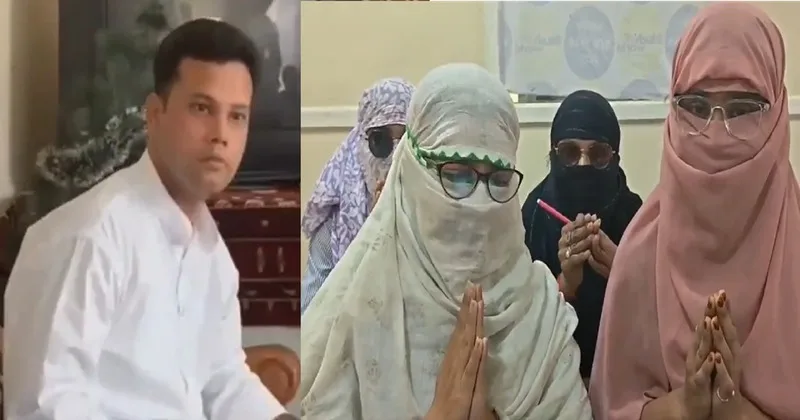
A case involving a “coaching center” from Jhansi, Uttar Pradesh, has now become a subject of national debate. Specifically, grave allegations levelled by female students against ‘Sohail Ahmed Khan, ‘ a teacher at ‘Study World Classes,’ a coaching centre operating within the Mission Compound area of the Kotwali police station limits in Jhansi, UP, have sparked tension throughout the region. The students have alleged that this English teacher, while conducting lessons, makes religious remarks pertaining to Islam and allegedly attempts to persuade and pressure them to embrace the Islamic faith. Furthermore, the students stated that, under the pretext of providing study notes, he asks them to share their mobile numbers and requests them to engage in conversations late at night.
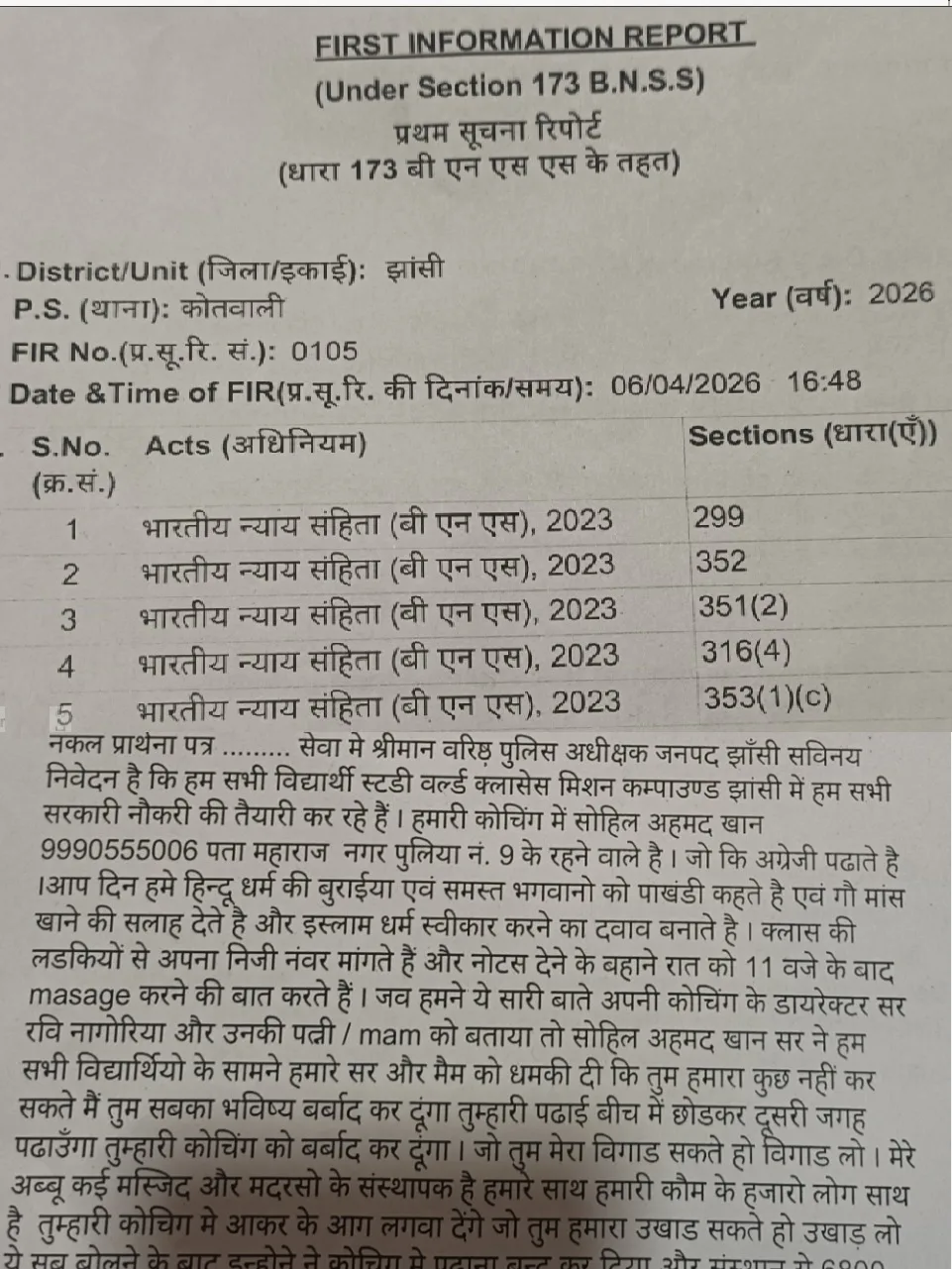
Given the gravity of the matter, the police have taken action based on a complaint filed the previous day and have registered a First Information Report (FIR). Addressing the incident, City Circle Officer (CO) Lakshmikant Gautam clarified that a case has been registered under the relevant sections of the law and that legal proceedings against the accused are currently underway. He further added that the police are conducting a thorough investigation into the entire affair.
The aforementioned FIR states: “…At our coaching institute, Sohail Ahmed Khan teaches English. He frequently disparages the Hindu religion, labels all Hindu deities as impostors, advises us to consume beef, and pressures us to embrace Islam. He asks female students in the class for their personal contact numbers and, under the pretext of providing study notes, suggests messaging them after 11:00 PM. When we reported these matters to our coaching institute’s Director, Mr. Ravi Nagoria, and his wife (the ‘Madam’), Sohail Ahmed Khan threatened them in front of all the students, declaring: ‘You cannot do anything to me. I will ruin all your futures; I will abandon your studies midway to teach elsewhere, and I will destroy your coaching institute. Do whatever harm you can to me, do it now. My father is the founder of several mosques and madrasas, and thousands of people from my community stand with me. I will come to your coaching center and have it set on fire…’”
Misuse of the Educational Platform?
On the other hand, this incident points to a broader concern: the alleged misuse of educational platforms to propagate Islamic ideology. It is allegedly being utilised to facilitate religious conversions and to mock the deities of the majority Hindu community. The allegations made by the female students reveal that the teacher not only made religious remarks but also interfered in their dietary choices, offering specific advice in this regard, and allegedly attempted to influence the students’ mindsets. If these allegations are substantiated during the investigation, they pose a grave threat to the fundamental spirit of education. However, the accused teacher has denied these allegations, claiming that he was embroiled in a financial dispute with the coaching centre’s management and is being framed as a result. This counter-narrative also forms a part of the ongoing investigation.
Analysing the Incident in a Broader Context
To fully comprehend this entire episode, it is essential to view it within a larger context. Often, such incidents appear to stem from a mindset in which an individual seeks to position themselves as an ideological propagandist. In India, the name ‘Zakir Naik’ is frequently cited in this context, as his style has mirrored that of such a teacher. Everyone must bear in mind that, within the Indian tradition, the definition of knowledge has always been remarkably comprehensive and balanced. Here, knowledge is not merely the acquisition of information; it is a process of understanding life, cultivating wisdom, and maintaining equilibrium within society. The principle of “Satyam Vada, Dharmam Chara” (Speak the Truth, Practice Righteousness), enshrined in the Upanishads, clearly establishes that the ultimate objective of education is to uphold truth and morality. In the “Gurukul” tradition, the Guru’s role was to guide the disciple rather than impose their own beliefs. Asking questions, engaging in rational inquiry, and exercising independent judgment have, in fact, always constituted integral components of education.
The Distinction Between Brainwashing and Education
Viewed from this perspective, the distinction between ‘brainwashing’ and ‘education’ becomes abundantly clear. Education flourishes where independent thought is encouraged, whereas brainwashing occurs when an individual is induced or compelled to think in a predetermined direction. Education teaches respect for diversity, whereas brainwashing often fosters a propensity to prove others wrong. Education fosters self-reliance, whereas brainwashing promotes dependency and blind conformity.
A Warning for the Education System
The allegations that have surfaced regarding the incident in Jhansi, including religious remarks, alleged pressure to convert, and inappropriate contact with female students- if substantiated by an investigation, would serve as a grave warning to the education system. Such findings would cast a shadow of doubt over the entire educational framework. This is because similar cases have periodically emerged in various parts of the country in the past, where teachers or institutions have been accused of attempting to ideologically influence their students. The recurring pattern of these incidents suggests that the problem is, in some quarters, assuming widespread proportions, a scenario in which non-Muslims appear to be the targets everywhere.
The JMD Coaching Centre Episode in Delhi
Manoj, who runs an auto garage in Delhi, visited the ‘Jai Mata Di’ (JMD) Coaching Centre in the city along with his sons. After meeting a man named Sanjay there, he enrolled his sons in the coaching institute. However, some time later, when his elder son asked, “What is the Quran?” and as this specific “term” was repeatedly emphasised, it came to light that a certain Mohammad Rizwan was present at the coaching centre. It was he who had been speaking to the children about these matters; specifically, Manoj’s elder son had been told, “You should start reading the Quran, because Islam is far more powerful than your religion (Hindutwa).”
Manoj’s elder son further revealed, “Rizwan Sir told me to read the Quran and to stop worshipping Hindu deities, because, according to him, Hindu gods and goddesses possess no power.” In this manner, the teachers at the institute made concerted efforts to entice and persuade the young boy into converting to Islam.
Examples from Raisen and Moradabad
Another case surfaced in the Raisen district of Madhya Pradesh, where a private school was found to be using Islamic religious references in its nursery-level English textbooks, replacing traditional educational examples with religious content. In the book, students were being taught that ‘K’ stands for Kaaba, ‘M’ for Mosque, ‘N’ for Namaz (prayer), and ‘O’ for a woman in a Hijab. In a government library in Moradabad, Uttar Pradesh, activities amounting to ‘Love Jihad’ were allegedly being facilitated. Asif Hasan, a senior assistant at the library, stands accused of encouraging female students visiting the facility to interact with young Muslim men and engaging them in conversations related to Islam. Disturbed by Asif Hasan’s conduct, several female students filed a written complaint with the District Magistrate (DM) regarding the matter.
Incidents in Bhopal, Indore and Other Locations
In Bhopal, Madhya Pradesh, a ‘Muslim gang’—comprising Hamid, Farhan, and Sahil, would entrap college girls by luring them with the promise of friendship. Subsequently, they would force them into sexual relations. Furthermore, they would pressure the girls to convert their religion and make derogatory remarks against Hindutwa. In another case in Bhopal, a conversion racket operating under the guise of a beauty parlor was exposed. In Indore, a ‘grooming gang’ operating under the cover of a shooting academy was apprehended. Just recently in Mewar (Rajasthan), a gang of young Muslim men was involved in entrapping Hindu girls, subjecting them to rape and blackmail, and forcing them into religious conversion. There are numerous such incidents to recount occurring across the country that are linked to educational institutions.
The fundamental question remains: why does this mindset persist, the belief that non-Muslims (Hindus, Jains, Sikhs, Buddhists, and others) must be converted to Islam? In this context, it must be emphasized that the incident in Jhansi serves as a warning; understanding this warning and drawing lessons from it constitutes the most significant response for the sake of our democracy. How can this mindset be eradicated? What concrete steps, ultimately, need to be taken to address this? Indeed, there is an urgent need today for both society and the administration to reflect deeply on this issue; only then, perhaps, can India find deliverance from such incidents.