On February 28, 2026, the United States and Israel launched what was arguably the most intensive air campaign against a single nation since the Second World War. Over 800 strikes. B-2 stealth bombers. GBU-57 bunker busters — the most powerful conventional weapons in the American arsenal. The declared objectives were sweeping: destroy Iran’s missile programme, eliminate its nuclear capability and force the Islamic Republic into unconditional surrender.
Forty days later, Iran still had missiles. It still controlled the Strait of Hormuz. It still had leverage. And it negotiated a ceasefire on its own terms. This was not resilience by accident. It was the product of a doctrine built over three decades, drawing simultaneously from Quranic theology, Shia spiritual tradition, and Persian imperial memory. To understand why the most sophisticated air campaign in modern history failed to break Iran, you have to understand three Arabic words: I’dad, Sabr and Istidraj.
The mountain that was always going to win
Before examining the ideology, the physical reality demands acknowledgement. Iran’s so-called “Missile Cities” — a network of underground bases buried up to 500 metres deep in solid granite mountains — represent one of the most extraordinary feats of military engineering in the modern era. Inside these facilities, automated rail systems move ballistic missiles from deep storage to launch-ready positions in under 15 minutes. Blast-resistant doors, independent power generation, fiber-optic communications, and compartmentalised tunnel networks ensure that even a direct hit on one section does not compromise the whole.
The fundamental problem for the United States was geological. The GBU-57 Massive Ordnance Penetrator — America’s most powerful bunker-busting munition — achieves a maximum penetration of 6 to 10 metres against solid granite. Iran’s critical facilities sit 500 metres below the surface. No amount of precision or sortie generation closes that gap. Despite 77 percent of visible tunnel entrances being struck, operations at the sites resumed within days. Construction equipment arrived, debris was cleared, and the railways kept delivering missiles to the surface.
As one analyst observed during the conflict: “IRGC did not prepare for this war by building rockets. It prepared by building railways inside mountains. The rockets are replaceable. The railways are permanent. And the granite that protects them was formed before mammals existed.”
I’dad: Preparation as sacred obligation
The question that demands an answer is not how Iran built this infrastructure, but why it prioritised it so absolutely — spending an estimated two to three trillion dollars over decades on military and nuclear capability while 30 million of its own citizens could not meet their daily calorie needs.
The answer begins in Surah Al-Anfal, chapter 8, verse 60 of the Quran: “Prepare against them whatever force you are able — to terrify the enemies of Allah and your enemies.”
The operative Arabic concept is I’DAD — preparation, readiness, the obligation to accumulate force. In the Islamic Revolutionary Guard Corps’ ideological framework, underground missile cities are not line items in a defence budget. They are the fulfilment of a divine command. Every tunnel excavated, every missile stored, every blast door installed is framed as an act of religious compliance.
It is essential to distinguish here between Islamic doctrine broadly and the IRGC’s specific political weaponisation of that doctrine. I’dad as a theological concept is legitimate Islamic scholarship. The IRGC’s application of it — to justify decades of defence spending at the direct expense of the Iranian civilian population — is a political choice dressed in religious language. The Iranian people paid the price for that interpretation. But the interpretation itself explains a resource allocation that appears irrational by any conventional strategic calculus, and becomes entirely coherent once the theological framing is understood.
Sabr: The strategy of endurance
The second doctrine is Sabr — patience and endurance — a concept that appears more than 90 times across the Quran and sits at the heart of Islamic spiritual practice. In the IRGC’s operational culture, Sabr is not merely a personal virtue. It is a strategic instrument.
Iran lost its Supreme Leader on the first day of the war. Senior IRGC commanders were killed in the opening strikes. Significant surface infrastructure was destroyed. By any Western military assessment framework, these losses should have produced either capitulation or at minimum a dramatic degradation in operational tempo. Instead, Iran maintained an average of 120 drone and missile attacks per day throughout the entire 40-day conflict.
The explanation lies in how suffering is framed within the regime’s ideological system. In Western strategic culture, absorbing catastrophic losses is a cost — something to be minimised, avoided, and ultimately used as justification for negotiated settlement. In the IRGC’s doctrinal framework, absorbing those same losses while continuing to fight is theological virtue. Suffering is not a cost. It is the strategy itself — and it draws its deepest roots from Karbala.
Karbala: The political weaponisation of grief
In 680 AD, Imam Hussein ibn Ali — the grandson of the Prophet Muhammad — chose death over submission to the Umayyad caliph Yazid. His martyrdom at Karbala is among the most sacred events in Shia Islam, observed by approximately 200 million believers worldwide as a moment of profound spiritual significance.
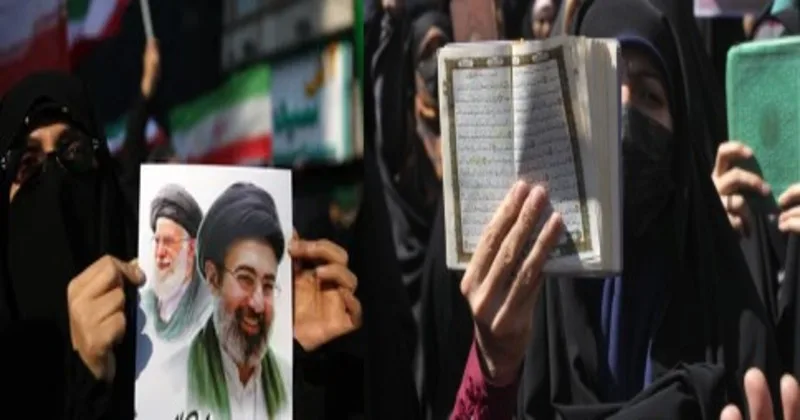
The Islamic Republic has spent 47 years appropriating that grief as a political weapon. IRGC soldiers are not trained to mourn Karbala in the traditional Shia sense. They are trained to replicate it — to see themselves as Hussein, their enemies as Yazid, and their willingness to absorb punishment as religious replication of the imam’s choice. Trump is cast as the modern Yazid. America as the modern Umayyad empire. Submission, in this framing, is not strategic calculation. It is apostasy.
Most Iranian Shia Muslims would reject this manipulation of their faith. Many do, privately and sometimes publicly. The regime’s survival depends on sufficient numbers not recognising the distinction between genuine Shia theology and its political instrumentalisation.
Istidraj: The art of patient overextension
The third doctrine — Istidraj — is perhaps the most sophisticated. Drawn from Surah Al-A’raf 7:182, it describes the gradual leading of an arrogant enemy into a trap of their own making: “Those who deny Our signs — We will gradually lead them where they do not know”.
Iran’s entire strategic architecture in this conflict was built around a single calculated bet: that American political will, public tolerance for high energy prices, and coalition cohesion would collapse before Iranian granite did. Rather than seeking a quick military resolution it could not achieve, Iran absorbed strikes, maintained missile fire, closed Hormuz, and waited.
The results speak for themselves. Iran received a ceasefire based on its own 10-point proposal. Its enriched uranium stockpile remains intact and in-country. The Strait of Hormuz stays under IRGC control with a formalised revenue mechanism. A new Supreme Leader — reportedly more hardline than his father — is in place. China, India, Russia, and Pakistan were successfully disaggregated from the Western coalition through selective passage exemptions. Thirteen American service members were killed. Over 365 were wounded. Not one declared US war aim was achieved.
The lesson
Iran’s survival in Operation Epic Fury was not a military miracle. It was the predictable outcome of a doctrine assembled from Quranic obligation, Shia martyrdom theology, Persian strategic patience, and Soviet-North Korean engineering — executed over 30 years with absolute prioritisation.
The world’s most powerful air force encountered something it had not fully war-gamed: an adversary for whom suffering is doctrine, preparation is worship, and patience is a weapon older than any bunker buster in the American inventory.
Trump came for unconditional surrender. He found a theology that had been building railways inside mountains for 30 years.