The intellectual legacy of BR Ambedkar is often invoked across the political spectrum, but one of the most compelling and underexplored dimensions of his thought is his critique of Marxism. At a time when socialist ideas are once again gaining traction in global and Indian discourse, revisiting Ambedkar from a different perspective reveals a thinker deeply committed to institutional stability, individual liberty, and gradual reform rather than ideological upheaval. Far from being an unquestioning ally of leftist thought, Ambedkar offered a powerful intellectual challenge to Marxism that remains relevant in contemporary debates about justice, governance, and national unity.
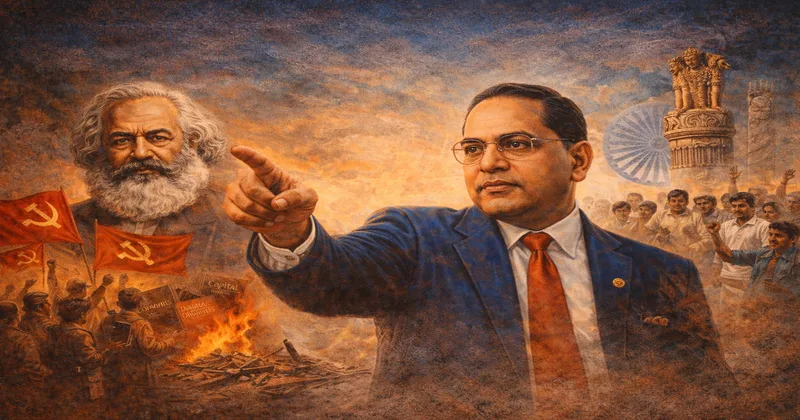
Ambedkar’s engagement with Marxism was rooted in respect for its critique of economic exploitation, yet he found its framework fundamentally incomplete. Influenced by, but not beholden to, the ideas of Karl Marx, Ambedkar argued that Marxism’s singular focus on class struggle ignored the uniquely entrenched and civilizational-embedded reality of caste in India. From a conservative standpoint, this insight underscores the danger of importing universal ideological templates into deeply complex societies. Ambedkar recognised that India’s social order could not be reduced to economic categories alone, and any attempt to do so risked misunderstanding the problem itself. This scepticism toward one-size-fits-all theories aligns closely with a right-wing preference for context-sensitive, culturally rooted policymaking.
A central pillar of Ambedkar’s critique was his rejection of violent revolution as a legitimate tool for social transformation. Marxist theory, with its emphasis on overthrowing existing systems through force, stood in stark contrast to Ambedkar’s belief in constitutionalism and democratic evolution. He warned that methods shape outcomes, and that a system born out of coercion is unlikely to sustain freedom or justice. This concern resonates strongly with conservative thought, which typically prioritises order, stability, and the rule of law over radical disruption. In today’s political climate, where ideological polarisation often fuels calls for sweeping and abrupt change, Ambedkar’s insistence on institutional continuity offers a sobering counterpoint.
Equally significant was Ambedkar’s defence of individual liberty against the collectivist tendencies of Marxism. Historical experiences with Marxist regimes have shown that the pursuit of absolute equality can come at the cost of personal freedoms, a trade-off Ambedkar was unwilling to accept. Having personally endured systemic discrimination, he placed immense importance on individual dignity and autonomy. From a right-wing perspective, this emphasis reinforces the idea that freedom must remain central to any vision of justice. Economic policies, no matter how well-intentioned, cannot justify the erosion of fundamental rights. Ambedkar’s framework thus challenges both unrestrained collectivism and excessive state control.
Ambedkar also questioned the Marxist assumption that economic restructuring alone would dissolve social hierarchies. He argued that caste, unlike class, possesses a cultural and religious dimension that cannot be eradicated solely through changes in property relations. This critique highlights a broader conservative insight: that social institutions and traditions have a persistence that cannot be engineered away overnight. Attempts to forcibly flatten these structures without addressing their underlying social logic often led to unintended consequences. Ambedkar’s approach, which combined legal reform with social awakening, reflects a more measured and sustainable path to change.
From a governance perspective, Ambedkar’s preference for incremental reform over sweeping revolution aligns closely with right-of-centre policy thinking. Rather than advocating for the dismantling of economic systems, he supported targeted interventions such as reservations, labour protections, and educational access. These measures sought to expand opportunity without destabilising the broader institutional framework. This balance between reform and continuity is a hallmark of conservative policymaking, which tends to favour evolution over disruption. Ambedkar’s vision demonstrates that meaningful change does not require abandoning the structures that hold society together.
Another aspect of Ambedkar’s thought that resonates with the right is his critique of ideological dogmatism. He was wary of any system that claimed absolute authority over truth, whether rooted in religion or political theory. Marxism, in its more rigid interpretations, often functions as a closed ideological system resistant to critique. Ambedkar, by contrast, championed rational inquiry, debate, and adaptability. This intellectual openness is essential in a democratic society, where policies must respond to changing realities rather than adhere to fixed doctrines. His scepticism toward ideological rigidity serves as a reminder that no single framework can adequately address the complexities of human society.
Ambedkar’s emphasis on fraternity as a foundational principle of social life also offers an important corrective to the divisive tendencies of class-based politics. While Marxism foregrounds conflict as the engine of change, Ambedkar believed that social harmony and mutual respect were indispensable for a stable and cohesive nation. From a right-wing perspective, this focus on unity over perpetual struggle aligns with the goal of building a strong national identity. A society fractured along lines of class, caste, or ideology cannot sustain long-term progress. Ambedkar’s call for fraternity underscores the importance of shared values and collective purpose.
In the contemporary context, the resurgence of socialist rhetoric often reflects genuine concerns about inequality and economic concentration. However, Ambedkar’s critique cautions against embracing solutions that overlook the importance of institutions, incentives, and individual agency. Policies driven by redistributive zeal but lacking in structural understanding can undermine economic dynamism and social stability. A right-leaning reading of Ambedkar would advocate for empowering individuals through education, entrepreneurship, and equal opportunity rather than relying solely on state-led redistribution. This approach seeks to address inequality without stifling growth or innovation.
Ambedkar’s faith in the Constitution as a living document further reinforces his alignment with institutionalism. He believed that change should be pursued within the framework of law, not outside it. This respect for legal processes is a cornerstone of conservative thought, which views institutions as safeguards against arbitrary power. In an era marked by rising populism and distrust of established systems, Ambedkar’s commitment to constitutional morality serves as a vital reminder of the need to preserve democratic norms. His warnings against the misuse of power, regardless of ideological justification, remain strikingly relevant. He was unequivocal in his opposition to inequality and discrimination, and any interpretation of his thought must take this seriously. However, his methods and principles offer a distinct alternative to Marxist approaches, one that prioritises reform over revolution, liberty alongside equality, and unity over division. This balanced framework provides a valuable lens through which to address contemporary challenges.
Ultimately, Ambedkar’s critique of Marxism matters today because it bridges the gap between the pursuit of justice and the preservation of order. It challenges the assumption that radical change is the only path to progress and instead offers a vision rooted in democratic evolution, institutional strength, and individual dignity. For those on the right, engaging with Ambedkar is not merely an exercise in intellectual history but an opportunity to articulate a model of governance that is both compassionate and pragmatic. His ideas remind us that a just society is not built through upheaval alone, but through careful, sustained effort grounded in the realities of human nature and social complexity.