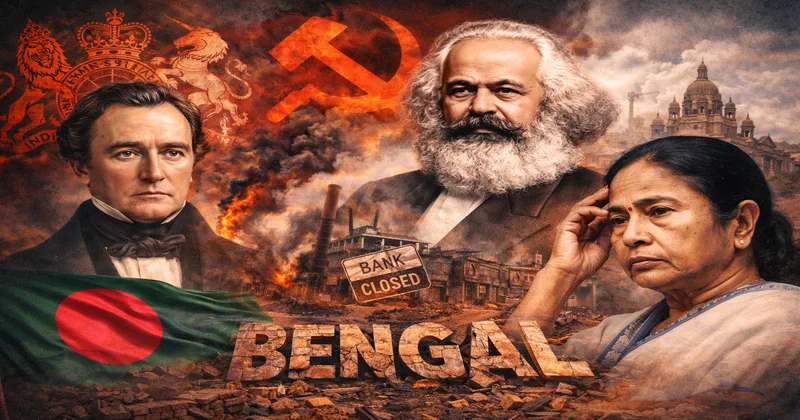
Few regions in the Indian subcontinent carry as much historical gravitas as West Bengal. Once the epicentre of intellectual ferment, industrial enterprise, and nationalist politics, Bengal produced reformers, scientists, jurists, artists and entrepreneurs who shaped modern Bharat. Kolkata (formerly Calcutta) was the capital of British India until 1911 and among Asia’s most important commercial cities. Its port linked eastern Bharat to global markets; its universities shaped generations of civil servants; its press influenced political consciousness across the subcontinent.
Yet contemporary West Bengal struggles with industrial stagnation, high unemployment, capital flight, fiscal stress, and a pervasive culture of political patronage. Its relative economic position among Bharatiya states has declined over the decades. This transformation invites an uncomfortable but necessary question: Who bears responsibility?
Is the answer rooted in the educational policies of Thomas Babington Macaulay and his 1835 “Minute on Indian Education”? Does responsibility lie with the 34-year rule (1977–2011) of the Communist Party of India (Marxist)? Is it attributable to the populist welfare orientation under Mamata Banerjee and her All India Trinamool Congress? Or does the explanation lie deeper—in the socio-cultural evolution of Bengal’s Hindu elite, the bhadralok, whose historical advantages under colonial modernity did not translate into entrepreneurial dynamism in a post-liberalisation economy?
Bengal’s economic predicament is not the result of a single regime or ideology, it is the cumulative outcome of nearly two centuries of educational design, political ideology, governance choices, and cultural psychology.
I. Macaulay’s Project and Bhadralok’s Birth
In 1835, Macaulay argued before the Governor-General’s Council for the introduction of English education in Bharat. His stated objective was to create a class of intermediaries—Bharatiya in blood and colour, but English in taste, opinions, morals and intellect—who would assist in administering the colony. The consequences in Bengal were transformative.
English education rapidly became a gateway to social mobility. Institutions in Calcutta began producing a new class of English-educated, upper-caste Hindu professionals. This class, later described as the bhadralok, dominated administration, law, academia, journalism and the colonial bureaucracy. They were articulate, literate, reform-minded and politically conscious. From this milieu emerged the Bengal Renaissance, social reform movements, patriotic leaders and intellectual luminaries.
However, the structural design of the educational system had long-term economic implications: Western liberal arts and legal education were privileged over vocational training, engineering, commerce or industrial management; Employment in the colonial bureaucracy offered prestige, stability and status; and salaried employment became the gold standard of success, commerce and trade were often relegated to non-bhadralok communities.
This was not accidental. Colonial governance required clerks, translators, judges and administrators—not industrial entrepreneurs competing with British capital. Thus, while Bengal developed a formidable intellectual class, it did not simultaneously nurture a broad-based indigenous capitalist class on the scale seen in western Bharat.
Over time, this educational bias produced a deep psychological imprint: education was a pathway to secure employment, not wealth creation. The preference for stability over enterprise became culturally encoded.
It would be simplistic to indict Macaulay as the sole architect of Bengal’s decline. His reforms catalysed intellectual awakening and political consciousness. Yet, structurally, they oriented aspirations towards bureaucracy rather than industry. The seeds of a particular employment psychology were sown.
II. Marxism and the Reshaping of Political Economy
If colonial education shaped elite psychology, post-independence politics reshaped institutional structures. The watershed moment came in 1977, when the Left Front led by the CPI(M) assumed power in West Bengal. The Left would govern uninterrupted for 34 years—one of the longest democratically elected communist regimes in the world.
The Left’s early years were marked by significant land reforms and decentralisation. ‘Operation Barga’ provided tenancy security to sharecroppers. Panchayati Raj institutions were strengthened. Rural political participation expanded. These measures improved agrarian equity and consolidated political support in rural Bengal. For a time, West Bengal recorded agricultural growth that outpaced several other states. However, over decades, three interlocking dynamics altered the industrial climate.
1. Labour Militancy and Industrial Relations: Trade unions became powerful actors. Strikes, gheraos and political interference in management decisions created an adversarial environment. While labour rights were protected, industrial flexibility diminished. Several business houses gradually shifted investment to states perceived as more industry-friendly.
2. Ideological Suspicion of Private Capital: Marxist orthodoxy fostered structural distrust of large private capital. Bureaucratic hurdles, politicised clearances and policy unpredictability discouraged fresh industrial investment. The state’s rhetoric often positioned capital as adversarial rather than collaborative.
3. Expansion of State-Centric Dependence: The ideological commitment to class politics and state provisioning reinforced expectations that government should guarantee employment, subsidies and social security. The state became the primary economic actor in public imagination.
By the 1990s, as Bharat liberalised its economy, states like Maharashtra, Gujarat, Karnataka and Tamil Nadu embraced private investment, IT services, manufacturing clusters and export-oriented growth. West Bengal’s relative industrial share declined. Attempts at course correction such as industrial land acquisition in Singur and Nandigram were politically mishandled and violently contested. Ironically, the political movement opposing these efforts would eventually displace the Left.
The 34-year Marxist period did not merely affect industrial output; it shaped societal expectations. It institutionalised the belief that the state is the guarantor of economic security. This psychological transformation may have outlasted the regime itself.
III. The Mamata Banerjee Era
In 2011, Mamata Banerjee ended Left rule, positioning herself as the agent of change. Expectations were high that governance would shift towards industrial revival and administrative efficiency. Her tenure has indeed seen improvements in certain social indicators and extensive welfare outreach. Numerous direct-benefit schemes targeted women, students, farmers and marginalised communities. These initiatives expanded social safety nets and generated political loyalty. However, structural economic transformation has been less visible.
Critics argue that revenue expenditure has expanded significantly relative to capital expenditure, large-scale industrial job creation has not kept pace with demographic pressures, fiscal stress constrains infrastructure investment, and investor confidence remains mixed.
The governance model has shifted from Marxist class ideology to populist welfarism. Yet, in structural terms, dependence on state distribution continues. From a political economy perspective, this may be rational. In a state with limited industrial expansion, redistributive politics provides immediate and visible benefits to voters. Industrialisation, by contrast, requires long gestation, land acquisition consensus, labour flexibility and political risk. Thus, while the ideological vocabulary changed, the centrality of the state in economic life persisted.
Reinvention over Recrimination
The central question is not who destroyed Bengal. The more productive question is whether Bengal can reinvent itself.
History explains trajectories but does not imprison societies. Cultural capital can coexist with commercial dynamism. Intellectual depth need not preclude entrepreneurial ambition.
The challenge is generational: to retain Bengal’s intellectual soul while cultivating economic resilience.
Responsibility, therefore, is collective and historical. From Macaulay to Marxists to Mamata, each phase contributed strands to a complex tapestry. The future depends less on apportioning blame and more on reshaping aspiration.
Decline is not destiny. Reinvention is possible—if the mindset that once prized secure service can evolve to embrace creative enterprise without surrendering its moral and cultural heritage.