Why Sabarimala is not about women’s exclusion
June 13, 2026
  • Read Ecopy
  • Circulation
  • Advertise
  • Careers
  • About Us
  • Contact Us
Android AppiPhone AppArattai
Organiser
  • ‌
  • Bharat
    • Assam
    • Bihar
    • Chhattisgarh
    • Jharkhand
    • Maharashtra
    • View All States
  • World
    • Asia
    • Europe
    • North America
    • South America
    • Africa
    • Australia
  • Editorial
  • International
  • Opinion
  • RSS @ 100
  • More
    • Op Sindoor
    • Analysis
    • Sports
    • Defence
    • Politics
    • Business
    • Economy
    • Culture
    • Special Report
    • Sci & Tech
    • Entertainment
    • G20
    • Azadi Ka Amrit Mahotsav
    • Vocal4Local
    • Web Stories
    • Education
    • Employment
    • Books
    • Interviews
    • Travel
    • Law
    • Health
    • Obituary
  • Subscribe
    • Subscribe Print Edition
    • Subscribe Ecopy
    • Read Ecopy
  • ‌
  • Bharat
    • Assam
    • Bihar
    • Chhattisgarh
    • Jharkhand
    • Maharashtra
    • View All States
  • World
    • Asia
    • Europe
    • North America
    • South America
    • Africa
    • Australia
  • Editorial
  • International
  • Opinion
  • RSS @ 100
  • More
    • Op Sindoor
    • Analysis
    • Sports
    • Defence
    • Politics
    • Business
    • Economy
    • Culture
    • Special Report
    • Sci & Tech
    • Entertainment
    • G20
    • Azadi Ka Amrit Mahotsav
    • Vocal4Local
    • Web Stories
    • Education
    • Employment
    • Books
    • Interviews
    • Travel
    • Law
    • Health
    • Obituary
  • Subscribe
    • Subscribe Print Edition
    • Subscribe Ecopy
    • Read Ecopy
Organiser
  • Home
  • Bharat
  • World
  • Operation Sindoor
  • Editorial
  • Analysis
  • Opinion
  • Culture
  • Defence
  • International Edition
  • RSS @ 100
  • Magazine
  • Read Ecopy
Home Politics

Why Sabarimala is not about women’s exclusion

In essence, the Sabarimala issue is not a question of denying women dignity but of preserving a unique spiritual tradition rooted in the nature of the deity and Hindu pluralism. Reducing it to a binary of equality versus faith ignores the civilizational depth and diversity of Hindu practices. A balanced approach requires respecting both constitutional values and the autonomy of religious traditions. True discourse must move beyond selective narratives and engage with the issue in its full cultural and philosophical context

Diganta ChakrabortyDiganta Chakraborty
Apr 12, 2026, 05:00 pm IST
in Politics, Bharat, Analysis, Law, Kerala
Follow on Google News
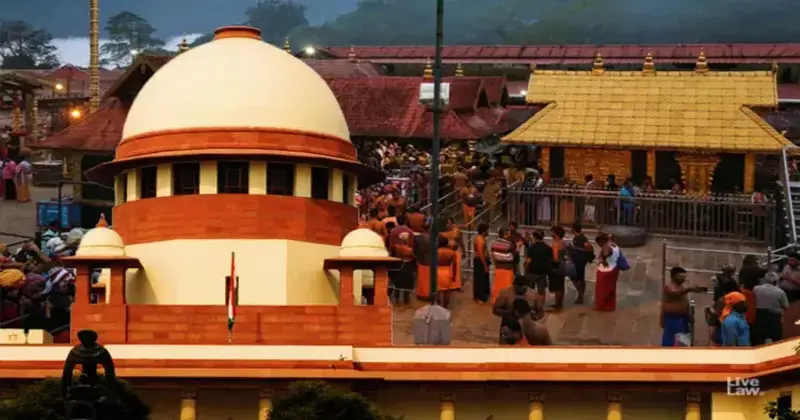
Representative Image

Representative Image

FacebookTwitterWhatsAppTelegramEmail

The ongoing hearings on Sabarimala Temple before the Supreme Court of India have once again brought to the forefront a deeply sensitive issue—how should a modern constitutional democracy engage with ancient religious traditions? The debate has often been framed in binaries: equality versus faith, rights versus customs, progress versus orthodoxy. However, such simplifications risk distorting both the nature of Hindu traditions and the essence of the Sabarimala practice. The Sabarimala issue is neither about discrimination against women nor about denying dignity. Rather, it is about preserving a specific spiritual discipline rooted in the unique nature of the deity worshipped—Lord Ayyappa—and the centuries-old traditions associated with Him.

At the heart of the Sabarimala tradition lies the concept of Naishtika Brahmacharya, meaning eternal celibacy. Lord Ayyappa is worshipped as a Naishtika Brahmachari, a deity who embodies renunciation and strict celibacy. The customs associated with the temple—including the restriction on women of menstruating age typically 10–50 years)—must be understood within this theological framework. Unlike many other Hindu temples, Sabarimala is not a universal model of worship. Hinduism, by its very nature, is pluralistic and accommodates a vast diversity of practices. There are temples where women are central to rituals, temples where men are excluded at certain times and spaces where gender roles are reversed in ritual contexts. The Sabarimala tradition is one among many such unique expressions.

The claim that Sabarimala and Hindu Dharma are inherently opposed to women is not only misleading but appears to be a deliberately constructed narrative aimed at discrediting a deeply rooted civilizational tradition. In reality, Hindu Dharma stands out as one of the few ancient traditions that explicitly upholds the dignity and reverence of women in its foundational texts. Hinduism is perhaps the only major religious tradition where the divine feminine is not just acknowledged but revered as supreme. God is worshipped not only as male but as female, and often as both simultaneously.

As the scriptures declare:

“Yatra nāryastu pūjyante ramante tatra devatāḥ;
yatraitāstu na pūjyante sarvāstatrāphalāḥ kriyāḥ”.

(Where women are honoured, there the gods rejoice; where they are not honoured, all actions remain fruitless.) Again, the scriptures say, “Yaa Devi Sarva-Bhuteshu Matri Ruupenna Samsthitaa.” That is, in our Bhartiya society, where women are worshiped as gods. We believe that primal power Mahamaya resides in Kumari. In Hindu Dharma, the feminine is not merely respected; it is revered as divine. From Durga, the embodiment of shakti(power), to Saraswati, the source of knowledge and Lakshmi, the symbol of prosperity, the sacred feminine forms the very foundation of Hindu spirituality.

Beyond theology, Hindu civilization has historically acknowledged women as intellectual and spiritual authorities. In the Vedic period, women like Gargi Vachaknavi and Maitreyi participated in profound philosophical debates recorded in the Upanishads. Gargi, in particular, is known for challenging the sage Yajnavalkya on metaphysical questions in the Brihadaranyaka Upanishad. Similarly, women saints like Andal, Mirabai and Akka Mahadevi played pivotal roles in shaping devotional traditions across India.

In more recent times, personalities such as Sister Nivedita and Sarada Devi have played transformative roles in shaping modern spiritual thought. These examples demonstrate that Hindu society, at its best, has never excluded women from the highest realms of spiritual pursuit. Against this backdrop, it becomes evident that the Sabarimala tradition cannot be reduced to a question of gender discrimination. It is a specific practice tied to a specific deity and a specific mode of worship. To interpret it through a purely secular lens is to misunderstand its essence.

Solicitor General Tushar Mehta also countered this false and so-called feminist narrative. During the proceedings before the Supreme Court of India, he pointed out that religious practices across different temples in India often involve gender-specific traditions that are not necessarily discriminatory in intent. He clearly said, “There are temples like the Pushkar temple where married men are not allowed. There is one temple in Kerala where the system is that man will go dressed as women. They go to a beauty parlour and lady family members help them dress wearing saree and other things. Only males go”.

Also Read Keralam Polls 2026: Internal dissent rocks Church as mouthpiece Deepika, bishops face heat over pro-congress call

The narrative that portrays the tradition as anti-women does a disservice not only to the faith but also to the women who have been active participants in it. Many women devotees themselves have expressed their desire to preserve the sanctity of the tradition, viewing it as an integral part of their spiritual identity. Their voices must be acknowledged, rather than overshadowed by external interpretations.

Even outside Hinduism, gender-specific religious practices exist. Monasteries, convents, and certain sacred rituals across religions have historically maintained gender-based restrictions. Yet, these are often seen as expressions of discipline rather than discrimination. Why, then, is Sabarimala singled out as inherently regressive?

When certain self-proclaimed secularists and feminists protest on the Sabarimala issue, it raises questions about whether their intent is genuine concern for women’s rights or an attempt to defame Hindu Dharma. At the same time, many of these voices remain silent when Hindu women in Bangladesh face violence and persecution because of their identity. Similarly, there has been little consistent outrage from them when women’s education was severely restricted in neighbouring Afghanistan. This selective activism reveals a troubling double standard. If the concern were truly about women’s rights, it would be consistent across regions, communities, and contexts. Instead, the pattern suggests that the issue is not feminism in its true sense, but a targeted criticism of Hindu traditions. One must ask: why does sympathy appear only in certain cases and disappear in others?

In essence, the Sabarimala issue is not a question of denying women dignity but of preserving a unique spiritual tradition rooted in the nature of the deity and Hindu pluralism. Reducing it to a binary of equality versus faith ignores the civilizational depth and diversity of Hindu practices. A balanced approach requires respecting both constitutional values and the autonomy of religious traditions. True discourse must move beyond selective narratives and engage with the issue in its full cultural and philosophical context.

Topics: traditionkeralaSupreme CourtCultureConstitutionSabarimala
ShareTweetSendShareSend
✮ Subscribe Organiser YouTube Channel. ✮
✮ Join Organiser's WhatsApp channel for Nationalist views beyond the news. ✮
Previous News

Karnataka: High court orders CBI probe into Hebbal land scam and KIADB acquisition fraud

Next News

The End of Naxalism: Vanvasi Bharat reclaims its soul

Related News

Keralam ex- CM Pinarayi Viajayan and his daughter Veena Vijayan

Keralam: Former CM Pinarayi Vijayan’s daughter Veena Vijayan gets fresh ED summons in Rs 2.78 crore CMRL case

Keralam: Audit finds gold and silver ornaments missing from nearly 20 temples under Neyyattinkara Devaswom sub group

The AMU Judgment: Why the Supreme Court must revisit Article 30

Tamil Nadu Assembly (File Photo)

Tamil Nadu speaker drops action against 21 rebel AIADMK MLAs after EPS withdrawal, targets 4 who joined TVK

The image of alleged "Kolkotta Bayee" Jewel King living at Pathanamthitta

Keralam: WhatsApp status reveals illegal Bangladeshi who lived in Pathanamthitta for five years as ‘Kolkotta Bayee’

Forced to Remove the “Faith”: How Hindu students are targeted at exam centres

Load More

Latest News

Pramukh Sanchalika Shantakka Ji and Varg Adhikari Mukta Thakur Ji (Himachal Prant Karyavahika) present on the stage on the occasion of the commencement of Praveen Varg of the Rashtra Sevika Samiti

Nagpur | Rashtra Sevika Samiti Praveen varg begins; Sita Gayatri calls for united efforts for progress of nation

At the press conference marking two years of the state government, CM Mohan Charan Majhi and others addressing the media at the Convention Centre, Lok Seva Bhavan.

Odisha: BJP Government completes two Years; CM Majhi announces free KG-to-PG education and 10 kg rice scheme

Mohammad Faraz remanded to custody as ATS probes alleged terror links (This is an AI generated image)

ATS Crackdown in Bhopal: Mohammad Faraz detained; Foreign links under investigatio

New congressional boundaries have reshaped the 2026 House battleground, leaving Republicans in a stronger position as both parties compete for control of Congress

Delimitation in America: Republicans seize edge over Democrats in redistricting push ahead of 2026 midterms

(Left) Russian President Vladimir Putin (Right) Prime Minister Narendra Modi (Image Credit: ANI)

Russia Day 2026: The ancient civilisational bond between India and Moscow

After the conclusion of the 11th Governing Body meeting of NITI Aayog, the Chief Minister of Tamil Nadu, Joseph Vijay, met Prime Minister Narendra Modi in Delhi

Tamil Nadu: At first NITI Aayog meet, CM Joseph Vijay charts cooperative course with Modi govt unlike DMK

Keralam ex- CM Pinarayi Viajayan and his daughter Veena Vijayan

Keralam: Former CM Pinarayi Vijayan’s daughter Veena Vijayan gets fresh ED summons in Rs 2.78 crore CMRL case

Radical Islamists forced to stop the construction of Bhagwan Ram idol in Bangladesh

Bangladesh: Construction of Bhagwan Ram murti halted amid threats by Islamists; Reflects spiking anti-Hindu hostility

Subash Chander of Bajrang Dal Telangana

Telangana Shocker: VHP demands strict punishment for Md Ghouse in Khammam 12-year-old girl sexual assault case

Rare Rashtrakuta-Era inscription unearthed in Karnataka

Karnataka: Rare Rashtrakuta-Era inscription unearthed, reveals extraordinary bond between king and servant

Load More
  • Privacy
  • Terms
  • Cookie Policy
  • Refund and Cancellation
  • Delivery and Shipping

© Bharat Prakashan (Delhi) Limited.
Tech-enabled by Ananthapuri Technologies

  • Home
  • Search Organiser
  • Bharat
    • Assam
    • Bihar
    • Chhattisgarh
    • Jharkhand
    • Maharashtra
    • View All States
  • World
    • Asia
    • Africa
    • North America
    • South America
    • Europe
    • Australia
  • Editorial
  • Operation Sindoor
  • Opinion
  • Analysis
  • Defence
  • Culture
  • Sports
  • Business
  • RSS @ 100
  • Entertainment
  • More ..
    • Sci & Tech
    • Vocal4Local
    • Special Report
    • Education
    • Employment
    • Books
    • Interviews
    • Travel
    • Health
    • Politics
    • Law
    • Economy
    • Obituary
  • Subscribe Magazine
  • Read Ecopy
  • Advertise
  • Circulation
  • Careers
  • About Us
  • Contact Us
  • Policies & Terms
    • Privacy Policy
    • Cookie Policy
    • Refund and Cancellation
    • Terms of Use

© Bharat Prakashan (Delhi) Limited.
Tech-enabled by Ananthapuri Technologies