On March 31, 2026, Bharat witnessed not merely the end of an insurgency, but the conclusion of a prolonged assault on its civilisational fabric. The formal declaration by Union Home Minister Amit Shah that the nation stands Naxal-free marks the culmination of a decisive struggle, one that pitted Bharat’s democratic ethos against a violent, imported ideology.
For decades, the so-called “Red Corridor” carved out zones of fear across the tribal heartlands from Bastar to Gadchiroli, from Jharkhand’s forests to Odisha’s interiors. These were not merely territories of conflict, but zones of systematic alienation, where Vanvasi communities were cut off from both development and their rightful place in the national mainstream. Today, that chapter stands closed.
The myth of revolution, The reality of exploitation
The Communist Party of India(Maoist) projected itself as a liberator of the oppressed. In reality, it functioned through coercion, fear and systematic exploitation. Under the doctrine of “protracted people’s war”,Maoist cadres entrenched themselves in tribal regions, not to empower communities but to control them. Villages became operational bases; forests turned into theatres of violence. The Vanvasi deeply rooted in Bharat’s dharmic traditions were reduced to instruments in an ideological war that was neither indigenous nor humane.
Women were coerced into participation, children indoctrinated and dissent silenced through violent “jan adalats”, Infrastructure roads, schools, communication networks was deliberately destroyed to preserve isolation. Development was not ignored; it was actively sabotaged. This was not revolution. It was domination disguised as resistance.
The turning point: National will and decisive leadership
The dismantling of Naxalism reflects sustained political resolve under Prime Minister Narendra Modi and the firm strategic direction of Amit Shah. Rejecting both appeasement and passivity, Bharat adopted a calibrated approach security enforcement aligned with development and dignity. Localised forces such as the District Reserve Guard and Bastar Fighters, composed largely of tribal youth and surrendered cadres, proved decisive. Their deep knowledge of terrain and society enabled precise operations that dismantled Maoist strongholds from within. Simultaneously, governance expanded into areas long neglected. Roads reached remote interiors, mobile connectivity reduced isolation, schools reopened and healthcare infrastructure improved. The state re-entered not as an external force, but as a partner in progress.
Surrender figures: The collapse of the maoist machine
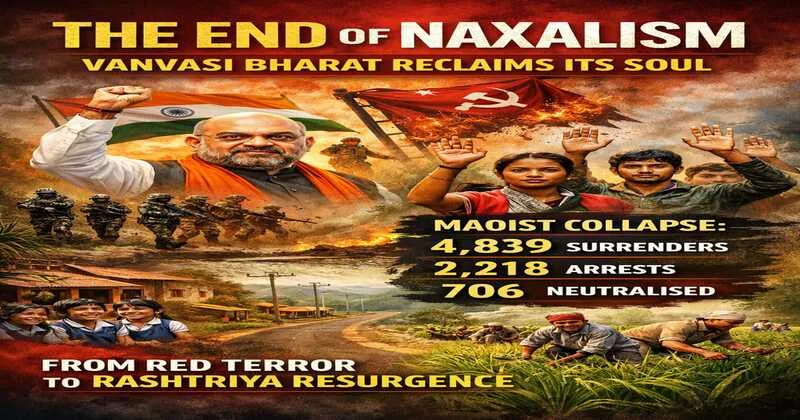
The decline of Maoist influence is not merely rhetorical, it is borne out by concrete data that reflects the complete erosion of its organisational structure. As per official figures placed by the Government of India, 4,839 Naxalites surrendered between 2024 and March 2026, while 2,218 were arrested and 706 neutralised. In 2025 alone, 2,337 cadres laid down arms, marking one of the highest surrender rates in the history of the movement. Equally significant is the territorial contraction. From 126 LWE-affected districts in 2014, the number has fallen to single digits by early 2026, indicating the near-total collapse of Maoist influence across the country. These figures reflect a decisive reality, the Maoist movement has not merely weakened, it has structurally disintegrated.
Vanvasi awakening: From marginalisation to leadership
The most enduring outcome of this transformation lies in the awakening of Bharat’s Vanvasi communities.
Through effective implementation of laws such as the Forest Rights Act and PESA, long-denied rights over land and local governance have been restored. The Vanvasi is no longer a passive subject of policy, but an active participant in governance and development. Across former strongholds like Bastar and Gadchiroli, visible changes are underway. Markets are functioning, children are attending schools, healthcare services are reaching remote areas and local economies are reviving.Significantly, former Maoist recruits, including women are now integrated into security and development frameworks. They stand today not as instruments of insurgency, but as stakeholders in national progress. This is not merely development, it is a civilisational correction.
A civilisational victory
The end of Naxalism represents a deeper ideological triumph. Maoism, rooted in class conflict and sustained through violence, ultimately failed to resonate with Bharat’s civilisational ethos, anchored in harmony, dharma, and coexistence. Its survival depended on isolation, coercion and misinformation. Once governance, connectivity and awareness penetrated these regions, the ideological edifice collapsed. What has emerged is not just security stability, but a reaffirmation of Bharat’s cultural and constitutional unity.
While the guns have fallen silent, the responsibility now lies in ensuring that the conditions which once enabled Maoist expansion do not re-emerge. Development must remain continuous, governance accountable and integration respectful of local identity and traditions. The end of Naxalism is not merely a counter-insurgency success, it is the restoration of balance between state and society, between rights and responsibilities, between tradition and progress. Bharat has not just defeated an insurgency. It has reclaimed its soul.