The End of Naxalism: Vanvasi Bharat reclaims its soul
June 15, 2026
  • Read Ecopy
  • Circulation
  • Advertise
  • Careers
  • About Us
  • Contact Us
Android AppiPhone AppArattai
Organiser
  • ‌
  • Bharat
    • Assam
    • Bihar
    • Chhattisgarh
    • Jharkhand
    • Maharashtra
    • View All States
  • World
    • Asia
    • Europe
    • North America
    • South America
    • Africa
    • Australia
  • Editorial
  • International
  • Opinion
  • RSS @ 100
  • More
    • Op Sindoor
    • Analysis
    • Sports
    • Defence
    • Politics
    • Business
    • Economy
    • Culture
    • Special Report
    • Sci & Tech
    • Entertainment
    • G20
    • Azadi Ka Amrit Mahotsav
    • Vocal4Local
    • Web Stories
    • Education
    • Employment
    • Books
    • Interviews
    • Travel
    • Law
    • Health
    • Obituary
  • Subscribe
    • Subscribe Print Edition
    • Subscribe Ecopy
    • Read Ecopy
  • ‌
  • Bharat
    • Assam
    • Bihar
    • Chhattisgarh
    • Jharkhand
    • Maharashtra
    • View All States
  • World
    • Asia
    • Europe
    • North America
    • South America
    • Africa
    • Australia
  • Editorial
  • International
  • Opinion
  • RSS @ 100
  • More
    • Op Sindoor
    • Analysis
    • Sports
    • Defence
    • Politics
    • Business
    • Economy
    • Culture
    • Special Report
    • Sci & Tech
    • Entertainment
    • G20
    • Azadi Ka Amrit Mahotsav
    • Vocal4Local
    • Web Stories
    • Education
    • Employment
    • Books
    • Interviews
    • Travel
    • Law
    • Health
    • Obituary
  • Subscribe
    • Subscribe Print Edition
    • Subscribe Ecopy
    • Read Ecopy
Organiser
  • Home
  • Bharat
  • World
  • Operation Sindoor
  • Editorial
  • Analysis
  • Opinion
  • Culture
  • Defence
  • International Edition
  • RSS @ 100
  • Magazine
  • Read Ecopy
Home Bharat

The End of Naxalism: Vanvasi Bharat reclaims its soul

The end of Naxalism is not merely a counter-insurgency success, it is the restoration of balance between state and society, between rights and responsibilities, between tradition and progress. Bharat has not just defeated an insurgency. It has reclaimed its soul

Adv Karan ThakurAdv Karan Thakur
Apr 12, 2026, 05:30 pm IST
in Bharat, Analysis
Follow on Google News
FacebookTwitterWhatsAppTelegramEmail

On March 31, 2026, Bharat witnessed not merely the end of an insurgency, but the conclusion of a prolonged assault on its civilisational fabric. The formal declaration by Union Home Minister Amit Shah that the nation stands Naxal-free marks the culmination of a decisive struggle, one that pitted Bharat’s democratic ethos against a violent, imported ideology.

For decades, the so-called “Red Corridor” carved out zones of fear across the tribal heartlands from Bastar to Gadchiroli, from Jharkhand’s forests to Odisha’s interiors. These were not merely territories of conflict, but zones of systematic alienation, where Vanvasi communities were cut off from both development and their rightful place in the national mainstream. Today, that chapter stands closed.

The myth of revolution, The reality of exploitation

The Communist Party of India(Maoist) projected itself as a liberator of the oppressed. In reality, it functioned through coercion, fear and systematic exploitation. Under the doctrine of “protracted people’s war”,Maoist cadres entrenched themselves in tribal regions, not to empower communities but to control them. Villages became operational bases; forests turned into theatres of violence. The Vanvasi deeply rooted in Bharat’s dharmic traditions were reduced to instruments in an ideological war that was neither indigenous nor humane.

Women were coerced into participation, children indoctrinated and dissent silenced through violent “jan adalats”, Infrastructure roads, schools, communication networks was deliberately destroyed to preserve isolation. Development was not ignored; it was actively sabotaged. This was not revolution. It was domination disguised as resistance.

The turning point: National will and decisive leadership

The dismantling of Naxalism reflects sustained political resolve under Prime Minister Narendra Modi and the firm strategic direction of Amit Shah. Rejecting both appeasement and passivity, Bharat adopted a calibrated approach security enforcement aligned with development and dignity. Localised forces such as the District Reserve Guard and Bastar Fighters, composed largely of tribal youth and surrendered cadres, proved decisive. Their deep knowledge of terrain and society enabled precise operations that dismantled Maoist strongholds from within. Simultaneously, governance expanded into areas long neglected. Roads reached remote interiors, mobile connectivity reduced isolation, schools reopened and healthcare infrastructure improved. The state re-entered not as an external force, but as a partner in progress.

Also Read: Energy resilience of India amid West Asia crisis; How Strategic realism delivers oil at reasonable prices to people

Surrender figures: The collapse of the maoist machine

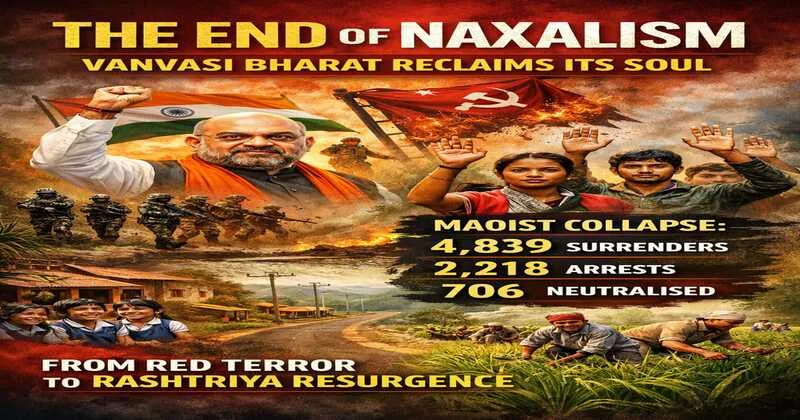
The decline of Maoist influence is not merely rhetorical, it is borne out by concrete data that reflects the complete erosion of its organisational structure. As per official figures placed by the Government of India, 4,839 Naxalites surrendered between 2024 and March 2026, while 2,218 were arrested and 706 neutralised. In 2025 alone, 2,337 cadres laid down arms, marking one of the highest surrender rates in the history of the movement. Equally significant is the territorial contraction. From 126 LWE-affected districts in 2014, the number has fallen to single digits by early 2026, indicating the near-total collapse of Maoist influence across the country. These figures reflect a decisive reality, the Maoist movement has not merely weakened, it has structurally disintegrated.

Vanvasi awakening: From marginalisation to leadership

The most enduring outcome of this transformation lies in the awakening of Bharat’s Vanvasi communities.
Through effective implementation of laws such as the Forest Rights Act and PESA, long-denied rights over land and local governance have been restored. The Vanvasi is no longer a passive subject of policy, but an active participant in governance and development. Across former strongholds like Bastar and Gadchiroli, visible changes are underway. Markets are functioning, children are attending schools, healthcare services are reaching remote areas and local economies are reviving.Significantly, former Maoist recruits, including women are now integrated into security and development frameworks. They stand today not as instruments of insurgency, but as stakeholders in national progress. This is not merely development, it is a civilisational correction.

A civilisational victory

The end of Naxalism represents a deeper ideological triumph. Maoism, rooted in class conflict and sustained through violence, ultimately failed to resonate with Bharat’s civilisational ethos, anchored in harmony, dharma, and coexistence. Its survival depended on isolation, coercion and misinformation. Once governance, connectivity and awareness penetrated these regions, the ideological edifice collapsed. What has emerged is not just security stability, but a reaffirmation of Bharat’s cultural and constitutional unity.

While the guns have fallen silent, the responsibility now lies in ensuring that the conditions which once enabled Maoist expansion do not re-emerge. Development must remain continuous, governance accountable and integration respectful of local identity and traditions. The end of Naxalism is not merely a counter-insurgency success, it is the restoration of balance between state and society, between rights and responsibilities, between tradition and progress. Bharat has not just defeated an insurgency. It has reclaimed its soul.
Topics: Home Minister Amit ShahNaxalismcounter-insurgencyNaxal Mukt Bharatred corridors
ShareTweetSendShareSend
✮ Subscribe Organiser YouTube Channel. ✮
✮ Join Organiser's WhatsApp channel for Nationalist views beyond the news. ✮
Previous News

Why Sabarimala is not about women’s exclusion

Next News

Constitutional Clarity vs. Ideological Noise: Supreme Court draws the line on scheduled caste status

Related News

Karnataka: Maoist activities fuelled by foreign funding; FIR against US-based missionary organisation & six individuals

North 24 Parganas: A large crowd of Bangladeshis residing in West Bengal gathers at the Hakimpur border crossing in the Basirhat subdivision of North 24 Parganas district to cross over to Bangladesh

Unnatural Demographic Change: Hint that would create a heat

Once known for maoist violence, Minpa now leads healthcare revolution with telemedicine services in Sukma

From Maoist Stronghold to Healthcare Hub: How Chhattisgarh’s Minpa is transforming through telemedicine & development

Union Home Minister Amit Shah addressing BSF personnel at the Lankamura Border Outpost along the India-Bangladesh border in West Tripura district on June 5, 2026

Amit Shah at Bangladesh Border: “India will have an impregnable security grid soon”

Ladakh: LG V. K. Saxena approves five new districts in the UT; Aims for improved governance and swift service delivery

'Anti-Incumbency Tsunami led to Record Voter Turnout; TMC will Exit,” says HM Amit Shah in Kolkata after Phase 1 Polls

‘Anti-Incumbency Tsunami led to Record Voter Turnout; TMC will Exit,’ says HM Amit Shah in Kolkata after Phase 1 Polls

Load More

Latest News

Prime Minister Narendra Modi and his Slovakian counterpart Prime Minister Robert Fico

India-Slovakia elevate ties to Comprehensive Partnership; PM Modi hails cultural bond, Upanishads translation to Slovak

Centre seeks explanation from Keralam Waqf Board on Munambam land entry into Umeed Portal

In China's strategic map of threats, geography continues to give India a significance that cannot be overlooked

The Rival China Cannot Ignore: Why India matters more than Beijing admits

Addressing the second day of Vijnana Bharati’s 7th National Convention at BHU, RSS Sah Sarkaryavah Dr Krishna Gopal

Vijnana Bharati’s 7th National Convention | Scientists must work to harmonise spirituality & science: Dr Krishna Gopal

Representative image

West Asia Conflict: Donald Trump announces landmark US-Iran agreement, raises hopes for peace

Keralam: CM VD Satheesan Faces Backlash for Criticising VCs Attending RSS Programme Addressed by Dr Mohan Bhagwat

Prime Minister Narendra Modi: Record maker and breaker

India surpasses South Korea, Enters big 5 manufacturing hub; Seals strategic footprint in the global supply chain

Gujarat: Married Man Karim Rafik Posed as Widower 'Aditya Patel' to Trap Hindu Women; 8,000 Photos and Videos Found on Phone

Gujarat Matrimonial Fraud: Karim posed as widower ‘Aditya Patel’ to target Hindu women; 8,000 photos found on phone

A suicide bomber attacked the Jhangi police checkpost in Taunsa Sharif, Dera Ghazi Khan, Punjab, near the Khyber Pakhtunkhwa border

Khyber Pakhtunkhwa: TTP suicide bomber hits police checkpost, two Pakistani policemen killed

Load More
  • Privacy
  • Terms
  • Cookie Policy
  • Refund and Cancellation
  • Delivery and Shipping

© Bharat Prakashan (Delhi) Limited.
Tech-enabled by Ananthapuri Technologies

  • Home
  • Search Organiser
  • Bharat
    • Assam
    • Bihar
    • Chhattisgarh
    • Jharkhand
    • Maharashtra
    • View All States
  • World
    • Asia
    • Africa
    • North America
    • South America
    • Europe
    • Australia
  • Editorial
  • Operation Sindoor
  • Opinion
  • Analysis
  • Defence
  • Culture
  • Sports
  • Business
  • RSS @ 100
  • Entertainment
  • More ..
    • Sci & Tech
    • Vocal4Local
    • Special Report
    • Education
    • Employment
    • Books
    • Interviews
    • Travel
    • Health
    • Politics
    • Law
    • Economy
    • Obituary
  • Subscribe Magazine
  • Read Ecopy
  • Advertise
  • Circulation
  • Careers
  • About Us
  • Contact Us
  • Policies & Terms
    • Privacy Policy
    • Cookie Policy
    • Refund and Cancellation
    • Terms of Use

© Bharat Prakashan (Delhi) Limited.
Tech-enabled by Ananthapuri Technologies