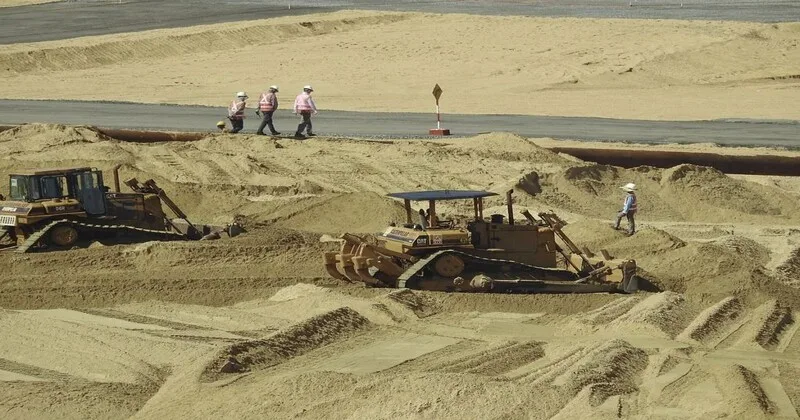
The Indian Beach Sand Minerals, or BSM, is one of the strategically important resources that the country possesses. These minerals, hidden in Indian coastal sands, are woven into the fabric of modern life, as they are used in smartphones, satellites, solar panels, nuclear reactors, and more. The world’s appetite for clean energy and advanced technology is growing; the race to secure these minerals is intensifying. India, with its vast coastline and mineral-rich beaches, sits right at the centre of this global contest.
What are Beach Sand Minerals?
Think of beach sand as a natural cocktail. Most of it is ordinary silica plain quartz, but when mixed, it becomes heavy minerals. These are denser than normal sand grains, and rivers and ocean waves have been concentrating them along coastlines for millions of years. In India, these deposits are rich, and they contain a remarkable lineup of minerals, each with its own value.
Ilmenite is often the most abundant. It is the primary source of titanium dioxide, a white pigment so white that it is found in everything from house paint, toothpaste, sunscreen and food colouring. But titanium is more than cosmetic. As a metal, it is lighter than steel yet as strong, making it indispensable for aircraft, spacecraft and medical implants.
Rutile is a purer form of titanium dioxide and is especially valuable in aerospace and high-performance applications. Then there is Zircon, derived from zirconium, which is vital for nuclear reactors because of its ability to withstand extreme temperatures and resist corrosion. Zircon also makes its way into ceramics, refractory materials and electronic components.
Garnet, familiar to most as a gemstone, has industrial uses too, primarily as an abrasive in water jet cutting and sandblasting. Then there is Monazite, the crown jewel of India BSM deposits. Monazite contains Rare Earth Elements (REE) and traces of thorium, making it both extraordinarily valuable and subject to very strict government control. REE are the backbone of permanent magnets used in electric vehicle motors and wind turbines, the materials that will drive the energy transition of the 21st century.
Where Does India Mine These Minerals?
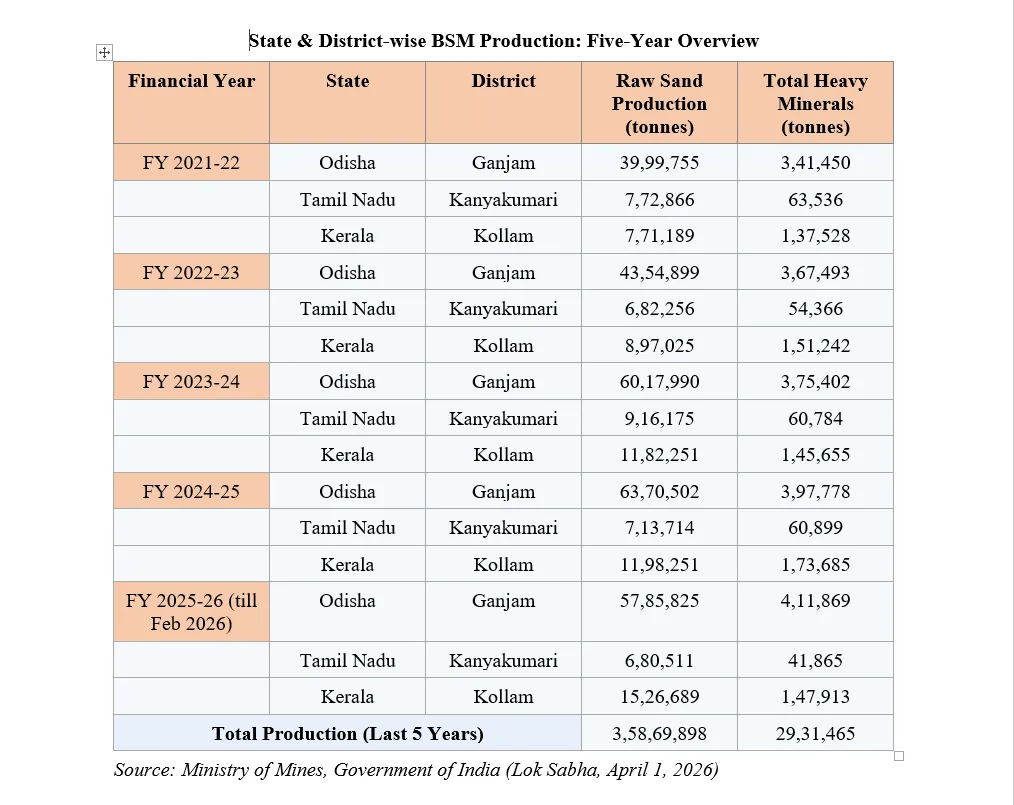
India major BSM deposits are spread across three coastal states of Odisha, Tamil Nadu and Kerala. Each of them has a distinct character and contribution. Odisha’s Ganjam district is the largest producer. Its beaches stretch along the Bay of Bengal and host some of the richest concentrations of heavy minerals in the country. Production here has grown from roughly 40 lakh tonnes of raw sand in 2021-22 to over 63 lakh tonnes in 2024-25 a near 60% jump in just three years. Even in the partial year of 2025-26, Ganjam has already contributed over 57 lakh tonnes.
Kerala’s Kollam district is the second major hub. The coastal strip near Chavara in Kollam has long been associated with heavy mineral mining and hosts Kerala Minerals and Metals Limited (KMML), one of India’s oldest mineral processing facilities. Kerala’s output has also grown, rising from 7.7 lakh tonnes in 2021-22 to 15 lakh tonnes in the partial year of 2025-26.
Tamil Nadu’s Kanyakumari district rounds out the three major producing zones. Sitting at the very tip of the Indian peninsula where three seas meet, Kanyakumari’s beaches have been mined for decades. Production fluctuates year to year but typically ranges between 6 and 9 lakh tonnes annually.
Who Controls This Wealth and Why it Matters
Not just anyone can dig up beach sand and sell it. Because BSM contains atomic minerals, particularly monazite with its rare earths and thorium content. Indian law places tight restrictions on who can mine and trade these resources. Under the Mines and Minerals (Development and Regulation) Act of 1957, known as the MMDR Act, mining of atomic minerals above the specified threshold levels must be carried out only by government-owned entities. Private operators are not permitted to mine these materials.
The primary agency entrusted with this work is IREL (India) Limited, formerly known as Indian Rare Earths Limited, a government undertaking under the Department of Atomic Energy. IREL operates integrated facilities that handle the full chain from mining to processing, extracting raw sand, separating the various heavy minerals, and refining rare earths. It works closely with the Bhabha Atomic Research Centre, which provides cutting-edge technological support for rare-earth processing.
In 2018, the Directorate General of Foreign Trade brought all BSM exports under a State Trading Enterprise arrangement, channelling everything through IREL. This effectively ended any possibility of unregulated or illegal exports a move designed both to protect national security and to ensure India retains the full value of its mineral wealth rather than exporting raw materials cheaply.
The Rare Earth Corridor: A Vision Taking Shape
The Union Budget 2026-27 carried an announcement for the Indian mineral sector. The government declared its intention to help the four mineral-rich coastal states, Odisha, Kerala, Andhra Pradesh and Tamil Nadu, to establish dedicated Rare Earth Corridors. These corridors would not be only mining zones. They would be end-to-end value chains encompassing mining, beneficiation, research, and manufacturing of finished rare-earth products.
India currently mines significant quantities of rare earth-bearing minerals but exports much of the processed material at relatively low value. Other countries, most notably China, which dominates global rare earth processing, then convert these materials into high-value magnets, motors and electronic components. By building Rare Earth Corridors, India aims to capture that value domestically by turning raw minerals into the permanent magnets for electric vehicle motors, the components for wind turbines, and the materials for defence electronics.
This ambition ties directly into three of India’s important national goals. Atmanirbhar Bharat calls for self-reliance in strategic materials, and rare earths are about as strategic as it gets. Net Zero 2070 requires massive expansion of renewable energy and electric mobility, both of which require an abundance of rare earth materials. And Viksit Bharat @2047 envisions a developed, high-technology economy, one that processes its own resources into finished goods rather than selling raw sand to foreign industries.
Andhra Pradesh: The Sleeping Giant
Andhra Pradesh, despite its extensive coastline stretching nearly a thousand kilometres along the Bay of Bengal, has recorded no beach sand mineral production over the past five years. Not a single tonne. This is not because the minerals are absent; geological surveys have identified BSM deposits along the Andhra coast in Srikakulam and Visakhapatnam districts. The absence of production reflects regulatory, logistical and administrative factors rather than any lack of geological availability.
The inclusion of Andhra Pradesh in the proposed Rare Earth Corridor programme is more significant. It signals that the Centre sees the state’s untapped potential and wants to bring it into the fold. If Andhra Pradesh can develop its BSM sector, it would meaningfully expand India’s overall mineral production and processing capacity.
Why This Matters for Every Indian
It is easy to see BSM as a technical subject for geologists and policy wonks to worry about. But its implications touch ordinary lives in profound ways. The electric vehicle that a young professional buys, the solar panel that powers a rural home, the wind turbine that keeps a city’s lights on all of these depend on rare earth materials that ultimately trace back to deposits like those found in Ganjam, Kollam and Kanyakumari.
Globally, rare earth supply chains are a major geopolitical flashpoint. China’s dominance over rare earth processing has repeatedly been used as a lever in trade disputes. Countries across the world, such as the United States, Japan, the European Union, and Australia, are scrambling to diversify away from dependence on a single supplier. India, with its substantial coastal mineral wealth, government-controlled processing infrastructure and democratic governance framework, is uniquely positioned to offer an alternative.
Recent data shared by Union Minister of State Dr Jitendra Singh in the Lok Sabha on 1st April, 2026, underscore the sector’s momentum. Across the five years from 2021-22 to 2025-26, India mined over 35.8 crore tonnes of raw beach sand, yielding nearly 29.3 lakh tonnes of total heavy minerals. Odisha alone contributed the lion’s share a reflection of both geological richness and operational maturity.
The Sand That Could Change Everything
These sands are a key ingredient in the clean energy transition, the next generation of defence systems and the advanced electronics that define modern civilisation. India has the geological fortune to possess this resource in abundance along its vast coastline. What it does with that fortune in the coming decade will matter enormously not just for the coastal communities that live alongside these deposits, but for India’s standing in the world.
The Rare Earth Corridor initiative, the strong regulatory framework under the MMDR Act, IREL’s growing technical expertise, and the government’s clear focus on translating raw resources into finished value are all positive signs. The beach sand minerals sector is no longer a quiet backwater of Indian mining.
India has long been rich in natural resources. What is changing now is the determination to think strategically about them, moving beyond extraction and toward creation. The sand at the water’s edge may prove to be one of the foundations of a Viksit Bharat.