





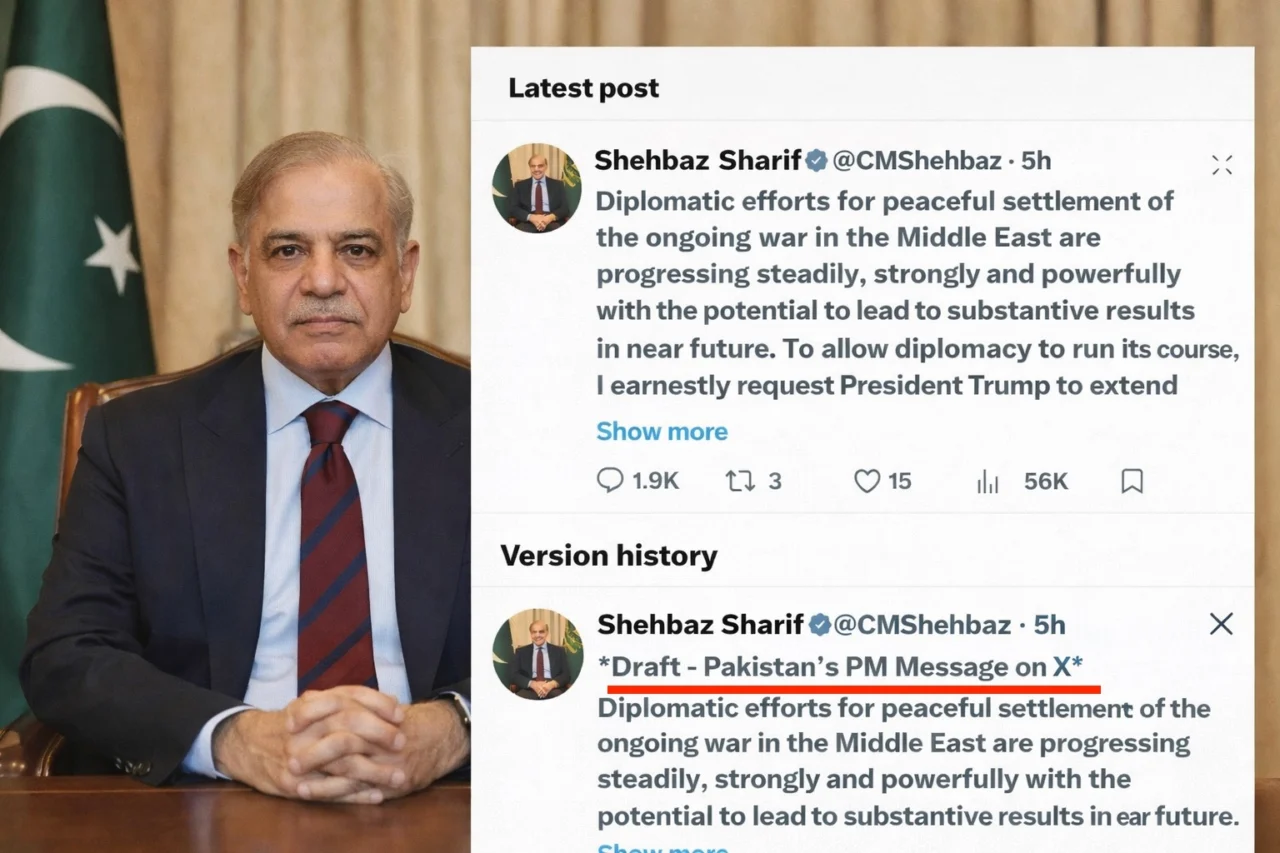
A recent social media post by Pakistan’s Prime Minister Shehbaz Sharif has triggered a wave of debate, not only for its diplomatic content but also for what many see as an unusual and revealing detail in its composition.
The post, shared on the platform X, was aimed at de-escalating tensions in the ongoing Iran conflict. It urged US President Donald Trump to extend his deadline for military action against Iran and called on Tehran to reopen the Strait of Hormuz to allow global trade to resume smoothly.
However, what might have otherwise been seen as a routine diplomatic appeal quickly turned controversial when users noticed a peculiar phrase in the post’s edit history: “Draft – Pakistan’s PM Message on X.”
The presence of the word “Draft” in an official communication immediately raised questions. Observers and critics began to ask whether this was simply a technical oversight by the Prime Minister’s communication team or an indication of something more significant.
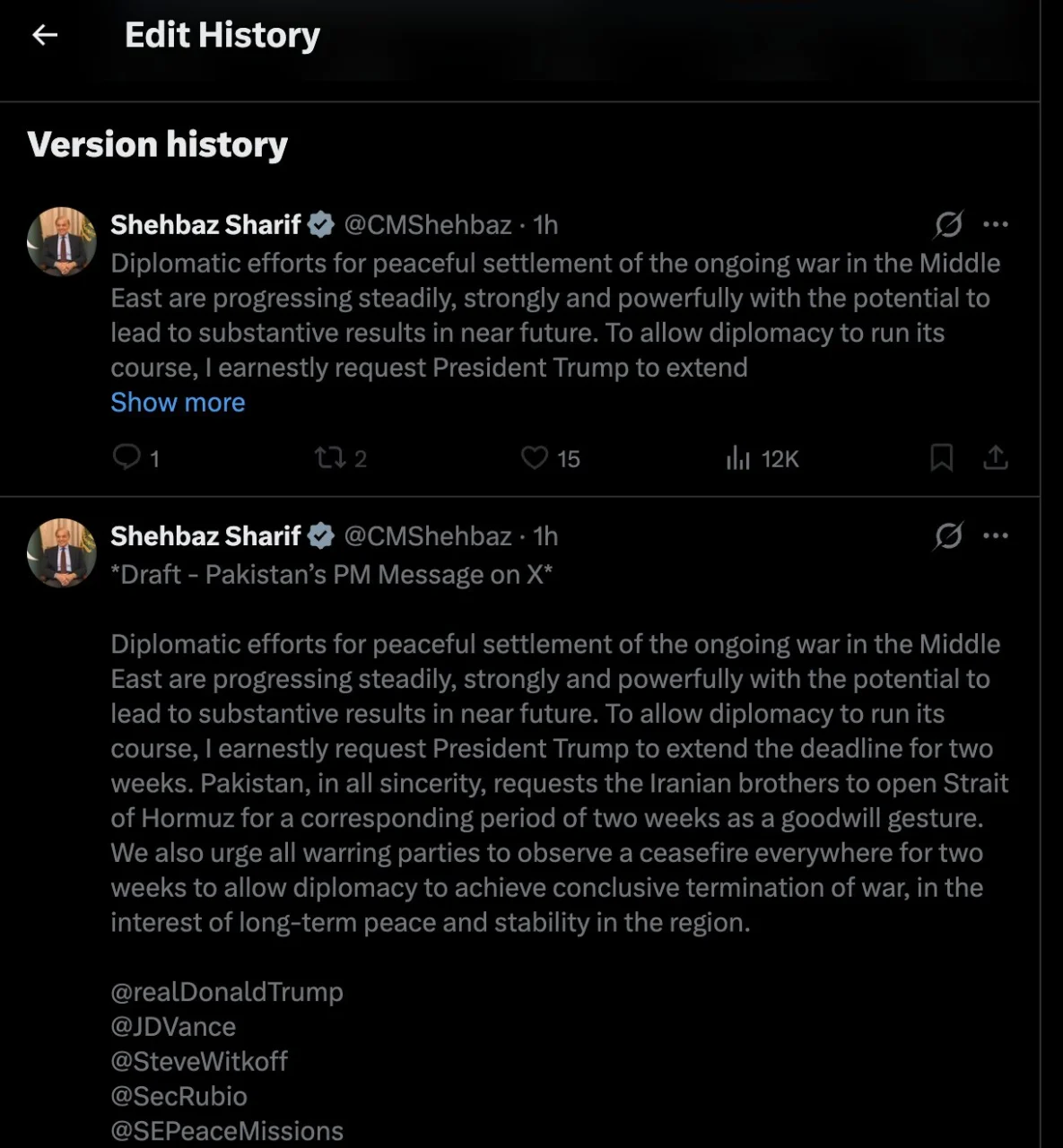
Adding to the speculation was the phrasing “Pakistan’s PM” within the draft itself. Critics argued that this wording sounded less like a personal statement from a national leader and more like a pre-prepared template or instruction note.
For many, the issue was not just about a minor error, but about what it might reveal regarding how official communications are crafted at the highest levels of government.
The controversy quickly evolved into a broader discussion about authorship and control over Pakistan’s diplomatic messaging. In international relations, official statements are carefully worded to reflect national positions and leadership intent.
The accidental inclusion of “Draft” created an impression that the message may not have been authored directly by the Prime Minister, but possibly prepared by aides or even influenced by external inputs.
While there is no concrete evidence to suggest that the message originated outside Pakistan’s leadership, the optics of the situation have proven difficult to ignore. In diplomacy, perception often carries as much weight as reality.
The episode has also revived longstanding debates about Pakistan’s decision-making structures. Analysts have often pointed to a complex balance of power between civilian leadership, military institutions, and external geopolitical stakeholders.
The timing of the controversy has further amplified its impact. The post came at a critical moment in the Iran crisis, when diplomatic efforts were intensifying to prevent further escalation.
Pakistan has been actively positioning itself as a mediator, urging restraint and facilitating dialogue between key players. In this context, any question over the authenticity of its messaging risks undermining its credibility as a neutral interlocutor.
The Prime Minister’s appeal to both Washington and Tehran was part of a broader push to create space for negotiations, including calls to keep the Strait of Hormuz open and avoid disruption to global energy supplies.
Ultimately, the “Draft” tweet controversy serves as a reminder of how even small details can carry significant weight in international relations. In a highly volatile geopolitical environment, where every statement is closely analysed, precision and clarity are critical.









