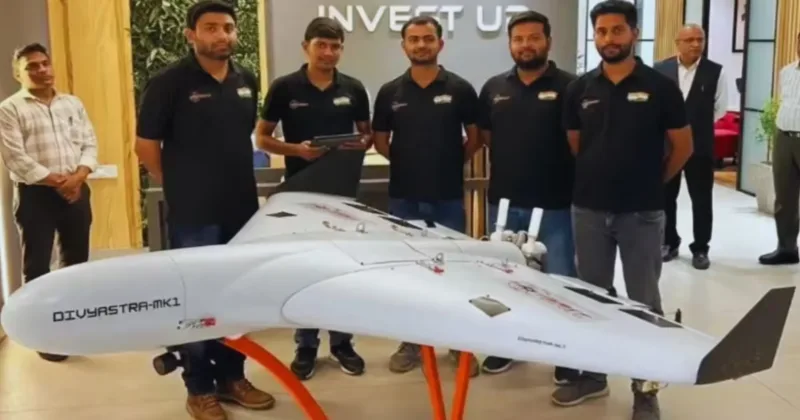
LUCKNOW: Uttar Pradesh is rapidly becoming a major centre of defence innovation, with a growing focus on indigenous technology, support for start-ups, and advanced military solutions. The latest development in this direction comes from Lucknow, where a promising start-up, Hover IT, has developed an advanced unmanned aerial vehicle (UAV) named Divyastra MK-1. It is a significant step toward boosting India’s indigenous defence ecosystem, particularly at a time when the country is actively working to reduce dependence on imported military equipment and to boost domestic production under initiatives like “Make in India.”
Over the past few years, Uttar Pradesh has steadily built a reputation as an emerging hub for defence manufacturing and innovation. With the establishment of the Uttar Pradesh Defence Industrial Corridor and proactive policy support, the state government has created an environment in which start-ups and private players can actively contribute to the development of defence technology.
Officials say that policies aimed at easing business operations, providing financial incentives, and encouraging innovation have played a crucial role in this transformation. Uttar Pradesh’s focus is not just on large-scale manufacturing but also on nurturing small and medium enterprises, particularly start-ups working in niche and high-tech areas such as drones, artificial intelligence, and surveillance systems.
Under the leadership of Hon’ble Chief Minister Yogi Adityanath ji, Uttar Pradesh is rapidly emerging as a hub of defence innovation, driven by progressive policies and a strong start-up ecosystem. A Lucknow-based start-up, Hover IT, has developed an advanced UAV, Divyastra MK-1,… pic.twitter.com/O2wH5dZo0P
— INVEST UP (@_InvestUP) April 7, 2026
The emergence of Hover IT and its UAV platform is now being seen as a direct outcome of this ecosystem.
Divyastra MK-1: Indigenous and Advanced
The Divyastra MK-1 UAV represents a mix of advanced engineering and artificial intelligence. It is designed primarily for surveillance and precision missions and is equipped with AI-enabled targeting systems, which makes it suitable for modern warfare and strategic operations. The UAV is said to have an endurance of several hours, which allows it to carry out long-duration missions without interruption. It can operate at high altitudes and carry payloads for surveillance and precision strike.
What sets the Divyastra MK-1 apart is its cost-effectiveness when compared to similar systems available internationally. The UAV has been designed with the evolving needs of modern warfare in mind, where real-time intelligence, accuracy, and minimal human intervention are key factors. With AI integration, the drone can analyse targets, assist in decision-making, and enhance mission efficiency.
Government initiatives have made it easier for start-ups to enter the sector by simplifying procurement processes and offering funding opportunities. This has encouraged young entrepreneurs and engineers to explore defence technology as a viable and impactful field. Hover IT, founded by young innovators, has leveraged this support to develop a product aligned with national priorities.
The Uttar Pradesh government has been actively supporting such ventures through policy measures, infrastructure development, and opportunities for collaboration. Officials have highlighted that start-ups like Hover IT are receiving not just financial backing but also technical guidance and access to testing facilities. Chief Minister Yogi Adityanath has repeatedly emphasised the importance of self-reliance in defence production. The state government’s vision includes making Uttar Pradesh a key contributor to India’s defence exports in the coming years.
The development of the Divyastra MK-1 aligns with India’s broader goal of achieving self-reliance in defence manufacturing. With increasing geopolitical challenges and evolving security threats, the need for homegrown technology has become more important than ever. By developing indigenous UAVs, India can reduce its dependence on foreign suppliers, ensure better control over critical technologies, and enhance its strategic capabilities. Moreover, domestic production also contributes to job creation, skill development, and economic growth.
Initial interest in the UAV has already been expressed by security agencies, and discussions are ongoing regarding potential deployment and testing. If successful, the drone could become a key asset in surveillance and tactical operations. In addition to UAVs, the start-up aims to develop a broader drone ecosystem that includes bomb-dropping drones, reconnaissance systems, and integrated defence solutions. This expansion could further strengthen Uttar Pradesh’s position as a centre for defence innovation.