There was a time when the monsoon season in eastern Uttar Pradesh carried a particular dread. Families in Gorakhpur, Maharajganj and the surrounding Purvanchal belt would watch the rains arrive and brace themselves. Japanese Encephalitis, locally called brain fever, had already claimed over 50,000 lives in the region across four decades. Mothers tucked in their children at night, unsure of what the morning would bring.
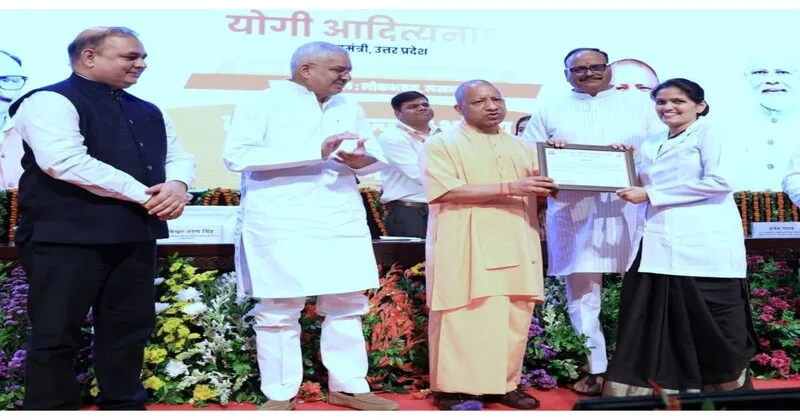
On the occasion of World Health Day on April 7, Chief Minister Yogi Adityanath addressed the citizens of the state through a widely circulated letter titled Yogi Ki Paati, a direct, personal communication connecting governance to the ground. The letter does not merely celebrate achievements; it reflects before and after comparison, and this data proves to be accurate as per the government data.
A Disease Eliminated, Not Just Controlled
Uttar Pradesh recorded zero deaths from encephalitis in 2024, marking a turnaround in a state that once faced recurring outbreaks of Japanese Encephalitis and Acute Encephalitis Syndrome. AES cases dropped from 1,472 in 2018 to just 116 in 2024, and JE cases fell from 174 to five in the same period. In 2017, the government launched a focused, time-bound campaign centred on early identification, localised treatment and strict accountability. Within two years, encephalitis was brought under control, and the state went on to record zero deaths.
In 2005, more than 6,000 children were affected, and over 1,400 died during a single severe JE-AES epidemic. The district-wise data reveal that the water mechanism in Gorakhpur was responsible for this issue, and that water household coverage reached 92% through the Har Ghar Jal Pariyojna, which correlates directly with zero JE deaths compared to three deaths in 2019. Clean water, vaccination and institutional accountability worked together where decades of neglect had failed under the Samajwadi Party.
The Infrastructure Revolution: From 36 to 83 Medical Colleges
The number of medical colleges in Uttar Pradesh has increased from 36 in 2017 to 83 as of now. This is not a rounding-up figure; it reflects a policy of converting district hospitals into functional medical colleges, plugging one of the largest gaps in India’s largest state.
Before 2017, there were only 12 government medical colleges in UP. Today, the expansion has added thousands of MBBS seats. Currently, 5,250 MBBS seats are available in government colleges, 6,550 in the private sector, and an additional 350 in three new colleges established under the PPP model. The postgraduate pipeline has also widened the number of MD/MS/Diploma seats in the government sector, increasing it from 900 to 1,871.
What does this mean for an ordinary patient? In hospitals converted into medical colleges, OPD admissions rose from 56 lakh in 2019 to over 85 lakh in 2022. Major surgeries more than doubled from under 35,290 to 67,867. C-sections went from 13,112 to 26,583 in the same facilities. Better staffing, consolidated diagnostics and greater institutional accountability drove these gains.
The state has also added two AIIMS and over 100 district-level government hospitals. The Chief Minister has consistently emphasised one outcome where citizens no longer need to sell land or travel out of state to seek specialist care. That promise is now backed by infrastructure.
5.5 Crore Ayushman Cards and the End of Medical Debt
Before 2017, healthcare costs drove millions of UP families into debt. Medical bills for serious illness meant mortgaging fields, pulling children from school or travelling hundreds of kilometres to Lucknow, Varanasi or Delhi only to wait in overcrowded queues.
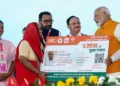
Uttar Pradesh has issued 5.5 crore Golden Cards under the Ayushman Bharat scheme, providing Rs 5 lakh in coverage per family per year. Families who cannot be covered under the central scheme are being supported through the Mukhyamantri Jan Arogya Yojana. The Ayushman Card now ensures free and non-discriminatory treatment across medical colleges, district hospitals, CHCs, PHCs, and Health and Wellness Centres throughout the state.
The macro numbers reinforce this shift. Nationally, out-of-pocket expenses for healthcare dropped from 62.6% of total health spending in 2014–15 to 39.4 percent in 2021–22. The AB PM-JAY scheme played a decisive role in that reduction, and UP, as the country’s most populous state, has been among its largest implementing grounds.
Arogya Melas: Bringing the Hospital to the Village
One of the more underreported successes of the Yogi government has been the Mukhyamantri Arogya Swasthya Mela, a weekly health fair model that flips the traditional burden of healthcare access. Instead of patients navigating distances and bureaucracy, the state brings consultations, diagnostics and medicines to them.
More than 13 crore patients have benefitted from these Mukhyamantri Arogya Swasthya Melas. From CT scans to X-rays, over 35 lakh people have availed these free-of-cost diagnostic services. The government planned to organise over 1.72 lakh Arogya Melas across all 75 districts between August 2024 and July 2025, held every Sunday at more than 3,000 primary health centres. Services include OPD treatment for tuberculosis, dengue, malaria, brain fever and kala-azar, along with distribution of Golden Cards and screening for malnourished children.
In 2024–25, outpatient services recorded a growth of over 27%, while inpatient services increased by more than 32%. These are not statistical abstractions they represent millions of people who sought and received care that would previously have been inaccessible.
Emergency Care, Teleconsultation and the Digital Bridge
Emergency response services expanded in 2025, with the government claiming the best response times for the 108 and 102 ambulance services in the country. More than 2,500 new ambulances were added, improving access in remote areas. The same year, the Heart Attack STEMI Care Network and a Hub-and-Spoke model for stroke management were launched, enabling timely CT scans, thrombolytic therapy and referrals during the critical golden hour, saving over 150 lives according to official estimates.
Uttar Pradesh ranked second nationally in e-Sanjeevani teleconsultation services, handling an average of over 75,000 consultations daily. Tele-MANAS mental health services were implemented, providing counselling support to millions. Health ATMs at PHCs, mobile medical units and free dialysis services have further bridged the gap between urban and rural healthcare access.
Sports, Yoga and the Preventive Turn
The Yogi Ki Paati letter closes with a note that distinguishes it from standard governance communication: a direct appeal to parents to involve their children in sports, yoga, and exercise. The government has been building a sports-friendly ecosystem, with playgrounds in every gram panchayat, mini-stadiums at the block level, and modern stadiums in every district.
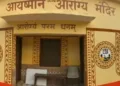
The emphasis on preventive health is not rhetorical. Nationally, over 5.73 crore wellness sessions have been conducted at Ayushman Arogya Mandirs, with activities including yoga, cycling and meditation. In UP, yoga wellness centres have been established alongside Ayushman Arogya Mandirs as the state pursues what the CM describes as the goal of Sarve Santu Niramayah, may all be free from disease.
Critical care capacity was substantially enhanced by adding 1,800 ICU beds in medical colleges and 1,029 in district hospitals. Along with 49 LMO storage tanks, an uninterrupted oxygen supply is ensured. Maternal and child health, TB control and vector-borne disease management have all shown statistically significant improvements in recent years.
What the Yogi Ki Paati letter captures is a shift in the social contract of healthcare in Uttar Pradesh. For generations, access to quality medical care was a function of geography, caste and income. What the last eight years have attempted to measure is to make that access a right rather than a privilege. The children of Purvanchal who no longer fear the monsoon season are the proof.