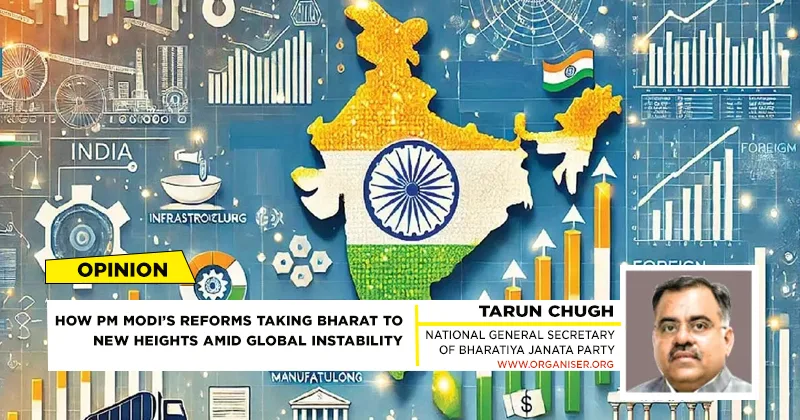
In an era where the global economic compass often points toward uncertainty, India stands as a beacon of unwavering stability and visionary leadership. Under the transformative governance of Prime Minister Narendra Modi, the nation has not only navigated the post-pandemic recovery but also fundamentally re-engineered its economic DNA to thrive amid global turbulence. The Economic Survey 2025-26 tells a compelling story of a nation that has moved from a “fragile” past to a future of “strategic indispensability,” driven by a relentless pursuit of excellence and citizen-centric reforms. Prime Minister Narendra Modi’s administration has unleashed a wave of reforms that are as compassionate in their social outreach as they are rigorous in their fiscal discipline. This reflects a multi-dimensional triumph of the Modi governance model, a model that has turned the 2020s into India’s definitive decade.
The most striking achievement of the government is the absolute transformation of India’s macroeconomic fundamentals. For decades, the Indian economy was characterised by challenges and sluggish growth. Today, the narrative has flipped. One of the most significant triumphs highlighted in the latest Economic Survey is the government’s unwavering adherence to the fiscal consolidation roadmap. The Survey rightfully notes that the government’s calibrated fiscal strategy, anchored in credible deficit reduction, resilient revenue mobilisation, and a decisive reorientation of spending toward capitalformation, has strengthened macroeconomic stability and supported growth in the post-pandemic period. Importantly, this fiscal resilience reflects prudent fiscal policy choices and careful fiscal management. The government, under the leadership of Hon’ble Prime Minister Narendra Modi, remains committed to fiscal consolidation without compromising on growth.
In 2021, amid the peak of global uncertainty, the government set a target to reduce the fiscal deficit. Against the scepticism of global analysts, the Prime Minister has delivered, with the deficit projected at a lean 4.4% for the current fiscal year. This is not just a triumph of accounting; it is a triumph of credibility. By reducing the deficit from 9.2 per cent in FY21, the government has signalled to the world that India is a safe harbour for capital. This discipline was the primary driver behind the historic credit rating upgrade by S&P, the first in nearly twenty years, moving India’s outlook to ‘Positive.’ While the global economy is in a state of total instability, India’s real GDP growth has remained anchored at a robust 7 per cent or higher. This growth is qualitatively different from previous cycles; it is driven by record-breaking Capital Expenditure. The effective capex has risen from 2.7 per cent (pre-pandemic average) to 3.9 per cent of the GDP (post-pandemic).
By prioritising infrastructure like roads, railways, and digital networks over short-term populist subsidies, the government has ensured that today’s spending creates tomorrow’s earning potential.
The government has focused on building assets that serve as the vital economic arteries of a rising nation. Since FY14, the national highway network has seen a remarkable 60% expansion, growing from 91,287 km to 1.46 lakh km by FY26. During the same period, operational high-speed corridors have expanded nearly tenfold to 5,364 km, effectively dismantling long-standing freight bottlenecks. This momentum extends to the railways, where the pace of annual commissioning has more than doubled over the last ten years.
Maritime infrastructure has kept pace with this growth; cargo handling has climbed from 1,052 MMT to 1,602 MMT, with total capacity now reaching 2,771 MMT. Efficiency gains are equally evident at the docks, where the average turnaround time for container vessels has been slashed from 43.44 hours to 30.88 hours. However, the most profound shift is occurring in Inland Water Transport. Cargo movement via waterways has skyrocketed from 18 MMT in 2013–14 to 146 MMT in 2024–25, marking a permanent transition toward more affordable, sustainable, and streamlined logistics.
Beyond the physical infrastructure of roads and rails, the Economic Survey emphasises that urban success is built on a foundation of trust, predictability, and civic harmony. When regulations are transparent, services are dependable, and public spaces are treated with respect, economic growth becomes more inclusive and sustainable. The ultimate goal remains the creation of smart, functional cities that prioritise the “ease of living” for every citizen.
The hallmark of the Modi government is its shift from ‘Ruler’s Raj’ to a ‘Citizen’s Raj.’ At the heart of the Prime Minister’s vision is a fundamental transformation in the relationship between the state and the individual. The era of the “License-Permit Raj” has been decisively buried. The government’s approach to “trust-based governance” is best exemplified by the Jan Vishwas Act and the subsequent amendments that have decriminalised several minor procedural lapses.
The government has empowered small business owners and MSMEs to focus on innovation rather than compliance. The Task Force on Compliance Reduction has already implemented 76 per cent of the identified priority areas across States and Union Territories, simplifying land-use, labour norms, and building approvals. This is the “Ease of Doing Business” in its most practical form, removing the friction that once held back Indian ingenuity. Similarly, the Goods and Services Tax (GST) has matured into a sophisticated engine of economic formalisation. Recent reforms have addressed the “inverted duty structure” in labour-intensive sectors like textiles and fertilisers, making Indian exports more competitive. By rationalising rates on goods of mass consumption, the government has effectively provided a permanent tax cut to the middle class, while simultaneously seeing record-high monthly tax collections.
If the 20th century was defined by physical infrastructure, the 21st is defined by digital public goods. India’s Digital Public Infrastructure (DPI)—the “India Stack”—is now the global gold standard. Through the JAM (Jan Dhan-Aadhaar-Mobile) trinity, the Modi government has achieved in one decade what other nations took half a century to accomplish: near-universal financial inclusion. The Survey notes that Direct Benefit Transfer (DBT) has not only saved billions by eliminating “ghost beneficiaries” but has also provided a dignity-first safety net for the poor. During global shocks, this digital architecture allowed the government to provide instant relief without a single rupee leaking out of the system. India is no longer just a consumer of technology; it is a creator. India’s 36th position on the UNCTAD Frontier Technology Readiness Index underscores its expanding leadership in generative AI and cybersecurity. Through an ‘Entrepreneurial State’ approach, characterised by proactive government intervention in shaping emerging technology markets, India is laying the institutional foundations for leadership in the Fourth Industrial Revolution.
The Prime Minister Modi has often emphasised that the farmer is the Annadata of the nation, and the latest economic data highlights a steady and resilient performance in the agriculture and allied sectors. The Digital Agriculture Mission is revolutionising the agricultural supply chain from production to consumption. By providing farmers with real-time data on soil health, weather, and market prices, the government is reducing the information asymmetry that once exploited the rural poor. The expansion of Farmer-Producer Organisations (FPOs) has given smallholders the collective bargaining power of large corporations, ensuring they get a fair share of the value chain. Furthermore, the One Nation One Ration Card (ONORC) scheme is a masterpiece of social engineering. By ensuring that beneficiaries can access their foodgrains anywhere in India, the government has protected the most vulnerable, particularly migrant workers, from the shocks of inflation and local supply disruptions. This is a citizen-friendly reform that ensures that food security is treated as a fundamental human right.
In line with Prime Minister Narendra Modi’s vision of Aatmanirbhar Bharat and Make in India, the nation’s industrial sector has transitioned from traditional manufacturing toward high-tech capabilities, greater resilience, and deeper global integration. Key initiatives, such as the National Logistics Policy and the Unified Logistics Interface Platform (ULIP), are actively enhancing logistics efficiency and reducing transaction costs, thereby directly boosting the competitiveness of Indian manufacturing on the world stage. The Economic Survey highlights a robust revival in the sector, with manufacturing growth reaching 7.72 per cent and 9.13 per cent in the first and second quarters of FY 2025-26, respectively. This momentum is largely driven by the Production Linked Incentive (PLI) schemes and comprehensive structural reforms. As of September 2025, the PLI schemes have realised actual investments exceeding Rs 2 lakh crore, generating over Rs 18.70 lakh crore in incremental production and creating employment opportunities for more than 12.60 lakh people. Reflecting the government’s push for modernisation, medium- and high-technology activities now account for 46.3 per cent of India’s total manufacturing value added. The Manufacturing Purchasing Managers’ Index (PMI) consistently remained in the expansionary zone, signalling broad-based confidence in the business environment. India’s rank in the Global Innovation Index improved to 38 in 2025 from 66 in 2019.
Under the Prime Minister’s leadership, “Make in India” has evolved into a quest for “Strategic Indispensability.” The objective is no longer merely to manufacture for domestic consumption, but to establish India as a mandatory node in every global supply chain. By launching mission-mode platforms in high-tech sectors such as semiconductors and green energy, the government is future-proofing the economy. India is now positioned to become a global hub for Green Hydrogen, effectively aligning economic growth with the global climate agenda. This strategy of “strategic indigenization” ensures that the nation is not dependent on volatile global markets for its energy or technological security. Parallel to these efforts, the PM Gati Shakti National Master Plan has dismantled traditional departmental silos. By integrating the planning of railways, roads, ports, and airports, the government has drastically reduced logistics costs. The sheer scale of the National Infrastructure Pipeline stands as a testament to the government’s conviction that world-class infrastructure is the right of every Indian citizen, rather than a privilege reserved for those in metropolitan centers.
As highlighted in the Economic Survey 2025-26, India’s growth strategy is anchored in strengthening human capital, with measurable gains in both education and health outcomes.
Economic growth is hollow without human development, and the Modi government’s “Sabka Saath, Sabka Vikas” serves as the guiding light for social reforms. The world’s largest health insurance scheme, Ayushman Bharat, has provided a safety net to crores of people. By removing the fear of “catastrophic health expenditure,” the government has allowed millions of families to climb out of poverty and stay out of it. Health indicators show parallel structural progress. Infant mortality has declined from 40 in 2013 to 25 in 2023, reflecting sustained improvements in public health delivery. A nationwide primary healthcare network is now anchored by 1.82 lakh Ayushman Arogya Mandirs, while 42.78 crore Ayushman cards and over 10.98 crore hospital admissions demonstrate large-scale protection for families. Disease control efforts continue to strengthen, with tuberculosis incidence falling 21% since 2015. In education, the new National Education Policy (NEP) is transforming India from a nation of rote-learners to a nation of innovators. By emphasizing vocational training and digital literacy from a young age, the government is preparing the “demographic dividend” for the jobs of the future.
While the rest of the world struggled with double-digit inflation and ‘cost-of-living’ crises, India maintained a remarkably stable price environment. Amid a global landscape in which many emerging markets faltered, India stood out for its effective management of inflation without compromising growth. The Government’s proactive supply-side management has driven inflation down to historic lows, with the Survey highlighting India’s success in maintaining macroeconomic stability and protecting the purchasing power of the common citizen. Notably, the Economic Survey 2025-26 reports the sharpest reduction in headline inflation (1.8%) among major economies in 2025. Between April and December 2025, India recorded an inflation rate of 1.7%, largely driven by a contraction in the prices of major food commodities such as vegetables and pulses.
As India moves forward under the capable and visionary leadership of Prime minister Modi, our country has transitioned into what the Survey calls an “Entrepreneurial State”—a government that does not wait for certainty but acts to create it.The story of the Indian economy under Prime Minister Narendra Modi is one of courage, clarity, and compassion. It is the story of a nation that refused to be defined by its challenges and instead chose to be defined by its potential. From the record-breaking heights of the financial markets to the quiet dignity of a rural household receiving a gas connection or a digital payment, the reforms are visible everywhere. India is not just “pushing the growth frontier”; it is redefining what is possible for a developing nation in the 21st century. The foundation laid in the last decade serves as a launchpad, and with a stable government and a clear vision steering towards acheiving the vision of Viksit Bharat by 2047.