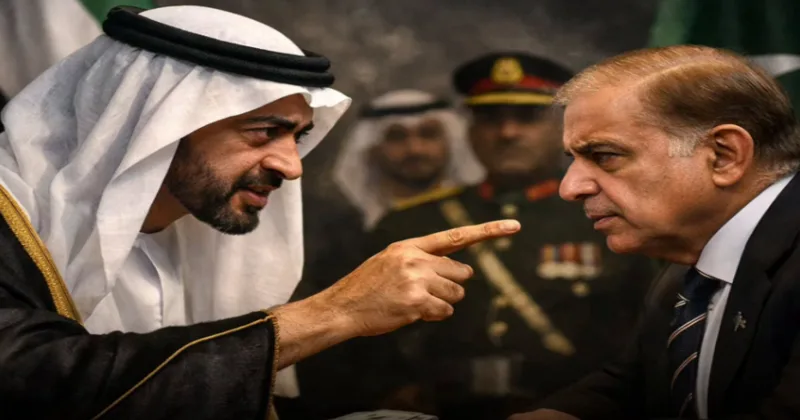
With no immediate end to the raging West Asia war visible at this juncture, Pakistan is likely to face major challenges in the days ahead. Unhappy with Pakistan, the United Arab Emirates(UAE) has asked Islamabad to return a loan of $3.5 billion.
Pakistan plans to return this $3.5 billion debt to the UAE by the end of this month, a report in the Dawn newspaper quoting a senior Pakistani official said. The official described the move as a cost the country was willing to bear to uphold “national dignity”, even as it is set to significantly draw down foreign exchange reserves.
The official said on April 4, Friday that Abu Dhabi had sought the immediate return of the amount. “The amount will be returned as soon as possible”, the official said, adding that “national dignity could not be compromised for financial considerations”. It is interesting that the return of a loan to a country who had shown benevolence towards Pakistan has been described as a matter of “national dignity”. But, not as a normal commercial transaction between two sovereign nations.
These funds were part of external financing support given by the UAE in 2019 to help stabilise Pakistan’s balance of payments(BoP) problems. The official said this ends uncertainty about these funds placed through the Abu Dhabi Fund for Development. It needs to be stressed here that the payback time for the loan has been extended(rolled over) several times by the UAE government since 2019.
The UAE government had, in recent months, given extensions for brief periods though earlier rollovers were on yearly basis. This was because the Emirati government did not want an indefinite continuation of the arrangement.
Under its ongoing International Monetary Fund(IMF) programme, Pakistan had to secure rollovers for around $12.5bn it owed to the UAE, Saudi Arabia and China. This was one important condition the IMF had imposed while granting it yet another loan, bailout package, to maintain reserve levels and meet external financing needs. The UAE deposits were considered a critical component of this arrangement.
According to the latest available data, Pakistan’s central bank reserves stand at about $16.3bn. A repayment of $3.5 billion owed to the UAE will bring down this figure to $12.8 billion, slightly over $12.5 billion that were received as rollovers.
The likelihhood of such demands of repayment of similar loans from Saudi Arabia can prove to be very tricky and derail Pakistan’s finances. The chances of the Saudis making such demands are very real as they are also unhappy with Pakistan. The reason for the anger of Saudi Arabia is Pakistan’s failure to come to its aid when Iranian missiles rained on its infrastructure. So far, the Saudis have not shown any signs of displeasure with Pakistan openly but nobody doubts that they are very cross with it. In fact, the Saudis also provided substantial amounts of various petroleum products to Pakistan virtually for free.
It needs to be said here that Saudi Arabia and Pakistan had entered into what was called a NATO-type defence pact last year. After signing the agreement, Pakistan had publicised it as a guarantee that any attack on one of them will be considered an attack on both of them. The pact was signed as Pakistan hoped to gain access to hardware like advanced aircraft and other armaments that Saudis had purchased over the last many years.
To wriggle out of its supposed commitments towards defending Saudi Arabia, Pakistan first launched attacks against Afghanistan. This was when a ceasefire in force between the two sides was holding and the Taliban government in Kabul had not committed any violations. Pakistan’s action against Afghanistan was signalling to Saudis that it was already waging a war and cannot join another on the side of Saudis and against Iran.
Some Pakistani officials have said that returning UAE’s money will lower foreign exchange reserves. However, given that the UAE government’s demand for immediate settlement leaves Pakistan no choice. One major worry for Pakistan would be reduced remittances in the months ahead from expatriate Pakistanis. In the UAE alone, it is estimated that over 1.7 million(17 lakh) Pakistanis are doing jobs.
For Pakistan, this is a very tricky situation as any refusal to repay the debt could lead to the UAE government expelling Pakistanis in a phased manner. Something that Pakistan itself did to Afghan refugees after deterioration in bilateral relations with Afghanistan. Since Pakistan itself has propped up the Haqqani group of Afghan Taliban, it expected that the entire Taliban government will be its stooge. However, the Taliban government’s refusal to be Pakistan’s lackeys is the real reason for harsh measures taken against the Afghan refugees.
Meanwhile, the return of the funds could increase pressure on the Pakistani rupee and complicate Pakistan’s position under the IMF programme as any fresh inflows are unlikely right now. No immediate alternative for replacement financing and shoring up the reserves is available right now.
The Ministry of Finance, handled by Nawaz Sharif loyalist Ishaq Dar, has said on X that it was “continuously monitoring and managing Pakistan’s external flows”. The post is being interpreted as the Federal government’s message that there was no cause of concern as was being suggested by some media reports.
The disruption in oil supplies from sea route, as also smuggling from Iran border, has already strained Pakistan’s finances over the last month. It has been forced to revise the cost of all petroleum products upwards to curb demand. Pakistan has also initiated Covid-19 period protocols in many sectors advising Work From Home(WFH) and vacations in most schools, colleges and officers nationwide.