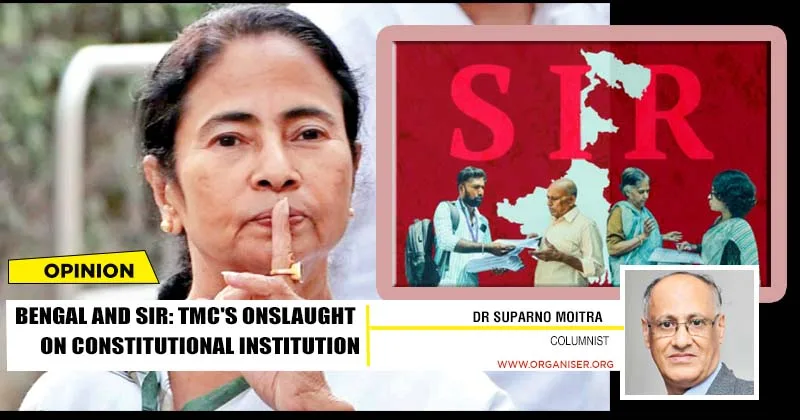
There are moments in politics when a procedural exercise reveals more than any speech, slogan or rally ever could. West Bengal’s confrontation over the Special Intensive Revision (SIR) of electoral rolls is one such moment.
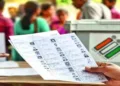
Officially, the SIR is an administrative exercise undertaken by the Election Commission of India to identify Absent, Shifted, Dead or Duplicate (ASD) names in the voter list. In a functioning democracy, such a process ought to be uncontroversial. Electoral legitimacy depends not merely on voting, but on the integrity of who is entitled to vote.
And yet, in West Bengal, the exercise has triggered an extraordinary wave of resistance — legal, political, emotional and ideological. That, in itself, is revealing. Because what is at stake here is no longer merely a dispute over forms, documentation, deletions or verification. What has emerged instead is a much deeper struggle over power, demographic anxiety, institutional trust, and the architecture of electoral control.
Politically Instructive Reaction
The Trinamool Congress has responded to the SIR with a level of intensity that is striking even by Bengal’s own standards of political mobilisation. Its objections are framed in familiar but serious terms: that the exercise is arbitrary, poorly designed, and capable of excluding genuine voters; that it has generated harassment and confusion, and has been implemented in a manner that invites distrust rather than confidence.
There is democratic force in those concerns. Any revision of electoral rolls must be procedurally sound, humane in implementation, and accessible in appeal. But there is another dimension to this response, one that cannot be ignored.
‘Official Threat’ to Judges
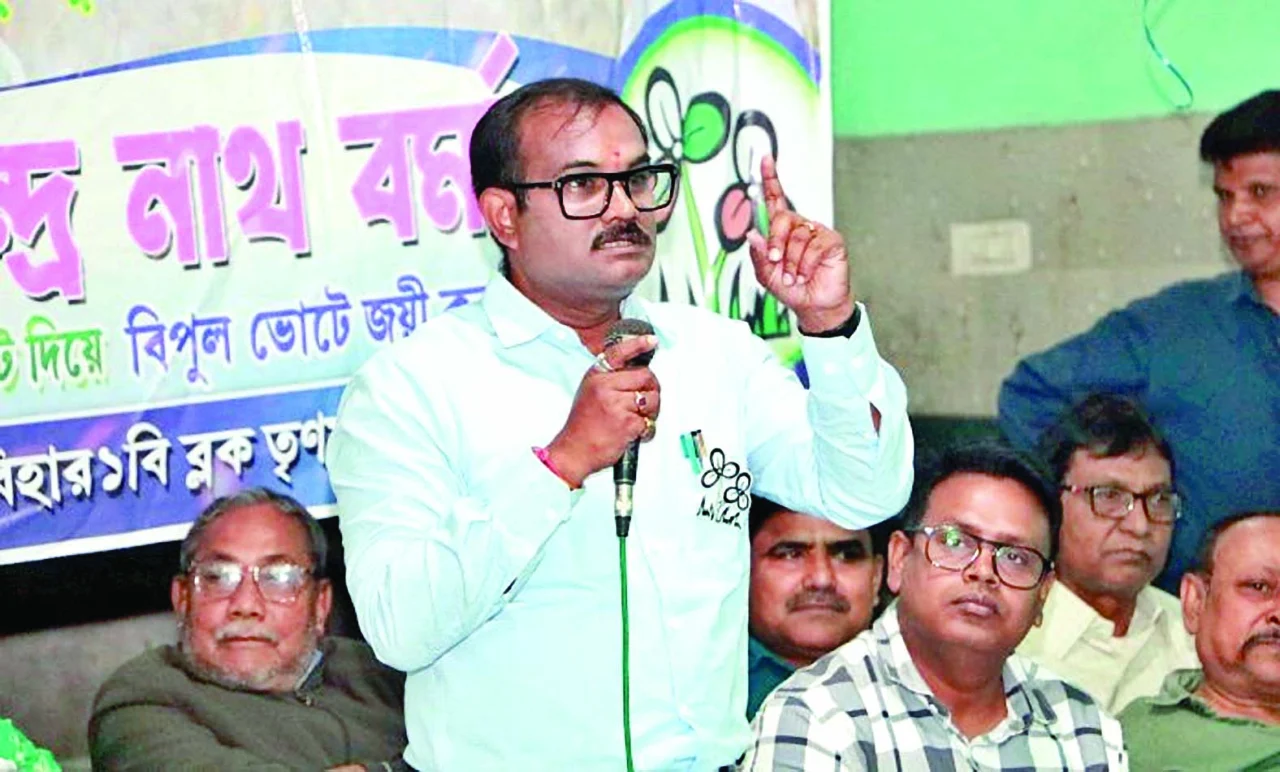
Two judicial officers in Cooch Behar, including a woman judge, have received threatening letters sent on the official letterhead of the Trinamool Congress (TMC) district president, triggering widespread concern and immediate intervention by the Calcutta High Court. According to media reports, the letters were sent in connection with the judges’ work on the pending list under the Election Commission’s Special Intensive Revision (SIR) of electoral rolls, a process to verify and update voter lists ahead of the 2026 West Bengal Assembly elections. The letter expressed displeasure over the manner in which certain names were being dealt with in the supplementary list and allegedly contained an implied threat, with a warning that they will “look at” at the judges, a common phrase use to threaten in Bengali. Two similar letters were sent to both the judges individually by the district Trinamool Congress president Avijit De Bhowmik, alleging that the judges were deleting names in high numbers.
For a party that has completed three consecutive terms in office and continues to project confidence about returning to power, the TMC’s political reaction has had the character not of calm institutional challenge, but of deep electoral unease. That is what makes the SIR issue so politically significant.
Flashpoint in Bengal
The question is worth asking plainly: why has the SIR become such a politically combustible issue in West Bengal, even though electoral roll revisions and deletions occur elsewhere in Bharat as well? Part of the answer lies in Bengal’s particular political sociology.
This is a state where elections are not experienced merely as a periodic democratic ritual, but as a dense and localised contest over territory, influence, identity, networks and neighborhood control. In such a landscape, the electoral roll is not a dry administrative document. It is, in many ways, the nervous system of political power. That is why any attempt to revise or cleanse it, produces far greater anxiety here than in many other states. And that is also why the ruling party’s agitation has reached such unusual heights.
Institutional Distrust or Selectivity
The TMC has sought to place the SIR within a larger national argument: that independent constitutional institution are increasingly vulnerable to political capture by the ruling dispensation at the Centre. This is not a trivial claim. It deserves engagement.
Yet constitutional credibility depends not only on the integrity of institutions, but also on the consistency with which political actors respond to them. If institutions are praised when they align with political interest and denounced when they do not, then the language of constitutionalism becomes less a principle and more a tactic. That is the contradiction the TMC now confronts.
Its battle against the Election Commission may be politically understandable. But when every adverse administrative or judicial development is folded into a larger narrative of conspiracy, the line between legitimate democratic resistance and selective institutional delegitimisation begins to blur. That blurring has consequences.
A Dangerous Sign
Nothing illustrates this more sharply than the controversy over the reported threats to judges in Cooch Behar associated with the SIR process. Even if one grants, for the sake of fairness, that a political party may later disown the actions of a district-level functionary, the episode is unsettling for a more fundamental reason: it suggests the possibility of a political culture in which adjudicatory authority is tolerated only so long as it does not inconvenience power.
“Brazen attempt to obstruct Justice”: SC

The Supreme Court has taken a serious view of the violence and intimidation faced by seven judicial officers, including three woman officers who are deployed to adjudicate claims in the Election Commission’s SIR process in West Bengal’s Malda district on April 1.
Terming the incident a brazen and deliberate attempt to obstruct the administration of justice, a bench led by CJI Surya Kant noted with concern that despite prior intimation, the State authorities failed to act promptly, leaving judicial officers without protection, food, or water for hours. The Court has issued show-cause notices to senior State officials, including the Chief Secretary, Home Secretary, and Director General of Police, for their inaction.
The Court directed the ECI to requisition and deploy adequate central forces to ensure the safety of judicial officers and the smooth conduct of the SIR adjudication process. It further mandated strict security measures at all venues, limited public entry and ordered immediate assessment of any threat perceptions faced by officers or their families, while requiring compliance reports and the virtual presence of officials at the next hearing.
“We are extremely disappointed to note these developments. Our previous order clearly reflects that judicial officers, who are entrusted with adjudicating the SIR process, must be allowed to perform their duties without fear or obstruction. The incident that took place is brazen and strikes at the very root of the rule of law. It amounts to a direct challenge to the authority of the Court. This was not a spontaneous act but appears to be a well-planned and deliberate attempt to demoralise judicial officers and obstruct the ongoing process of adjudication of objections. We will not permit any individual or group to take the law into their own hands or to create psychological fear in the minds of judicial officers,” the court stated.
“This conduct undoubtedly amounts to criminal contempt of court. It also exposes the failure of the State administration. The conduct of the Chief Secretary, Home Secretary, Director General of Police, Collector, and Superintendent of Police is highly deplorable. Accordingly, we issue show-cause notices to them as to why effective measures were not taken. The Election Commission of India (ECI) is directed to seek the deployment of central forces to protect the judicial officers. Taking cognisance of yesterday’s incident, we further direct that no obstruction or impediment shall be caused to the ongoing adjudication process. We reiterate that this Court shall ensure that the life, property, and family members of the judicial officers are duly protected”, the Court noted.
That is always a dangerous sign in a democracy. It is one thing to criticise an institution, and another to create an atmosphere in which institutions are made to feel that adverse decisions will carry political consequences. If Bengal is to remain a constitutional democracy in more than name, that distinction must matter.
Demography and Electoral Roll
There is also a more difficult question at the heart of this debate — one that no serious observer can entirely evade. Is there a relationship, however complex and uneven, between West Bengal’s electoral rolls and the politics of migration and undocumented settlement?
Any simplistic answer would be irresponsible. It would be both analytically weak and socially dangerous to collapse all disputed entries into one communal or cross-border narrative. And yet, it would be equally naïve to pretend that in a border state such as West Bengal, the politics of electoral registration exists in isolation from larger demographic realities. This is precisely why the issue has become so charged.
The BJP seeks to place that relationship at the center of public consciousness. The TMC, by contrast, seeks to interpret the entire exercise as a disguised attempt to smuggle NRC-style exclusionary politics into Bengal through administrative means. Both positions are politically intelligible. But neither fully resolves the central anxiety of the moment.
What SIR Is Actually Conveying
At bottom, the SIR controversy may be telling us something very simple, though politically uncomfortable: that the ruling establishment in West Bengal may be less worried about principle than about disruption. Not disruption of governance alone. Not disruption of administration alone. But disruption of an electoral ecosystem long familiar to it.
That is why this issue has acquired such existential overtones. And that is why the agitation in Bengal has surpassed ordinary protest and entered the realm of political alarm. If the electoral rolls are genuinely being corrected to remove Absent, Shifted, Dead or Duplicate entries, then that should strengthen democracy, not endanger it.
If, however, such correction is experienced by the ruling party as a threat, then an uncomfortable democratic inference inevitably follows: perhaps the old electoral order was more politically useful than a corrected one. That possibility may not yet be provable in a legal sense. But politically, it is now impossible to ignore.
A Final Reflection
Trinamool Congress faces a test. If it truly believes in the sovereignty of the people, then it must also believe in the legitimacy of a clean electoral roll — even when that cleanliness produces political uncertainty.
That may be the real source of Bengal’s present turbulence. And perhaps, beneath the rhetoric and the road protests, that is what the state is really witnessing: not merely a battle over voter verification, but the first visible signs of electoral insecurity within a regime long accustomed to certainty.