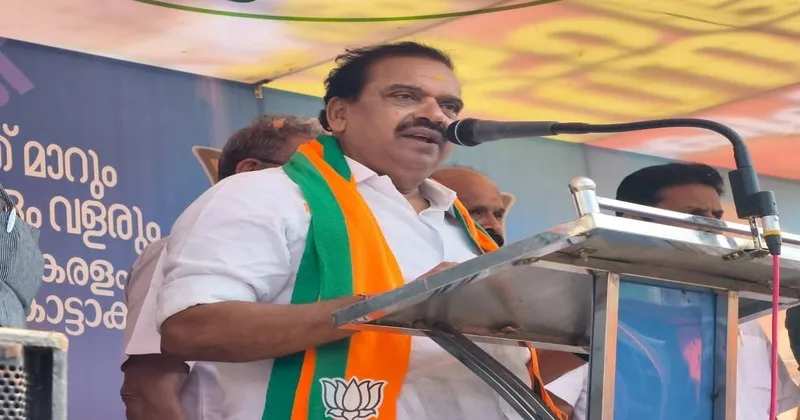
Thiruvananthapuram: Former BJP state president and Kattakada Assembly candidate P. K. Krishnadas has alleged that if the CPI(M)-led Left Democratic Front (LDF) or the Congress Muslim league -led United Democratic Front (UDF) comes to power in Keralam, they would enable activities for “love jihad,” targeting girls from Hindu and Christian families under the pretext of relationships. He further claimed that such developments could be linked to anti-national activities carried out in the name of love.
Krishnadas made these remarks while addressing a public meeting in Kattakada, which was attended by Union Home Minister Amit Shah. He presented these allegations to argue that the LDF and the UDF are effectively aligned in their functioning. According to her, if either front comes to power, the government would be influenced or controlled by organisations such as Jamaat-e-Islami and the PFI-linked Social Democratic Party of India (SDPI), which he characterised as having agendas detrimental to national interests. He stated that under such a scenario, young women from Hindu and Christian households could be drawn into activities framed as relationships but serving larger political or ideological purposes. Krishnadas used this line of argument to reinforce his broader claim that there is little substantive difference between the Marxist Party and the Congress in terms of political outcomes.
High-Stakes Contest for Key Leaders
Meanwhile, the Kerala Assembly election has become highly competitive, with sharp political exchanges and intense scrutiny of leadership across both the LDF and the UDF. Chief Minister Pinarayi Vijayan, CPI(M) state secretary M. V. Govindan, AICC general secretary K. C. Venugopal, and Opposition Leader V. D. Satheesan are among those whose leadership and strategies are under close watch.
Within the Congress, internal dynamics surrounding leadership and candidate selection have come into focus. K. C. Venugopal and V. D. Satheesan are seen as playing central roles in key decisions, including the selection of candidates, while senior leaders such as Ramesh Chennithala, K. Sudhakaran, and the KPCC president, Sunny Joseph, are perceived to have had a more limited say in the process. V. D. Satheesan, who replaced Ramesh Chennithala as Opposition Leader after the last Assembly election, had earlier stated that he would retire from politics if the UDF failed to secure 100 seats. He has since revised his position, stating that he would step away from politics if the UDF does not come to power, making the election outcome crucial for his political future.
Political observers indicate that a poor performance by the UDF could intensify internal dissent within the Congress, potentially triggering leadership debates. At the same time, K. C. Venugopal, though not directly contesting, has played a key role in shaping the candidate list, including accommodating individuals aligned with him.
Internal rifts and strategic calculations
Within the Congress, certain decisions by K C Venugopal have sparked criticism among party members. The inclusion of G. Sudhakaran, a long-time political opponent of the Congress, into the UDF fold and his nomination as a candidate have raised concerns within sections of the party. Additionally, the decision to field a KSU leader in the Alappuzha district and the efforts to secure victory in the constituency have drawn scrutiny. Some leaders view these moves as attempts to consolidate influence within the party, while others question the broader electoral strategy. There are also concerns that certain tactical decisions are being made with possible post-election adjustments in mind.
On the LDF side, attention has turned to leadership scenarios in the event of an electoral setback. It remains uncertain whether Pinarayi Vijayan would consider taking up the role of Opposition Leader if the Left Front fails to retain power, a position he has not previously held.
Observers suggest that in the event of a defeat, accountability may fall on CPI(M) state secretary M. V. Govindan. Under his leadership, the party and the front have faced setbacks in the Lok Sabha and local body elections.
Govindan’s tenure has also been marked by internal challenges within the party. Despite his image as a strong leader, critics argue that he has struggled to manage organisational issues, including those in his home district of Kannur. There is also a perception among some sections that his role has been closely aligned with safeguarding the leadership’s position rather than addressing internal dissent. As campaigning intensifies, the election is expected to have far-reaching implications not only for governance in Keralam but also for the political futures of key leaders across both fronts.