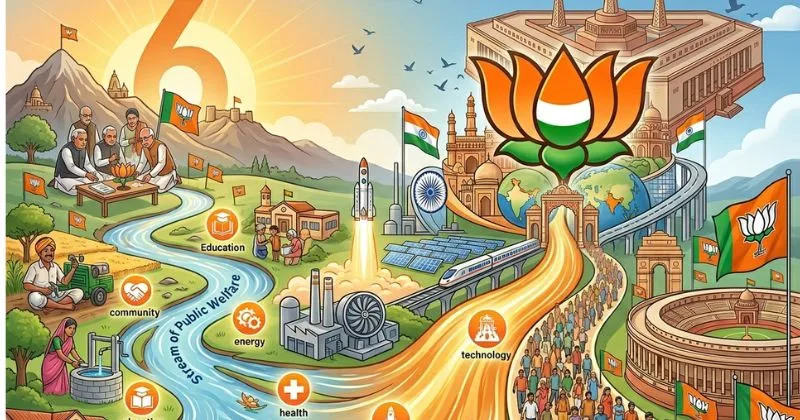
Within the vast and vibrant landscape of Indian democracy, the Bharatiya Janata Party (BJP) has not confined its ideological values- specifically “Antyodaya” (upliftment of the last person), Good Governance, and ‘Nation First’- merely to political rhetoric; rather, by translating them into practice, it has shaped them into a continuously flowing stream of public welfare. Since 2014, under the leadership of Narendra Modi, the Central Government, along with BJP governments in various states, has fundamentally transformed the style of governance. Development has now moved beyond the mere announcement of schemes to become synonymous with results-oriented administration, the impact of which is clearly visible across the country’s social, economic, and psychological fabric.
The Concept of Antyodaya and Financial Inclusion
If one observes various parts of the country today, it becomes evident that the focal point of the BJP’s governance system is to ensure that the benefits of development reach the very last person in society. The concept of “Antyodaya”, originally propounded by Pandit Deendayal Upadhyaya, is today visible in a tangible, concrete form. Launched with this very objective, the “Pradhan Mantri Jan Dhan Yojana” (PMJDY) has achieved a historic milestone in financial inclusion. By the year 2025-26, more than 50 crore (500 million) bank accounts had been opened under this scheme (Source: Ministry of Finance, Government of India, 2025). The total deposits held in these accounts have exceeded Rs 2 lakh crore (Source: PMJDY Official Portal, 2026).
Direct Benefit Transfer and Transparency
Today, this initiative is no longer limited to providing banking facilities; it has effectively brought the poor into the economic mainstream. Through the Direct Benefit Transfer (DBT) system, an amount exceeding ₹35 lakh crore has been transferred directly into beneficiaries’ accounts so far (Source: DBT Bharat Portal, 2026), resulting in unprecedented improvements in transparency and accountability.
The measures undertaken by the government for the welfare of the poor (Garib Kalyan) have brought about real, transformative change in the lives of the underprivileged sections of society. Under the Pradhan Mantri Ujjwala Yojana, more than 100 million LPG connections have been distributed by 2026 (Source: Ministry of Petroleum and Natural Gas, 2026). This scheme has safeguarded both the health and dignity of women by providing them with smoke-free kitchens. Similarly, under the Pradhan Mantri Awas Yojana, the construction or sanctioning of over 30 million ‘pucca’ (permanent) houses is expected to be completed by 2025 (Source: Ministry of Housing and Urban Affairs, 2025), thereby providing poor families with a foundation of stability and security. Under the Swachh Bharat Abhiyan, more than 110 million toilets were constructed, and the country was declared Open Defecation Free (Source: Ministry of Jal Shakti, 2025), transforming sanitation into a social movement.
Empowerment in the Agricultural Sector
Government policies have also had a profound impact on the agricultural sector. Under the Pradhan Mantri Kisan Samman Nidhi scheme, financial assistance of Rs 6,000 per annum is being provided to over 110 million farmers by 2026 (Source: Ministry of Agriculture and Farmers Welfare, 2026). To date, a sum exceeding Rs 3 trillion has been disbursed under this scheme (Source: PM-KISAN Portal, 2026). Through the Pradhan Mantri Krishi Sinchai Yojana, the irrigated area has been expanded, and water management systems have been strengthened. Under the Soil Health Card scheme, over 220 million cards have been distributed (Source: Ministry of Agriculture, 2025), helping farmers adopt scientific farming practices. Furthermore, under the Crop Insurance Scheme, financial security has been extended to millions of farmers during times of natural calamities (Source: PMFBY Dashboard, 2026).
A New Direction for Women’s Empowerment
The government’s initiatives toward women’s empowerment have also been noteworthy. As a result of the ‘Beti Bachao, Beti Padhao’ (Save the Daughter, Educate the Daughter) campaign, the sex ratio has improved, and an increase in girls’ education has been recorded (Source: Ministry of Women and Child Development, 2025). Under the Sukanya Samriddhi Yojana, over 30 million accounts have been opened (Source: Ministry of Finance, 2025), marking a significant step toward securing the future of girl children. By abolishing regressive practices such as ‘Triple Talaq,’ Muslim women have been granted justice and equal rights- a historic achievement in the realm of social reform. Furthermore, efforts have been made to empower women’s political participation through the ‘Nari Shakti Vandan Adhiniyam.’
Expansion of Health Security
In the healthcare sector, the Ayushman Bharat scheme has served as a life-saving shield for the poor. By 2026, under this scheme, health insurance coverage of up to ₹500,000 is being provided to over 500 million people (Source: National Health Authority, 2026). To date, more than 60 million hospitalisations have been facilitated under this scheme (Source: Ayushman Bharat Dashboard, 2026), thereby shielding millions of families from financial distress. Additionally, over 150,000 Health and Wellness Centres have been established across the country (Source: Ministry of Health, 2025), thereby strengthening primary healthcare services.
From Digital to a Self-Reliant India
Under the Digital India campaign, India has spearheaded a digital revolution. In 2025-26, more than 15 billion transactions per month are being recorded through the Unified Payments Interface (UPI) (Source: NPCI, 2026). This establishes India as the world’s leading nation in digital payments. Under the ‘Make in India’ initiative, India has joined the ranks of the top global nations in mobile manufacturing (Source: Ministry of Electronics and IT, 2025). Through the ‘Skill India Mission,’ training has been provided to over 15 million youth (Source: Ministry of Skill Development, 2025), leading to increased employment opportunities.
Unprecedented Growth in Infrastructure
The infrastructure sector has witnessed unprecedented growth. Under the ‘Bharatmala Pariyojana’ (Bharatmala Project), a target was set to construct over 35,000 kilometres of roads, a significant portion of which has already been completed (Source: Ministry of Road Transport and Highways, 2025). As part of railway modernisation efforts, the ‘Vande Bharat’ train network has expanded, and by 2026, these trains will be operational on over 75 routes (Source: Indian Railways, 2026). Under the ‘UDAN’ scheme, more than 500 air routes have been launched (Source: Ministry of Civil Aviation, 2025), thereby providing air connectivity to smaller cities. Regarding rural electrification, electricity has now reached almost every village across the country (Source: Ministry of Power, 2025).
Balancing Rural and Urban Development
In the realm of rural development, the ‘Jal Jeevan Mission’ has emerged as a revolutionary initiative. By 2026, access to tap water has been provided to over 140 million rural households (Source: Ministry of Jal Shakti, 2026). This initiative has proven to be immensely significant in enhancing the quality of rural life. Meanwhile, in urban areas, modern infrastructure is being developed across 100 cities under the Smart Cities Mission (Source: Ministry of Housing and Urban Affairs, 2025).
Good Governance, Transparency, and Public Participation
A common thread is clearly discernible across all these endeavours: good governance, transparency, and public participation. Through the utilisation of technology, digital platforms, and administrative reforms, the government has rendered its schemes more effective. Through public participation, these schemes have been transformed into mass movements, thereby enhancing both their success and their impact.
Thus, viewed holistically, from its inception to the present day, it must be affirmed that the schemes of the BJP government are not confined merely to development statistics; rather, they have served as instruments for empowering every section of society. These initiatives are laying the foundation for an India that is self-reliant, inclusive, and empowered. Inspired by the spirit of ‘Antyodaya’ (uplifting the last person), this developmental journey continues to advance steadily, pursuing goals that encompass not only economic progress but also social justice and equal opportunity.
Today, by translating its ideological philosophy into practice through these various schemes, the BJP has unleashed a powerful and expansive current of public welfare. This current is fortifying contemporary India while charting a new course for the India of tomorrow- a Bharat where the benefits of development reach the very last person, and where the nation establishes itself on the global stage as a self-reliant, prosperous, and empowered entity.