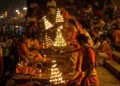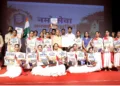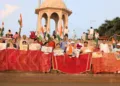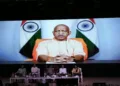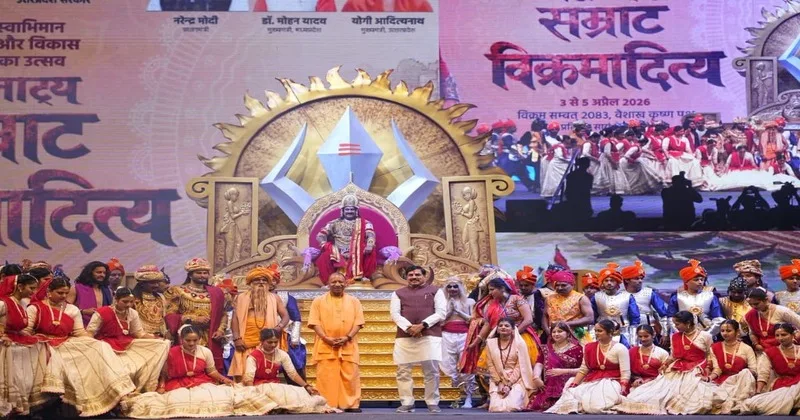
On the evening of April 3, 2026, at the BLW grounds in Varanasi, thousands of people experienced the story of legendary Vikramaditya. It was the two millennia of Indian civilisation coming to life before people’s eyes. In the glow of LED screens and the thunder of battle sequences, with chariots, horses, and the rich sonority of Sanskrit verse, the night of Kashi was filled.
This was Vikramotsav-2026, the three-day Samrat Vikramaditya Mahanaatya, a grand theatrical production staged jointly by the governments of Madhya Pradesh and Uttar Pradesh. It was one of the most ambitious cultural events to hit either state in recent memory. It carried a pointed message that India’s history is too rich, too profound and inspiring to remain confined in textbooks.
Two cities, One thread of civilisation
The choice of Varanasi for an event conceived in Ujjain was pre-planned several months ago. Uttar Pradesh Chief Minister Yogi Adityanath, addressing the inaugural ceremony, said that the connection is with characteristics. Just as Ram-Lakshman and Krishna-Balram represent ideal fraternal bonds in Indian tradition, so too does the pairing of Sant Bhartrihari and Samrat Vikramaditya, both initiated into the Nath tradition, which holds a special place in the country’s cultural memory. Vikramaditya’s karmabhoomi was Ujjain, while Bhartrihari’s sadhana site was on the far banks of the Ganga in Kashi. The geography of this event wasn’t a symbolic coincidence. It was a stitching together of two civilisational threads.
Yogi Adityanath described the event as a living illustration of Prime Minister Narendra Modi’s ‘Ek Bharat-Shreshtha Bharat’ vision. Two states, two ancient cities and one shared heritage. He also noted that Varanasi, the city of ‘Panchang’, the calendrical knowledge, and Ujjain, the city of Indian time-reckoning, are also home to the world’s first Vikramaditya Vedic Clock, which was inaugurated by PM Modi in 2024, and together embody the intellectual tradition. This has once made Indian contributions to astronomy and mathematics a reference point for the world.
The Production: History with its boots on
This programme was conceptualised by Madhya Pradesh Chief Minister Dr Mohan Yadav, who believes culture is policy. This Mahanaatya was written by Padma Shri awardee Bhagwatilal Rajpurohit, produced by Rajesh Kushwaha and directed by Sanjeev Malvi. The play brought Vikramaditya’s legendary Navratnas to the stage, Mahakavi Kalidasa played by Ravi Parmar, the astronomer-mathematician Varahamihira by Vikas Parihar and Amar Singh by Preet Meena, among others. A vast dance troupe under Aarohi Athavale and a contingent of Vikram warriors brought the battle and victory sequences to life in ways no history classroom could have imagined.
Modern production technology, such as LED screens, fireworks, and precision lighting, was deployed to serve the narrative. According to Dr Manoj Singh, Assistant Professor at Udai Pratap Degree College “has witnessed the first night, which was not spectacle for its own sake. It was a history rendered viscerally of Vikramaditya’s valor, his justice system, his patronage of scholars and artists, his model of dharmic governance, all of it presented not as ancient abstraction but as lived, breathing reality”. Students described the crowd as not merely watching but experiencing each scene. Thousands of residents of Varanasi, a city that has seen millennia of festivals and processions, came away saying this was something genuinely different.
A vedic clock at Kashi Vishwanath and what it means
Alongside the theatrical production, CM Mohan Yadav dedicated a Vikramaditya Vedic Clock at the Kashi Vishwanath Temple. It’s a gesture that carries weight beyond the ceremonial. The original Vedic Clock was installed in Ujjain and inaugurated by PM Modi in 2024 the first of its kind anywhere in the world, based entirely on Indian astronomical principles of time-reckoning, the same tradition that gave the world the concept of zero and the decimal system. Its arrival in Kashi isn’t simply a gift from one state to another. It’s a statement that India’s systems of knowledge deserve permanent, public, monumental presence in its most sacred spaces.
What Yogi said about art and why it matters
One of the more pointed observations of the evening came when CM Yogi addressed the role of art in shaping national character. Drama, cinema and performance are not only entertainment but they are instruments through which a society forms its ideals. He took direct aim at a phase of Indian cinema that elevated negative, even criminal characters as heroes, arguing that a generation of young people was warped by those narratives. His appeal to filmmakers was unambiguous, which put virtuous characters at the centre of stories. It won’t hurt the box office, and it might do something far more important for society.
CM also mentioned that the ancient Indian traditions of Yoga and the holistic practices of AYUSH are being embraced worldwide with growing respect and acceptance. The tradition of the Kumbh Mela dates back thousands of years, deeply rooted in India’s spiritual and cultural heritage. In 2019, under the leadership of the Prime Minister, the event was organized at a grand scale, transforming it into a truly global gathering.
During Mahakumbh in Prayagraj, more than 660 million devotees from across the world came together on its sacred land, making it not just a spiritual congregation but a remarkable symbol of cultural unity and global participation.
Vikramotsav as a national idea
Vikramotsav is no longer just an event on a government calendar. Across its editions, it has grown into something closer to a movement, the deliberate, sustained project of returning India’s pre-colonial history to the public imagination, not as nostalgia, but as a living context for the present. CM Yogi drew the line forward explicitly from Vikramaditya’s rediscovery of Ayodhya two thousand years ago to PM Modi’s Ram Temple, from Ujjain’s ancient time-reckoning to the Vedic Clock now resting in Kashi. India is not reviving old stories for their own sake. It is recovering its own narrative and owning it, on its own terms in its holiest cities in front of its own people.