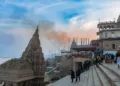
In June 2026, the Varanasi Municipal Corporation approved a plan to shift all of the city’s meat and fish shops to five designated sites on its outer edges of Ramnagar, Sujabad, Ganeshpur, Avleshpur and Shivpur in the first phase. The resolution has lalready cleared at the Town Hall in Maidagin under Mayor Ashok Kumar Tiwari. It was the latest in a steady sequence of measures that have, year by year, pushed meat to the margins of one of the oldest continuously inhabited cities on Earth. It also revived a question that travel writers, food critics and civic watchers keep returning to: is Kashi on the road to becoming the world’s second vegetarian city after Gujarat’s Palitana. The tradition is reasserting itself through the machinery of municipal planning and tradition of oldest living city.
The Palitana: First vegetarian city of world
Palitana, a temple town in Gujarat’s Bhavnagar district and a premier Jain pilgrimage site beneath the Shatrunjaya Hill temples, holds the distinction of being the world’s first fully vegetarian city. There the description is not cultural shorthand but the letter of the law: the sale and consumption of meat, fish and even eggs along with the slaughtering of animals is officially prohibited or provision of with penalties for violation.
That ban grew out of the Jain philosophy of ahimsa or non-violence, which regards the killing of even the smallest creature as a grave moral wrong. The decisive push came in 2014, when nearly 200 Jain monks went on a hunger strike demanding the closure of roughly 250 butcher shops in the town. Responding to those sentiments, the state administration enforced a legal, blanket meat ban, by making Palitana vegetarian by statute rather than by custom. Critics have argued ever since that the measure trespasses on individual dietary freedom, supporters call it a landmark recognition of faith. Palitana has set the bar and it set it at the level of law.
This is the crucial distinction against which Varanasi must be measured. In Varanasi, this scenario is arriving at allis arriving along a slower and very different path.
A city sattvic by inheritance
Long before any corporation passed a resolution, Kashi’s relationship with food was shaped by Lord Shiva. Most residents of Varanasi are devout Shaivites and because Shiva’s followers regard him as a vegetarian deity, the sattvic or pure vegetarian diet has been the spiritual norm in the city’s homes for generations. Meat, where it appeared at all, was historically prepared for visiting tourists and non-vegetarian pilgrims rather than eaten at the Banarasi family table. For countless households, an altar to Shiva sits in the home and the kitchen is treated as an extension of devotion.
The civic measures of recent years read less like an imposition on an unwilling population and more like the formal codification of a culture that already existed. The administration is not introducing vegetarianism to Kashi, it is rearranging the city’s commerce to reflect what its faith has long practised.
“In a Kashi home, the kitchen has always been sattvic, Mahadev’s city eats what is offered to Mahadev,” said a senior resident of the Pakka Mahal area. “What the corporation is doing now only matches our streets to our kitchens”.
In 2019, the sale and consumption of meat was banned within a 250-metre radius of all temples and heritage sites in Varanasi. In 2024, the Municipal Corporation unanimously widened that to a two-kilometre radius around the Kashi Vishwanath Temple. Enforcement followed in January 2025, the civic body issued closure notices to dozens of meat shops and ten owners near the temple were booked under the Bharatiya Nyaya Sanhita for defying the order, the cases registered at the Chowk and Dashashwamedh police stations as per police personal in Vishwanath Dham Duty.
The reach expanded again with the holy month of Sawan in July 2025, when the corporation ordered the closure of all meat and fish shops across its entire jurisdiction of roughly 183 square miles for the duration of the month, a window that draws an enormous influx of Kanwariyas and devotees to the Vishwanath temple. The June 2026 relocation plan is the natural next rung on this ladder, rather than a temporary or radius-bound restriction, it proposes to move the trade itself permanently outward.
Behind the timing lies a surge in pilgrim traffic. Since the inauguration of the Kashi Vishwanath Corridor in December 2021, official figures indicate that close to 29.8 crore devotees have visited the temple, with more than one crore arriving in a recent two-month stretch alone. A city whose narrow medieval lanes were never designed for open meat markets by these numbers under pressure to remake its public spaces around the experience pilgrims expect.
The official action reviving the city
The Varanasi administration has been careful with its language, presenting the relocation as urban management rather than prohibition. Varanasi Municipal Commissioner Himanshu Nagpal laid out the phased roadmap and the five relocation sites, framing the exercise around sanitation, decongestion and public health in a heritage city that hosts millions of visitors. The stated logic is that raw meat and fish stalls crowding the lanes near the ghats and the temple do not align with the dignity of a city of Kashi’s age and stature and that moving them into planned, hygienic zones serves cleanliness and commerce together. Officials have been emphatic that the step is not designed to target anyone livelihood.
A cuisine that was always green
If the civic map is only now turning vegetarian, the Banarasi plate has been so for as long as anyone can remember. Varanasi’s culinary traditions are said to stretch back more than two thousand years, rooted in spiritual and Ayurvedic practice and its signature dishes are overwhelmingly vegetarian by inheritance rather than by edict.
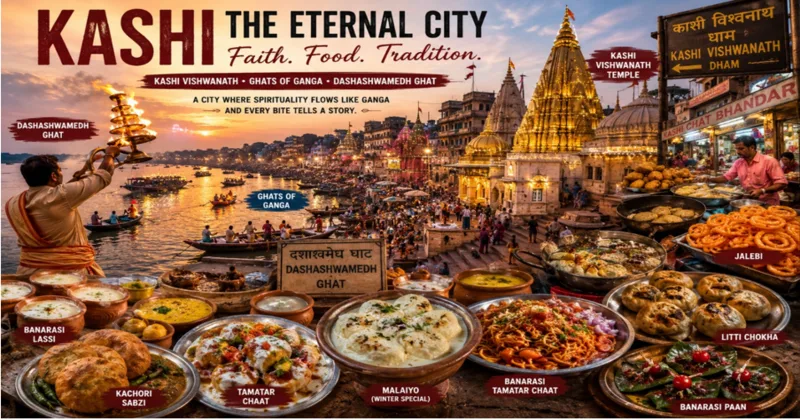
The day in Kashi begins with kachori-sabzi, a crisp, spiced fried bread with a tangy potato curry. Central to the city’s identity that the official Kashi government portal lists it among the city’s defining foods and locals queue after Ganga Aarti in Kachori Gali for the first batch. From there the repertoire unfolds, tamatar chaat cooked on a flat iron tawa in desi ghee, the hearty baati-chokha of the eastern plains and a parade of sweets and drinks that need no meat to dazzle. The dew-whipped winter delicacy malaiyyo, thick rabri, hot jalebi, the creamy Banarasi lassi served in earthen cups and thandai bound up with the festivals of Mahashivratri and Holi. Crowning it all is Banarasi paan, a centuries-old art once served in royal courts and still a marker of the city’s hospitality.
The state itself has formalised this heritage. Uttar Pradesh One District One Cuisine scheme spotlights Varanasi kachori-sabzi, thandai, tiranga barfi, lassi and paan every one of them vegetarian representes as the district’s signature foods. With the explicit aim of supporting local halwais, dairy workers and women’s self-help groups. The message embedded in that list is hard to miss in Kashi, a meat-free table is not a recent restriction imposed from above but the very grammar of the local kitchen.
“My grandfather sold the same kachori-sabzi from this corner before Independence. Not once did meat enter these lanes,” said a third-generation halwai near Godowlia. “The food of Banaras was green long before anyone wrote it into a rule.”
So, the Varanasi is second vegetarian city?
The honest answer is that slowly but steadily again Varanasi is becoming a vegetarian city in the way Palitana is. A 250-metre ring became a two-kilometre radius, a radius became a month-long city-wide closure, a closure has now become a plan to move the trade out altogether, all of it laid over a population that was sattvic by faith and a cuisine that was vegetarian by birth. Where Palitana arrived at the title by the force of law in a single year, Kashi appears to be approaching it by progression temple by temple, season by season, lane by lane.
“Palitana made it law in a day. Kashi is taking its own road temple by temple, season by season,” says Prof. Umesh. “Call it the second vegetarian city if you like, but here it is simply tradition catching up with paperwork”.
Whether that road ends at a formal designation or settles into a city that is functionally meat-free in its sacred core while its outskirts carry the trade. What is no longer in doubt is that Varanasi, Shiva’s eternal city has been green on the plate for two thousand years, is being remade in the image of its own oldest habits.